













A parliamentary working group tasked with revising the law governing Lithuanian National Radio and Television (LRT) has concluded its work, proposing significant changes to the broadcaster’s governance, oversight, and funding.
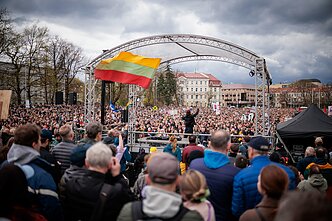
The effort follows a rushed attempt last December to amend the LRT law to make it easier to dismiss the public broadcaster’s director, which was blocked by opposition lawmakers submitting hundreds of proposals and by mass protests outside the parliament.
Critics also raised concerns about the working group’s composition, noting that most members were politicians rather than media experts or journalists. Representatives of the Journalists’ Professional Association and the LRT initiative group withdrew from the group over these issues, followed later by opposition politicians.
Key proposed changes
Director and term limits: The amendments would require a two-thirds vote of the LRT council to dismiss the director general for loss of confidence. Directors would be limited to two consecutive terms. Currently, eight of 12 council members can vote to remove a director, with dismissal requiring a public interest justification. Under the new proposal, directors could be dismissed mid-term for failing to perform duties, violating public interest, committing gross misconduct, or failing to meet ethical standards.
Board and Council reforms: The proposals would create a new governing board while expanding the LRT Council from 12 to 15 members. The Council would include members delegated by from organisations for people with disabilities, the Tripartite Council, and Lithuania’s Union of Local Community Organisations. A dedicated office would support the council.
Under current rules, the LRT Council consists of delegates picked by the president (four members), the parliament (two by the ruling majority and two by the opposition), and civil society organisations (one each by the Science Council, the Artists Association, the Education Council, and the Bishops’ Conference).
The Council would be responsible for developing LRT strategy, monitoring how the broadcaster is pursuing its set goals, approving statutes, organisational structure, budgets, ethical codes, and annual reports. It would also appoint and dismiss the general director, board members, ethics officers, and internal audit leaders.
The board, in turn, would implement council-approved documents, oversee the director, monitor strategies and budgets, evaluate financial and operational performance, and authorise contracts over 50,000 euros.
Eligibility and limits: Council members would need at least five years of experience in management, administration, science, media, or culture.
The amendments also limit the influence of other media representatives in shaping LRT content. Initially, the working group considered a hard ban, but later withdrew it.
Public mission: The working group decided to define the public broadcaster’s mission in legislation, emphasising respect for human dignity and the state, legality, impartiality, accountability, transparency, democracy, political neutrality, and freedom of expression. LRT would be tasked with informing the public about developments in Lithuania and the world, European and global cultural diversity, strengthening Lithuania’s independence and democracy, national culture, promoting tolerance and humanism, ecological awareness. LRT programs should reflect a variety of perspectives.
Implementation and funding: Some changes would take effect in 2027 or 2028.
The group also proposed developing a new financing model, in which LRT would sign public service contracts with a government-designated body to define tasks and objectives, so that public funds support services distinct from those provided by commercial media.
This funding model has been proposed by the Online Media Association representing commercial media.

Newsletter
Every Friday morning.