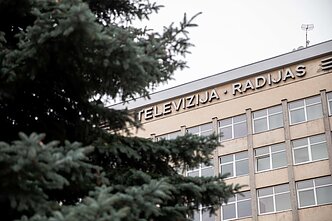
















Lithuania’s ruling coalition is pressing ahead with controversial amendments that would make it easier to dismiss the head of the national public broadcaster, LRT, while journalists consider whether to take part in a parliamentary working group proposed to defuse the standoff.
Parliament Speaker Juozas Olekas, a Social Democrat, said Monday after meeting with representatives of journalists and cultural sector protesters that the current draft amendments to the Law on Lithuanian National Radio and Television, or LRT, will move forward to the adoption stage.
Olekas said plans are in place to set up a working group to discuss the procedure for dismissing the LRT director general after a vote of no confidence.
“I think we have formed a common understanding that we can work and find some kind of solution that would satisfy the majority of interested parties,” Olekas said.
He said the ruling coalition intends to re-register an improved version of the bill, replacing a draft that parliament has already backed at the consideration stage.
“Our view is to re-register a refined project, and the project that was already approved will no longer exist – no Nuodėgulis or anything like that – but a normal project that can be voted on,” Olekas said.

At the consideration stage, lawmakers approved a satirical opposition amendment stipulating that the dismissal vote should also involve the cat of opposition lawmaker Agnė Širinskienė, named Nuodėgulis. The provision is to be removed during the final adoption procedure.
Olekas said the ruling coalition wants the revised version, prepared with input from the working group, to be submitted directly for adoption. “We would like to continue as planned – to improve the project that has already passed the consideration and submission stages,” he said.
Birutė Davidonytė, chairwoman of the Association of Professional Journalists, said after the meeting that journalists had urged lawmakers to take a broader look at LRT governance, but their proposal was not taken up.
“Now the discussion is about a very narrow issue – making it easier somehow to dismiss the LRT director,” Davidonytė said. “We suggested looking more broadly, at how the Council is formed, at depoliticising it and similar issues. That proposal was not heard.”
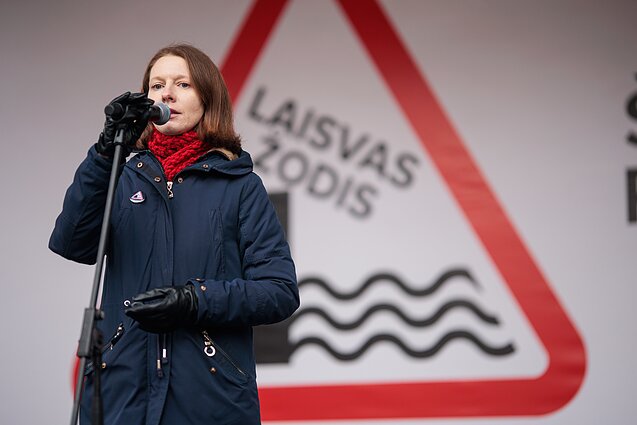
She said the association has not yet decided whether it will take part in the working group and will do so only after receiving a formal invitation.
Davidonytė said the amendments under discussion cover only a few lines of legislation. “You either agree to lowering the threshold for dismissing the LRT director or you don’t,” she said.
She added that forming a working group appears aimed at using the journalists’ community to reduce tensions while ultimately passing essentially the same amendments.
The ruling coalition last week planned to fast-track amendments allowing the LRT director general to be dismissed by a secret vote of seven out of 12 Council members, citing an unapproved annual activity report or improper performance of duties.
The process stalled after the chairman of the Culture Committee, Kęstutis Vilkauskas, fell ill, leaving the bill stuck in committee and forcing the cancellation of an extraordinary parliamentary session.
Opposition lawmakers have sought to delay the bill using filibuster tactics, registering about 1,000 amendments to the proposed changes.
In an effort to ease tensions between the bill’s backers and protesters, President Gitanas Nausėda and Prime Minister Inga Ruginienė have called on the LRT Council to resign. Such a move would also lead to the resignation of the director general and her deputy.
Further reading
The LRT Council was expected to discuss the issue in late January, but its chairman, Mindaugas Jurkynas, told BNS he is seeking to move the meeting forward.
Both LRT and the Association of Professional Journalists have warned that rushed amendments introduced without broad public consultation threaten the independence of the public broadcaster and media freedom.
More than 10,000 people have taken part in recent protests outside parliament, citing concerns over threats to freedom of expression. Davidonytė said Monday it remains unclear whether the protests will continue.
Under the current law, the LRT director general can be dismissed only by an open vote requiring at least eight of the Council’s 12 members, and the grounds for dismissal must be based on the public interest.

Newsletter
Every Friday morning.