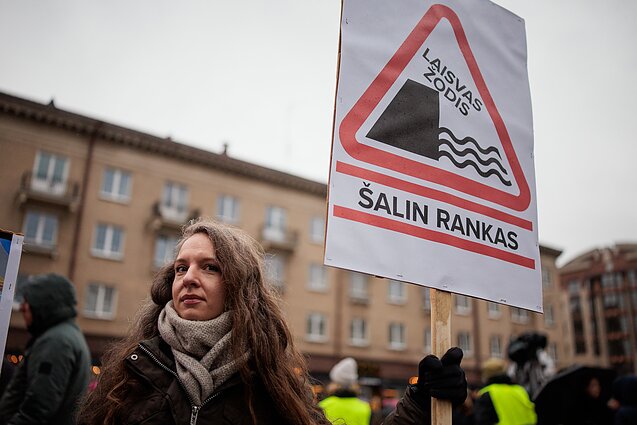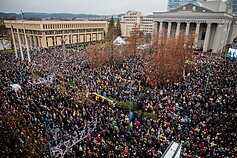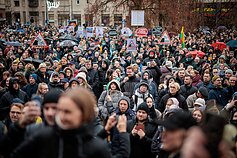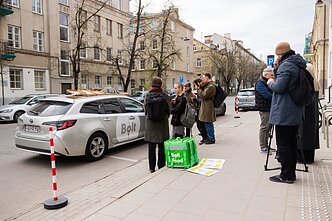















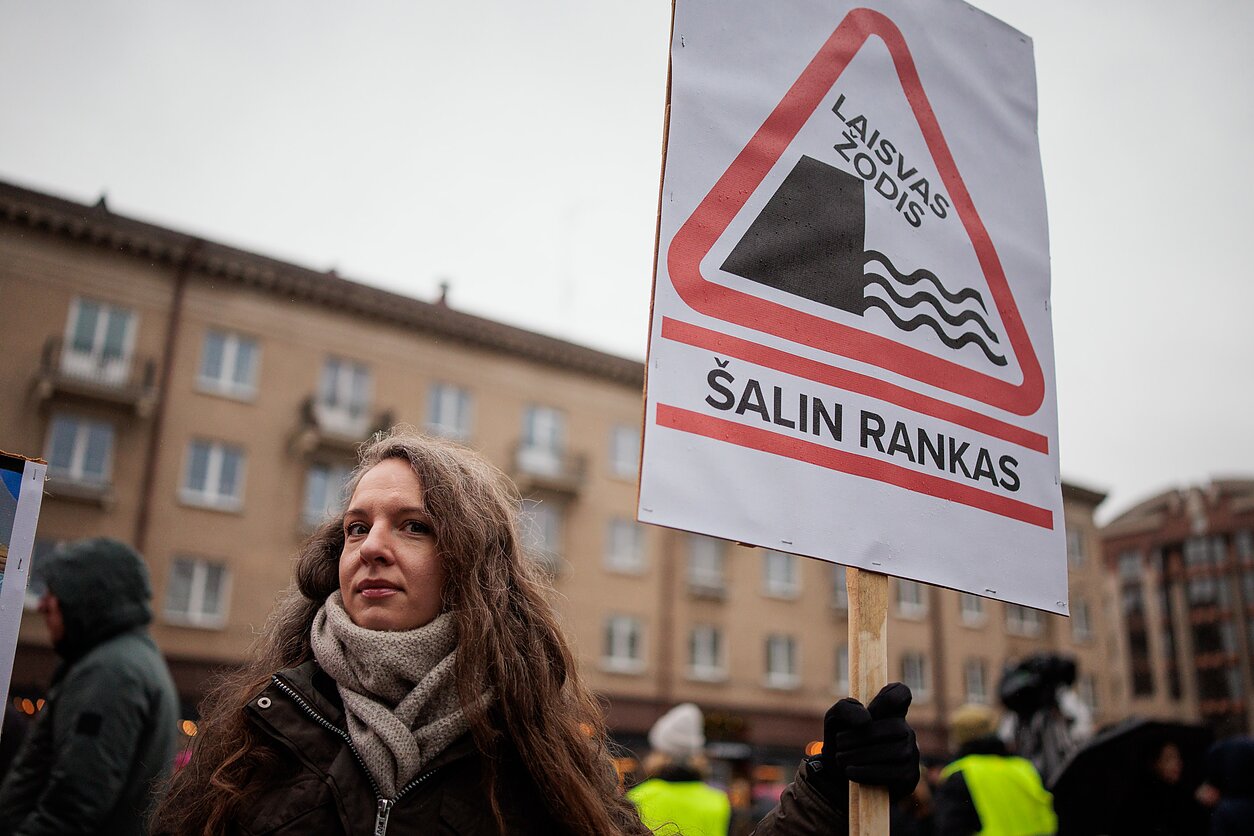
Several thousand people gathered outside the Parliament and the National Library of Martynas Mažvydas in Vilnius on Tuesday to protest against a growing threat to media freedom and government-backed amendments to the Lithuanian National Radio and Television (LRT) law.
Police said around 10,000 people gathered near the Lithuanian Parliament.
The rally, titled Hands Off Free Speech, was organised by the journalists’ community together with the Cultural Assembly.
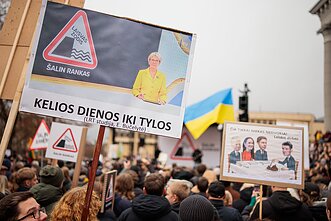
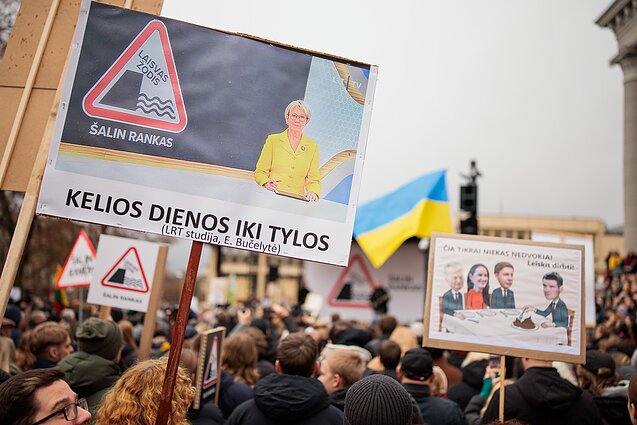
Demonstrators held placards reading “For free speech and media freedom”, “Hands off”, and “Nothing stinks here, let us work!”, the latter depicting President Gitanas Nausėda, Prime Minister Inga Ruginienė, Social Democrat leader Mindaugas Sinkevičius and Nemunas Dawn chairman Remigijus Žemaitaitis.
“We are here to ensure this government does not take control of our public broadcaster. To the thousands watching us on your computers and screens – thank you for standing with us to protect our independent media,” LRT radio journalist Edvardas Kubilius addressed the protesters.
He added that the authorities are attempting to “take away freedom of speech from the public.”
“I'm fed up – fed up with some of those sitting up there [in the Parliament – LRT], fed up with how the law and court rulings do not seem to apply to them, how they say whatever they like, slander freely, and feel no responsibility for their words,” the journalist said.
Kubilius' speech was followed by musician Andrius Mamontovas, who said he remembers what media “looked like when it was state-controlled and politicised.”
Mamontovas performed his song Wake Up, addressing the President Gitanas Nausėda and urging him to “wake up.”
“It’s very worrying to watch what’s happening [...] it already feels like we’re beginning to live in a country that isn’t ours,” said Viktorija, a 47-year-old company director from Klaipėda who joined the protest.
She said she hoped politicians would listen to the demonstrators’ demands.
“First of all, they should shelve and stop considering these amendments on changing the LRT director. And also move towards depoliticising the board. We want these processes to start moving in a positive direction,” she said.
Egidijus, a 45-year-old teacher at Vilnius Waldorf Green School, said he joined the demonstration to oppose attempts to “simplify the procedures at LRT and replace the director”.
“This is the beginning of something bigger, and I don’t want it to continue. I’d like this to end now, without any further backward steps. Too many backward steps have already been taken,” he told BNS.
He said that freedom of expression in Lithuania is currently protected and questioned why politicians were seeking change.
“For me, free speech means I can speak, I can let others speak. I can hear non-offensive words, I can debate and discuss ideas with arguments,” he said.

The protest comes as the Seimas considers amendments that would make it easier to dismiss the LRT director, and after voting to freeze the broadcaster’s budget for the next three years.
Journalists organising the protest say the proposed changes to the dismissal of the public broadcaster’s director are unconstitutional, run counter to European law and create conditions for political interference in LRT's editorial work.
Organisers are calling on the ruling majority to withdraw the proposal to change the director’s dismissal procedure and instead launch a serious debate on depoliticising the LRT Council, involving journalists’ organisations as well as media and legal experts.
The Council is a supervisory body made up of 12 members – four are appointed by the president, four by the parliament (two by the parties in power, and two by the opposition), and four by various civil society organisations.
A proposal by Nemunas Dawn to allow the LRT director to be dismissed by 6 out of 12 council members has already passed its first reading in parliament, though its sponsors admit the plan will need revising, likely requiring at least 7 votes.
At present, 8 votes are needed to remove the director.
Supporters of the amendments argue they are responding to findings from a State Audit Office review published in early November, which identified governance shortcomings at LRT. They say the changes would give the council genuine authority to replace the director if trust is lost.

On Tuesday, several NGOs urged state leaders to reject the proposed amendments, saying they contradict the European Media Freedom Act.
Last month, the Seimas – again following proposals from Nemunas Dawn – also voted to freeze LRT funding for three years. The public broadcaster is set to receive around €80 million annually from the state budget during that period.
Both Nemunas Dawn initiatives are supported by the governing Social Democrat and Farmers and Greens Union factions.
Public broadcaster employees began their own protest last week, holding moments of silence on air and calling on politicians to “take their hands off” the organisation.
LRT journalists have also been producing programmes highlighting the importance of a free press to democracy, citing examples of countries where the media has been captured by political forces.
Updated: updated the crowd size, organisers' statements.

Newsletter
Every Friday morning.