













Lithuania’s new government has set a goal of normalising diplomatic relations with China to the level maintained by other EU member states, but early signs suggest the effort will not be easy.
Prime Minister Inga Ruginienė’s government removed language used by its predecessor warning that China posed growing foreign policy and security risks, including its strategic partnership with Russia and increasing influence in Belarus. Still, more than a month into the new cabinet’s tenure, there is no public evidence that relations with Beijing are improving.
The Foreign Ministry says communication with China is taking place but has declined to provide details.
“Due to the nature of the contacts and the sensitivity of the information, we cannot disclose details at this time,” the ministry told LRT late last week. “We are seeking constructive dialogue with Chinese diplomats using direct and indirect communication channels, but cannot provide additional information.”

Relations collapsed in late 2021 after Lithuania allowed the opening of a Taiwanese representative office in Vilnius under the name “Taiwanese”. Beijing responded with harsh diplomatic and economic measures and downgraded its diplomatic relations with Lithuania from ambassador to chargé d’affaires.
EU avenues have stalled
Vilnius turned to Brussels for help. The European Commission filed a case against China at the World Trade Organization over Beijing’s trade restrictions on Lithuanian goods and launched an anti-coercion instrument, the EU’s so-called “bazooka”. But the tool has never been used, and the WTO case has repeatedly stalled.
In January, the Commission asked WTO adjudicators to suspend the case. It briefly revived it earlier this year before halting it again, saying it lacked additional evidence and that trade between Lithuania and China had nearly recovered, making a win unlikely.
In August, China imposed sanctions on two Lithuanian banks, Urbo Bankas and Mano Bankas, in retaliation for EU sanctions on Chinese entities for conducting business with Russia. While the sanctions had little practical effect because the banks have minimal business with China, they were seen as a symbolic warning to both the EU and Lithuania.
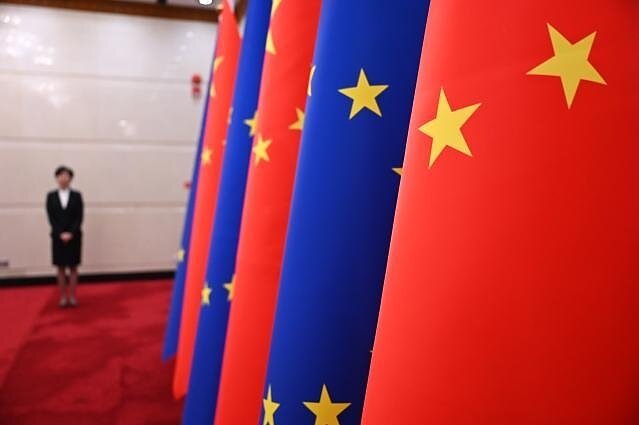
An EU spokesperson said Brussels would raise the issue with Chinese officials, but months later there has been no public progress. The Lithuanian Foreign Ministry says it is in “constant contact” with the European Commission on the matter.
Taiwan issue remains Beijing’s red line
Analysts are sceptical that relations can be quickly repaired. During a recent German Marshall Fund discussion, Linas Didvalis, an associate professor at Vytautas Magnus University, said China may be waiting for a clear shift from Lithuania, something that has not happened despite moths of talk about restoring ties.
“Even with a new government, our relations remain tense,” he said. “The foreign minister has not changed, which shows continuity in foreign policy, including toward China.”

He added that Lithuania views China’s friendly ties with Russia’s during its aggression against Ukraine very negatively, complicating any rapprochement.
At a Brussels forum last week, EU officials also cited China’s reluctance to acknowledge the severity of Russia’s war as a major obstacle in EU-China relations. China’s ambassador to the EU, Cai Run, reiterated that respect for the One China principle is a red line that cannot be crossed.
That stance helps explain why Estonia and Latvia, though they withdrew alongside Lithuania from the “17+1” cooperation format with China, have avoided following Vilnius in allowing a “Taiwanese” or “Taiwan”-named office. Both stick to the more widely used “Taipei” designation.

Lithuanian officials acknowledge that the name of the Taiwanese office may be the central sticking point.
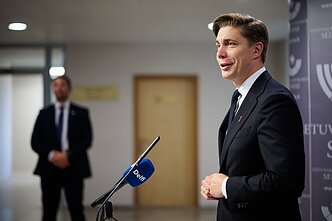
“The essential obstacle is likely the name of the Taiwanese office,” Remigijus Motuzas, chair of parliament’s Foreign Affairs Committee, told reporters last week.
Foreign Minister Kęstutis Budrys, visiting Brussels last Thursday, said Beijing should take steps towards any normalisation of relations.
“We must discuss what conditions could allow us to reach a different level of relations,” he said. “But it is wrong to think everything depends on us. This is a matter for both sides, and the decisions were not made on our side.”

Newsletter
Every Friday morning.