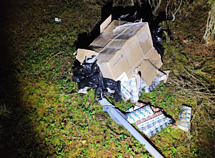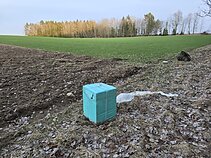













Despite Lithuania’s ongoing efforts, a weather balloon launched from Belarus last Saturday once again disrupted operations at Vilnius Airport. Meanwhile, smugglers were quicker than officials to recover a shipment of cigarettes dropped by another balloon near Alytus.
Information gathered by the LRT Investigations Team indicates that Lithuanian mobile operators’ SIM cards are being used to help guide the balloons carrying Belarusian cigarettes to smugglers waiting on the Lithuanian side. While state institutions see no reason to restrict the use of these cards, mobile operators have begun taking action themselves.
For years, Lithuanian authorities have been fighting a silent war against smugglers whose illegal activities cost the state tens of millions of euros annually. This year alone, the shadow market is estimated to have cost the country nearly €70 million. Lithuania’s illicit cigarette trade is the largest among the Baltic states and even surpasses Poland’s.
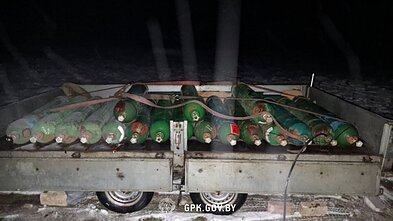
Until recently, Lithuanian border guards could see and hear balloons being filled with gas on the Belarusian side.
“You could hear the gas hissing, then a puff sound as the balloon gets released – one, then another, then a third rising into the air,” recalls Remigijus Burba, head of the Varėna Border Guard Station in southern Lithuania.
True number unknown
State authorities only report the balloons that have been recovered by officials. This year, nearly 600 have been intercepted, almost three times more than last year. In the first half of 2024, officers recorded only isolated cases of contraband balloons.
Still, officials admit these numbers are far from the full picture.
According to LRT sources, smugglers calculate that if they can successfully deliver two-thirds of their loads, the operation remains profitable. State Border Guard (VSAT) Deputy Commander Antanas Montvydas confirmed these estimates, explaining that when smuggling becomes unprofitable, the methods quickly change.
The smugglers’ maths is simple – if a box of cigarettes costs up to €350 in Belarus, it can fetch three to four times that amount in European countries.
“When the physical barrier was built and a patrol road was installed, it became impossible to quickly toss cigarette boxes across the border. So the smugglers started thinking of new methods. At first, they tried using drones, but those could only carry small quantities – and the drones themselves were quite expensive,” the officer explained. Each drone loss significantly cut into the smugglers’ profits.
That’s when smugglers began using balloons.
VSAT cannot say precisely what percentage of smuggled balloons it manages to intercept and only reports the number that are actually found. According to Montvydas, no institution in the country truly knows how many balloons have crossed the border.
“I don’t think any agency could guarantee exactly how many flew in or confirm that all of them were indeed balloons,” he said. Not all radar signals identified by the military as likely balloons necessarily are – some could be other objects.

Saulius Batavičius, head of the state enterprise Oro navigacija (Air Navigation), which oversees air traffic management at Lithuania’s airports, also said he doesn’t know the actual number of balloons.
According to him, Oro navigacija only receives information from the military that is relevant to civil aviation.
When the wind is favourable, balloons enter Lithuanian airspace almost daily, though not all of them reach areas sensitive to aircraft, said Batavičius. This year, temporary flight restrictions due to unidentified aerial objects were imposed seven times at Vilnius Airport and once in Kaunas.
“Everything seemed calm in recent days and over All Saints’ Day, but we were working with the Air Force and receiving updates about radar traces. There were fewer of them, and we managed the situation. The absence of flight restrictions doesn’t mean there were no objects in the air,” he added.
The military, meanwhile, has classified its data.
On some days, the number of balloons found on the ground should be doubled or even tripled to estimate the total. This means that the 600 balloons recovered by authorities could represent only a third – or even less – of the total that entered Lithuania.

After the night of October 22, when reports suggested that around 200 balloons had flown toward Lithuania, officers found only a few dozen of them.
“The radar data is classified military information. The Air Force monitors the situation on its radars, but such details are never shared,” said Oro navigacija director Batavičius. “What we can say is that over the past couple of weeks – when air traffic was restricted at Vilnius and Kaunas airports – the scale was significantly larger. We received information about a great number of balloons. When the risks became unmanageable, we had to impose [air traffic – LRT] restrictions,” he explained.
The commander of the Lithuanian Air Force, Colonel Antanas Matutis, added that the figures are highly sensitive – revealing them would hand secret information to hostile states such as Belarus and Russia.
“I understand the public’s interest in knowing, but the one who launched them already knows how many were sent. If I disclosed the number I’ve seen, I’d be revealing classified information – it would allow others to gauge our technical capabilities,” Matutis said.
According to him, monitoring the airspace is a constant, silent struggle, much like law enforcement's war against smugglers.
Matutis declined to comment on speculations that meteorological balloons only became recognised as a serious threat this autumn because the military began detecting them more effectively after two drones managed to enter Lithuanian airspace unnoticed over the summer.
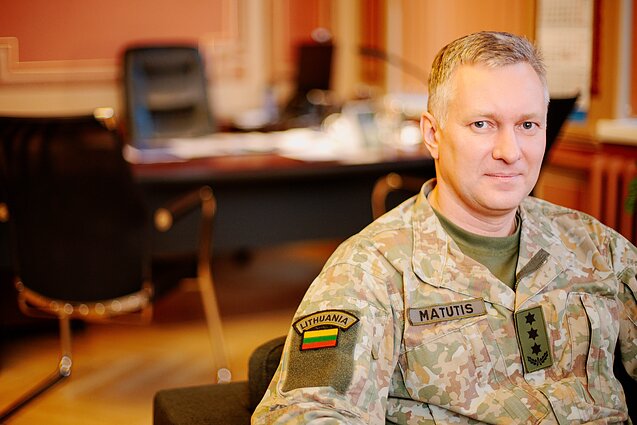
“Balloons are monitored constantly. The airspace surveillance procedures haven’t changed – what has changed is the other side’s tactics: the scale, the number of balloons launched at once, and how deep they fly into Lithuanian territory,” the Commander of the Air Force told LRT’s Investigations Team.
Smuggler: operations happen with the knowledge of Belarusian officials
Using night-vision and thermal imaging equipment, border guards spot balloons carrying contraband to this day. However, only some of these are sent up near the border. As officers directly involved in the issue point out, the situation has changed fundamentally this autumn – likely because Lithuanian officers have learned to intercept the cigarette-filled balloons faster than smugglers’ local helpers or buyers can retrieve them.
The State Border Guard Service (VSAT) estimates that it managed to intercept roughly one-third of the smuggling balloons – losses that have since forced smugglers to change tactics.
Now, many of the balloons carrying cigarette cargo are launched tens of kilometres from the Lithuanian border. They are filled with more gas, fly much higher, up to 11 kilometres, and fall deeper inside Lithuanian territory, far from the border zone where border guards and State Security officers are on constant patrol, leaving only the police to respond.
Police do not always make it in time – as was the case on the night of November 8. Although officers had received reports that a smuggling balloon might land near Alytus, it was spotted by local residents early in the morning, already stripped of its cargo.
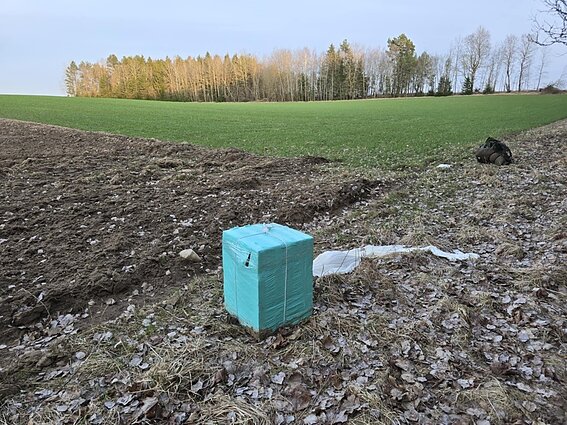
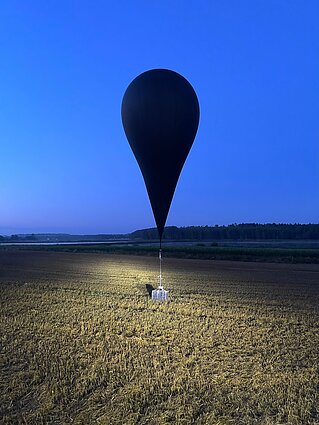
To make detection even harder, smugglers have started using black balloons.
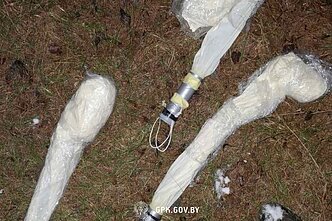
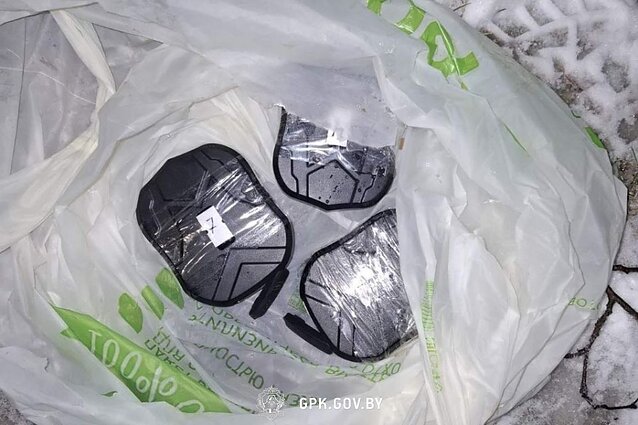
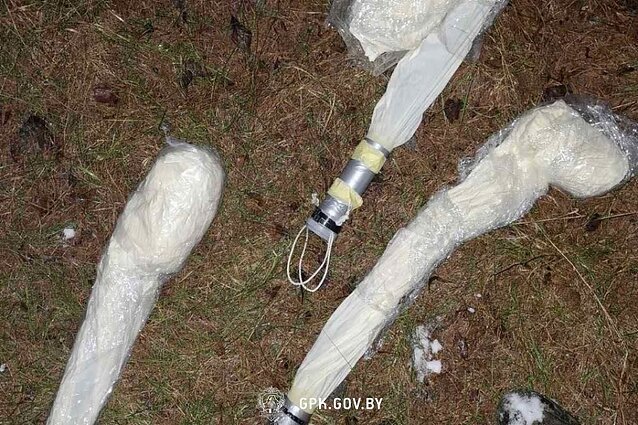
These balloons are silent, emit no signal, and rely entirely on the wind. Once they land, however, a navigation device attached to the balloon sends the exact coordinates to the smugglers’ helpers. Each device contains a SIM card – often Latvian, Polish, or Lithuanian.
Once the ballons began flying at high altitudes and deeper into Lithuanian territory, the smuggling operation started to resemble a hybrid attack.
Some of the areas in Belarus where balloons are launched are military zones. Although the Lithuanian Armed Forces have no evidence that Belarusian troops are directly involved, the entire border area on the Belarusian side is tightly controlled by border and other security services. VSAT Deputy Commander Antanas Montvydas is convinced that no balloon is launched without the knowledge of Belarusian officials.
That view is echoed by a former smuggler interviewed by Buro Media, an opposition outlet in Belarus and LRT’s investigative partner. He told reporters it was hard to believe that balloon launchers could operate without official approval.
“Sixty balloons equal around 180 boxes of cigarettes. Roughly speaking, that’s two or three vans’ worth of cargo. It’s immediately visible and easy to track. Border guards could reach the spot within 10–15 minutes and arrest everyone. They don’t launch from Minsk – they launch from the border zone. Either way, they need a permit for this to happen,” the former smuggler said.
Lithuanian SIM cards found in balloons
“In every case, Lithuanian SIM cards were found. That clearly shows that this activity involves and benefits individuals living in Lithuania and other EU countries,” a representative of Belarus’s State Border Committee said recently on Belarusian state television.
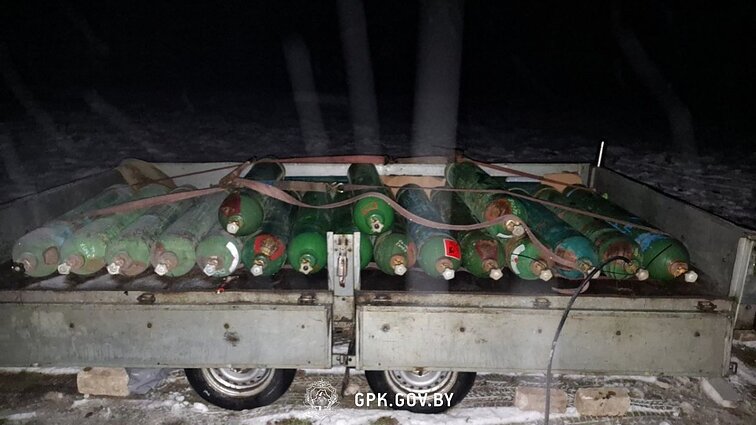
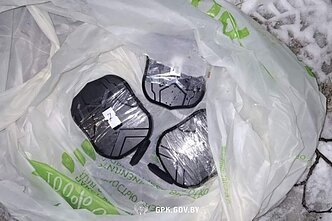
He spoke about individuals detained at the border and the meteorological balloons and navigation devices found nearby. According to official Belarusian border guard reports, there have been around ten such detentions since October 2024, mostly in the Gardin, Varanava, and Astravets areas, very close to the Lithuanian border.
Though Belarusian state border committee reports mention that Belarusian citizens were apprehended with the balloons, following Lithuania’s closure of the border with Belarus, state media channels have begun claiming that the smuggling balloons are the fault of the Lithuanians themselves, citing the use of Lithuanian SIM cards as evidence.
The SIM cards, inserted into the GPS devices, allow the smooth transfer of smuggled cigarettes from Belarus into Lithuania. Without mobile data, smugglers would not know the exact location where the cigarette cargo landed.
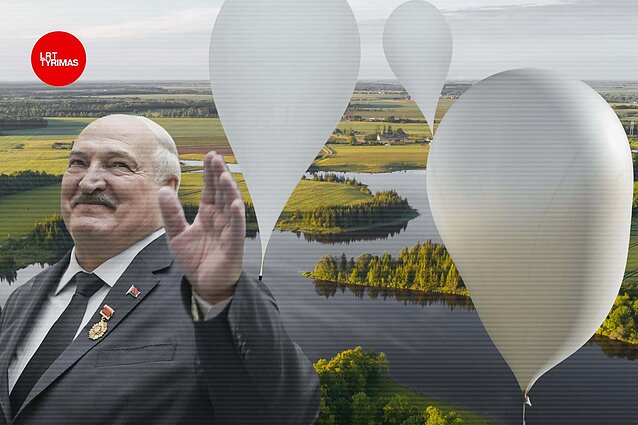
For example, on the state channel ONT, a Belarusian journalist displayed a navigation device, explaining that it had been brought into Belarus from Lithuania along with “a SIM card from a Lithuanian operator.” Similar claims are publicly repeated by Aliaksandr Lukashenko.
“Those Lithuanians bought the balloons themselves and transport them into Lithuania, where they are collected by their own people,” Lukashenko said on the same ONT broadcast.
According to LRT’s Investigation Department, more than half of the SIM cards used by the smugglers are Polish or Latvian, while the remainder belong to Lithuanian mobile operators Bitė Lietuva, Telia, and Tele2.
The cards used in the devices are prepaid, under the Labas, Pildyk, and Ežys brands. Since January this year, stricter regulations have applied – activation now requires registration with personal identification, meaning the cards are no longer anonymous.
Before these regulations came into effect, smugglers made more frequent use of Lithuanian SIM cards.
“Registering mobile SIM cards is a preventive measure – it is intended to make criminal activity more difficult, but it cannot completely prevent it,” Linas Marcinkevičius, Head of Credit and Risk Control at Tele2, told LRT.

Criminals are also aided by the online trade in anonymous SIM cards.
On ad platforms, sellers offer prepaid SIM cards bought last year for around €60 each. One listing noted: “A new SIM card cannot be activated without registration and cannot remain unregistered without verified ID. However, unregistered cards can be used if activated in 2024.”
Telia reports that by early 2025, its network held around 300,000 Ežys cards that did not require personal data to activate.
The total across three Lithuanian operators potentially reaches one million.
Secondary SIM card sales are nothing new for any of the operators, who point to law enforcement for regulation.
“Managing this requires law enforcement involvement and regulatory changes, such as declaring resale illegal, with penalties attached,” said Marta Matusevičienė, head of voice services for private clients at Bitė Lietuva.
So far, authorities have no plans for further restrictions.
Operators act independently
Lithuanian law does not limit the activation of prepaid cards outside the EU, nor the number of cards a single individual can register.
LRT sources report cases of hundreds of cards registered to one person.
Darius Kuliešius, deputy chairman of the Communications Regulatory Authority (RRT), said any further restrictions must comply with EU rules. He added that Lithuanian SIM cards are a valuable tool for authorities in identifying criminals.
“SIM cards are not only used in Belarus, nor solely for smuggling, fraud or other crimes. Like other tools employed in criminal activity, they provide crucial evidence that helps uncover offences and hold those responsible to account,” said Kuliešius.
Mobile operators say they have also introduced restrictions in response to criminal behaviour. For example, since January 1, Bite Lietuva allows Labas cards to be activated only within EU countries, although the operator notes that location can still be circumvented using a VPN.
Telia introduced restrictions even earlier.
“Before mandatory user verification, SIM cards could be activated by calling a short number, which only worked in Lithuania. After registration became compulsory, Ežys cards can now only be activated in-store or via Wi-Fi,” said Telia spokesperson Audrius Stasiulaitis.
Tele2 told LRT that it had acted specifically in response to the issue of smuggling balloons.
“Until now, users could buy SIM cards in Lithuania and activate them abroad. We have decided to prevent their use in smuggling balloons into the country and to block activation abroad,” said spokesperson Linas Marcinkevičius.
Still, there is no agreement on limiting the number of cards per person. Bitė Lietuva says it has unilaterally imposed a limit on sales to a single customer. Telia notes it has never had many users making bulk purchases, and suggests allowing only ten prepaid cards per person. Tele2 says it has not yet made a final decision.
This report was prepared in collaboration with Buro Media.

Newsletter
Every Friday morning.