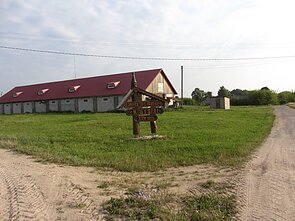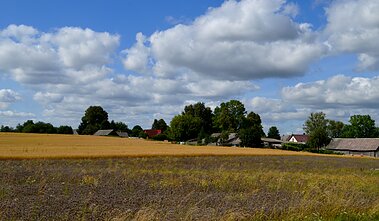










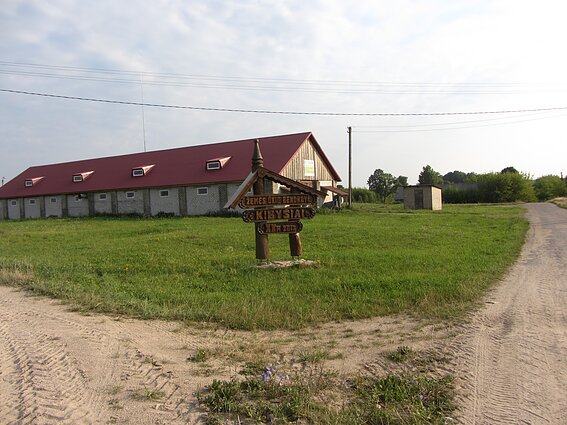
Sociologists estimate that since regaining independence, Lithuania’s rural towns and villages have lost around half of their population. LRT Radio recently visited Kibyšiai village in the Varėna district and spoke with residents to capture how their community looked in the past and what sustains it today.
“We had such a wonderful youth. Kibyšiai was a lively village. Everyone sang, nobody frowned –unlike today,” reminisced one local woman in a recording from a 1996 community gathering.
Now, nearly thirty years later, LRT Radio returned to the same spot to meet locals who shared stories of schoolchildren lining up before the school gates on the first day of school – each carrying gladiolus flowers for their teachers. They can still name the people from the gathering, though many are no longer alive.
In Kibyšiai, the population has almost halved over the past three decades, mirroring a trend seen across many Lithuanian rural areas.
“I was born here, grew up here, and have grown old here. It’s true, I once moved to the city, but I came back. There’s something about the countryside, the pull towards the land,” said 67-year-old Lina Žemaitienė, a resident of the village.
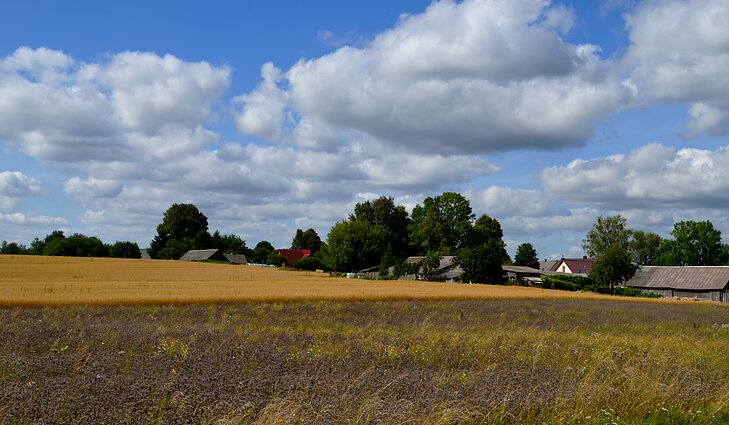
She recalls summers filled with chores: grazing cows, weeding gardens, and looking after her younger siblings. “Nobody was idle. We had to learn to churn butter, bake pancakes, and we needed to be resourceful, because our parents couldn’t have managed alone. We were five children,” she says.
Winters brought their own challenges: “We’d dug tunnels through heaps of snow, carried water and wood, fetched potatoes from the cellar. We were busy, cold and sweaty until all the chores were done.”
After returning to Kibyšiai, Lina raised four children there. She reflects, “Thinking back 30-50 years ago, I wouldn’t want my children to endure such hardships. Life was tough; tools like pitchforks, ploughs… now, tractors and machinery do the job. Young people today don’t want, or maybe even can’t, do all that physical, manual labour. Maybe we were stronger, shaped by tough childhood years.”
No youth, vanishing schools
The neighbouring Jakubiškiai village, which is practically a continuation of Kibyšiai, as the two shared the same school and shops over the years, is home to Ona Aldona Prunskienė. Having moved to the village in 1962, she recounts how things have changed. “For 23 years, I worked on the farm with calves. We fed them, looked after them. After work, we had to prepare meals, buy essentials. And the children – we had to care for them. Life was busy. Then, day by day, the village emptied, older people passed away, and younger ones moved to work in the cities. Some houses were sold, others are still visited by the descendants, only on Saturdays, Sundays.”
Her children attended the Kibyšiai eight-year school, which closed in 2003. “When my children were at school, Kibyšiai had about 120 pupils. Now there are virtually none, only some five or six children, who must travel to Merkinė for school. There are no young people, no kids. Everything’s changing.”
Her own children now live in different Lithuanian cities and visit only on weekends. Still, Ona refuses to move to the city: “This is home. I have my garden, flowers, and a patch of land. I couldn’t imagine moving.”
The soul of the village
Just before Lithuania’s independence was restored, another family, that of Tautvydas Prieskienis, settled in Kibyšiai to escape environmental fallout from what is considered to be the worst industrial accident in the history of Lithuania – the “Azotas” production association’s isothermal storage tank explosion of 1989. Tautvydas initially worked as a livestock specialist in the collective farm (kolkhoz), but as those structures collapsed, he and his wife Janina turned to the community’s cultural life.
“Perhaps because I’ve always been drawn to music and singing, and my wife is the same, we sing together. So I created a job for myself, which was before the cultural centre was closed down. With our own hands, we did what we could,” the man says.
Together with his wife, he started by reviving activities in the former school and cultural centre, refurbishing it themselves. Today, that building stands anew: two stories, freshly painted grey with white trim - the very soul of the village and the surrounding area.

Tautvydas plays his accordion whenever he can. Though he acknowledges that the village has changed and is gradually emptying, the remaining community is close-knit; he estimates it now comprises about 70 people, regularly meeting for cultural events.
Twice a week, he, his wife Janina, and neighbour Lina rehearse. Every July, the village comes alive with the Oninės festival, featuring traditional rye-harvesting rituals and bread-baking.
Still, one thought worries Tautvydas – who will take over the community leadership when the time comes?
“My sun is setting, I’m not so young anymore. I don’t know if anyone younger will take over. I wouldn’t want everything to collapse when I step down… I’d like someone to carry on, continue singing and playing,” he says.
Janina is less optimistic: “They want to close everything in the villages – cultural centres, libraries… We were told: ‘You can stay until retirement, but once you’re gone, we’ll shut things down.’” She adds: “There’s nowhere else to gather, but churches and cultural centres. We used to have clinics, post offices, schools, and shops. Now there’s nothing left, just a little library.”
Adapting to shrinkage
The decline of villages and small towns in Lithuania reflects broader Western European trends: job opportunities are concentrated in cities, and agricultural mechanisation reduces the need for manual labour. As a result, villages are left with mostly pension-age residents, while young people don’t return, and birth rates decline. The collapse of Soviet-era farm systems accelerated the shift.

Edis Kriaučiūnas, senior researcher at the Lithuanian Social Research Centre’s Institute of Sociology, points out:
“The village used to be a place of work and home. Now, it’s mostly a residential or leisure space for people working in the cities. We must adapt to shrinking populations, manage transitions so they don’t cause crises, and learn to live with fewer residents.”
Yet, shrinkage compounds isolation – essential services like schools, post offices, and clinics are closing, making life more difficult for those who remain in the villages. Still, locally tailored solutions and community-driven efforts can help preserve rural life.
Translated to English by Smiltė Titovaitė.

Newsletter
Every Friday morning.