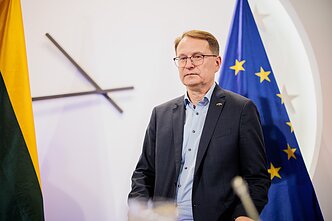














NATO and the US are committed to the defence of the Baltic states, assures US Ambassador to NATO Matthew G. Whitaker, as Washington is reviewing American troop presence in Europe and appears to be in the mood to roll back its involvement.
Whitaker spoke on the LRT TV programme Topic of the Day on August 27.

The US is reviewing its troop deployment in Europe. There are about 1,000 American troops in Lithuania – what factors will determine whether they’ll stay?
Obviously, they’re treated very well and we’re very appreciative of how well the people of Lithuania and your government provide for them.
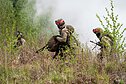
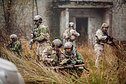
I was up with them yesterday and was able to see the base, the new construction, how well the facilities have come along, and how well our troops are being treated. Right now, we expect another 1,000 troops to come in October to replace these troops on a rotational basis.
The US remains committed to the NATO alliance, remains committed to the eastern defence line. And we’re very grateful to the Lithuanian people.

And so right now, I don’t expect any changes, but we’re going to always be reviewing our force posture. But certainly, we’re going to make sure that any force posture addresses the threats both to the US and to NATO.
Is pulling back forces from the eastern flank still one of the requirements of Russia? Would the US negotiate with Russian about that?
Right now, that is most likely not on the table. President Trump is trying to get to peace, he wants the killing to end. He knows that right now, it is a meat grinder on the front line. A lot of civilians are being killed and injured in Ukraine. And so he wants to get to a peace.
What’s in or what’s out of any peace deal, I don’t have anything to announce today. President Trump ultimately is the consummate dealmaker, but I don’t think he’ll trade away eastern flank security for peace in this situation.
But President Trump is going to be the one who makes any deal and mediates any resolution of the killing and the fighting.
But, obviously, our commitment, NATO’s commitment to the eastern flank is ironclad and we’re going to continue to make sure that we are positioned to the threats that we face.

Can we trust Russia? It previously pledged to uphold Ukraine’s territorial integrity but then started a war.
I don’t think just because we get a peace deal or a ceasefire in Ukraine, that we should expect Russia to somehow become different from what they’ve been. They invaded Ukraine, that’s a fact.
And we should always be prepared to make sure that we can defend every inch of the NATO alliance. And that is making sure all of our allies are strong. It’s why at the NATO summit in June that we agreed to 5% [of GDP for military spending].
Lithuania is, if not already, going to be there next year. They’ve committed to significant defence spending and that’s why they’re a model ally.
And I think we have to always be ready to defend every single territory, every single member of the NATO alliance. The way we do that is through making sure everyone’s strong, making sure all 32 allies are strong. Not just the United States that is strong and lethal, that it is all 32 countries that are strong and lethal, and that strength is what’s going to ensure peace.

When it comes to the Ukraine peace talks, President Trump has recently said that getting Presidents Zelensky and Putin at the same table is like mixing oil and vinegar. Is that a tacit admission that negotiations won’t work, because Russia simply does not want to end the war?
Well, I don’t know what Russia does or doesn’t want. I know that the Ukrainians have been willing to come to the table and to negotiate. They have been willing to enter into a ceasefire and, ultimately, a lasting peace.
President Trump is trying to create the conditions so that both sides come together. He just said in the last couple of days that he believes both sides need to sit down, that it is going to take both of them to come to the table and be willing to negotiate a peace deal.
One of the things that he’s done, first of all, today, the India sanctions go into place, the tariffs at 50%. One of the reasons those tariffs were put in place is because India continues to buy Russian oil. India has already indicated that they’re going to buy less Russian oil because of those tariffs in hopes that they can negotiate out of that situation that they’ve created for themselves.
Second, we have the prioritised Ukraine requirements list where US armaments are being sold to our NATO allies, and those are being provided to Ukraine. That’s 2 billion dollars in the last two months of weapons that help Ukraine defend themselves.
And ultimately, what President Trump has created incrementally is a situation that ultimately, we expect, will make Russia come to the table.

To end this war, we have to end the killing, it is at this point senseless. People are dying in the thousands on the front line, in addition to the people that are being hurt in cities across Ukraine because of drone and missile strikes.
And so we need this war to end and Donald Trump is trying to create the situation – and I think is going to create the situation – where both sides are willing to come and enter into an end to the fighting.
The US president’s recent meeting with Vladimir Putin in Alaska was seen, in our region, as a red carpet and legitimisation for Putin, his return to the international arena after several years of isolation. What would you say to critics who see the summit as Putin’s victory?
I don’t think that’s a proper criticism because Donald Trump was elected, among other reasons, because he’s a peacemaker. He’s made at least six peace deals in the first six plus months he’s been in office. […]
And he wants to add Ukraine and Russia to that. You can’t do what Joe Biden did, which is not talk to the Russian side, to ignore the Russian side, browbeat the Russian side. You have to give the space for a peace deal.
Obviously, what has happened on the battlefield in Ukraine is terrible and we all know the facts. Ultimately, those issues will be resolved for another day. Right now, we need the fighting to end. And the only way you’re going to do that is by talking to the Russians and talking to Vladimir Putin.
President Trump believes, and I agree with him, that he can create the situation. And one of those situations that can be created for a peace deal is to sit down and talk to Vladimir Putin.

And so they met in Alaska. I mean, he flew a B-2 bomber over the Russian president’s head. That is a sign of strength. Donald Trump knows that the United States is strong and he demonstrated that to Vladimir Putin. And I think he is trying to, again, convince the Russian side that peace is in their best interest.
But again, he continues to hold cards that he can play and I’m sure he’s communicated that to the Russian side. We’ll just continue to see if the Russians are willing to come to the table. But as President Trump says, it takes two to tango, and ultimately it’s going to be up to both sides. I know the Ukrainians want peace, they’re willing to make a deal. And now we need to get to the Russians.
If the deal involves ceding Ukrainian territories to Russia and freezing the frontline, will this not send a message to Putin that he’s free to, a few years hence, to demand Baltic territories, too?
I don’t think so. The Baltic states are entirely different, they’re a member of NATO. That’s significant, that means 32 allies and the NATO alliance all agree to Article Five protections, which is an attack on one is an attack on all.

And we’ve all agreed to Article Three of the NATO treaty that says that we agree to invest in our collective and our individual defence. And what I’ve seen in Lithuania during my visit here is a significant investment in their own defence. […]
I’ve seen [Baltic] investments in their own defence and also the commitment to NATO. And, likewise, NATO is committed, the United States of America is here in Lithuania, the United States of America is here in Europe. […]
This summer, two Russian Gerbera drones flew into our territory from Belarus. Our leaders turned to NATO, asking allies to provide anti-drone capacities. Can we expect NATO assistance in this area?
NATO is already helping. All of these drone incursions from outside of Lithuanian or NATO territory are investigated as soon as help was requested from the Lithuanian allies. We sent a NATO team and a US team to help investigate, that investigation is still ongoing.
As to the most recent July incursion, obviously, we are paying very close attention to it, but it also points to the importance of air defence and making sure that the alliance and our Lithuanian allies are working constantly on innovation, air defence, drone protection, multi-layered expertise so that we can address ballistic missiles all the way down to weaponised drones.

Newsletter
Every Friday morning.