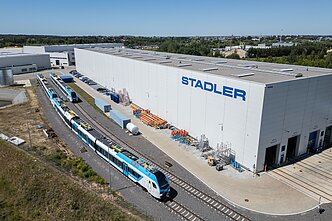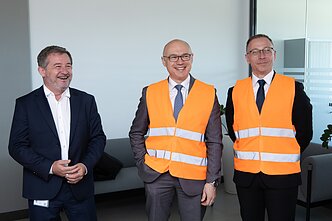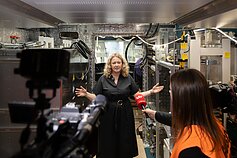















Equipped with Swiss technology and manufactured in Poland – Lithuania’s new generation of passenger trains is under construction at the Stadler Polska factory in Siedlce, near Warsaw.
A total of 15 trains will be delivered: nine electric units and six battery-powered ones, capable of travelling up to 120 kilometres without connection to the overhead power line.
The first train is expected to roll out of the production line this autumn but will not be available for Lithuanian passengers until trial runs are completed. Passenger services are scheduled to begin in the second half of 2026.
From Italy and Norway – now to Lithuania
Stadler Polska, a subsidiary of the Swiss group Stadler Rail, began operating in Poland in 2006. Today, it employs over a thousand workers, local residents from the Siedlce area, as well as some from Warsaw and neighbouring towns. The factory produces not only conventional trains but also trams and metro units, having delivered around 1,000 rail vehicles to countries including Norway, Italy, and Estonia.

The state-owned Lithuanian Railways (LTG) order of 15 trains is the company’s first for the Baltic country.
“This is not our largest order overall, but it is undoubtedly the most significant and one of the most important orders for this year and the next,” said Radosław Banach, CEO of Stadler Polska.
“All of the vehicles we manufacture are customised according to client specifications, whether for Italy or LTG. In this case, I can say that the trains ordered by LTG do not stand out in any particular way. Of course, these trains will be slightly larger, offering greater comfort and a different travel experience for passengers, but there are no other distinct features setting them apart from orders placed by other countries,” Banach told reporters.

Contract worth €226 million
LTG Link, the passenger transport arm of LTG Group, signed a contract for the 15 new trains worth €226.5 million. This includes not only the rolling stock, but also technical support, maintenance, and spare parts supply until 2037.
“The trains were acquired through a public procurement process. Offers were evaluated based on economic parameters, but not only on the train’s purchase price. Operational costs over the train’s service life were considered,” said Egidijus Lazauskas, CEO of LTG Group.

The procurement decision also included plans to acquire battery-powered trains to serve non-electrified routes. This decision was partly driven by cost-efficiency. Electrifying certain routes, such as the line from Vilnius to Klaipėda, could cost nearly €400 million. For less busy routes like those to Marcinkonys in southern Lithuania, the battery units provide a flexible alternative to major infrastructure upgrades, explained Lazauskas.
First train to arrive this year
Each train takes up to 12 weeks to manufacture. Once ready, the units will be transported by lorry to Lithuania. As Stadler Polska’s production director Paweł Sztukowski explained, this approach avoids complications arising from the differing railway gauges in Poland and Lithuania.

According to Lithuania's Transport Minister Eugenijus Sabutis, the project is running on schedule, with the first train set to arrive this autumn. However, it will undergo several months of testing before entering passenger service, likely in the third quarter of 2026. All 15 trains are due to be delivered by January 2027.
“One of the key routes is Vilnius–Klaipėda, and it’s expected that some of the new trains will be deployed there. However, it’s important to note that our current trains aren’t bad either. Some might ask why new trains aren’t operating on all routes – the answer is that it’s simply not feasible. The first trains will replace the oldest ones on the network,” said Sabutis.
Hot meals on board
Kristina Meidė, CEO of LTG Link, said the new trains will accommodate between 128 and 200 passengers, nearly 30% more than the current models. During peak times, three trains can be linked, allowing up to 600 passengers to travel at once.
“The main difference is that these new trains are 60 cm wider than our current ones. That means they’ll be more spacious and offer greater comfort to passengers,” Meidė said.

Each train will include first and second-class seating, spaces for prams, bicycles, and pets, as well as “bistro zones” with vending machines or catering areas. These will allow passengers to purchase snacks, drinks, and even hot meals during longer journeys.
The new trains will feature both first- and second-class seating, space for pushchairs, bicycles, pets, and a ‘bistro’ area or vending machines offering meals, snacks, and drinks.

“We looked to European examples, and right now, when passengers travel internationally, for instance to Tallinn, they are surprised they can’t get food. So we believe it will genuinely please passengers to have access to hot meals during a four-hour journey or longer. We're currently working on the menu and considering whether to provide the bistro service ourselves or partner with another provider,” she added.
“In truth, we’re applying best practices. If you’ve travelled in France or Germany on high-speed trains, there’s always a space where passengers can stand, look out the window, and have a coffee or tea. It’s a psychological element that brings a sense of comfort. It’s more of a psychological than a business decision,” said Lazauskas.
Ticket prices to remain stable
Despite the high cost of the new trains, passengers are unlikely to see price hikes anytime soon.
According to Meidė, “We currently have no plans to raise fares. These new trains will actually cost less to maintain than our older models.”
Mr Lazauskas added that modern electric trains – whether for passengers or freight – have nearly three times fewer components than diesel trains.
“In other words, they have a simpler structure and are easier to repair. From a cost perspective, they’re cheaper to operate. That’s another advantage, on top of speed and passenger comfort,” he said.

Sabutis also suggested that increased use of public transport and a shift to electric trains could eventually lead to lower ticket prices.
“Replacing diesel trains with electric ones is essential. We know that fuel will inevitably become more expensive due to geopolitical tensions, tax changes and so on. The longer we hold on to old, inefficient diesel trains, the worse it will be. Electric trains, in this case, will help us save money – and perhaps even reduce ticket prices,” he said.
According to Lazauskas, Lithuania currently operates a fleet of 50 passenger trains, and LTG Link transports around 5.5 million passengers annually. The group aims to nearly double this number to 10 million by 2030.
The journalists’ visit to the Stadler Polska plant was organised by LTG. This had no influence on the content of the article.

Newsletter
Every Friday morning.