












Russia has expanded several of its nuclear weapons facilities close to Baltic borders in recent years, according to new satellite imagery obtained by Swedish public broadcaster SVT.
The images, taken in May by commercial satellite company Planet Labs, show that at least five nuclear weapons facilities in western Russia have been upgraded or expanded. Visible in the photos are weapons testing grounds, newly fenced rail stations, and military infrastructure developments.
“We are aware of this and have been monitoring it for a long time. It is connected both to Russia’s investments in nuclear capabilities and to the development of a new nuclear doctrine,” Swedish Defence Minister Pål Jonson told SVT.
Significant activity has been observed in the Kaliningrad region, a Russian exclave on the Baltic Sea sandwiched between Poland and Lithuania. Satellite photos show what appears to be a major overhaul of a suspected nuclear storage facility. According to the Polish government, Kaliningrad may hold up to 100 tactical nuclear warheads.
Other locations mentioned include the former Soviet nuclear site at Asipovichy in Belarus, a weapons testing area on the Novaya Zemlya archipelago, and a site on the Kola Peninsula, where around 50 storage bunkers for submarine-launched ballistic missiles have reportedly been built.
Lithuania: no new threat, but activity closely monitored
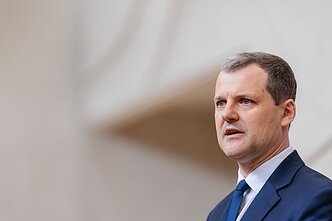
Lithuanian Prime Minister Gintautas Paluckas said on Monday that the country's intelligence services are well aware of Russia's nuclear infrastructure near its borders and that the situation does not currently pose additional threats.

“Our intelligence services likely have more detailed knowledge than the Swedes,” Paluckas told journalists on Monday. “They provide this information to national leaders. There is no indication at this stage that further action or heightened concern is necessary.”
Foreign Minister Kęstutis Budrys also weighed in, stating that while there is no new intelligence that would warrant heightened concern, the existing information is already cause for strategic reflection.
“This is not new. We know the current status well”, Budrys told BNS. “But even the current developments are significant. Russia is openly demonstrating the expansion of its military infrastructure, including its nuclear capabilities”.
Budrys argued that nuclear deterrence remains central to European defence policy.
“This is why nuclear deterrence is topic number one right now,” he said. “I’m glad we have clear reassurances from the United States that the strategy of nuclear deterrence remains firmly in place”.
Broader strategic context
Last November, Russian President Vladimir Putin signed an updated nuclear doctrine that eases the conditions under which Moscow could use nuclear weapons – potentially even in response to a conventional attack supported by a nuclear-armed state.
Former Lithuanian President Dalia Grybauskaitė has argued that nuclear deterrence is losing relevance in modern warfare. However, Minister Budrys disagreed, insisting that it continues to play a critical role in regional security.

NATO’s nuclear umbrella in Europe remains heavily reliant on US capabilities. In an interview with LRT in May, President Gitanas Nausėda’s national security adviser Deividas Matulionis said those assets would only be used in “the most extreme circumstances”.
France is the European Union’s only nuclear-armed state. In March, President Emmanuel Macron said Paris was considering the possibility of extending its nuclear deterrence umbrella to cover European allies.

Newsletter
Every Friday morning.