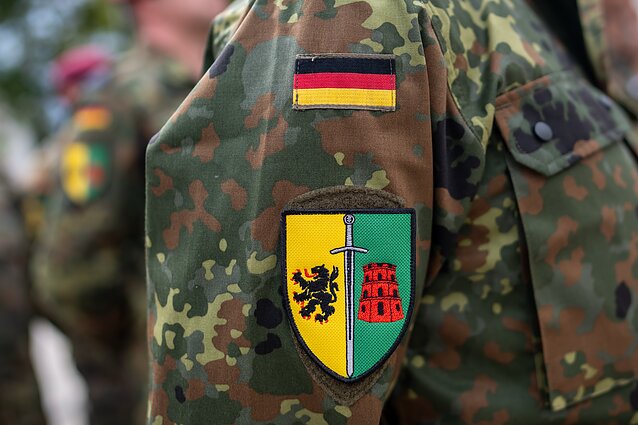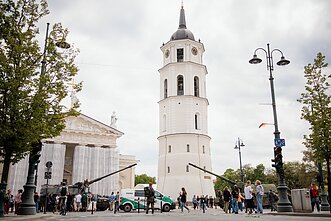














Germany officially inaugurated its 45th Armoured Brigade “Lithuania” on Thursday in Vilnius, marking a historic moment in NATO’s eastern flank defence.
The German unit, known in German as Panzerbrigade 45 “Litauen” – or simply Litauenbrigade and PzBrig 45 in military shorthand – is intended to bolster deterrence and defence in Lithuania and across NATO’s eastern borders.
45th Armoured Brigade “Lithuania”
- What’s its makeup? The Brigade will consist of five battalions, some 5,000 troops and personnel overall, with equipment.
- When will it be deployed? The brigade will be fully deployed in Lithuania by 2027–2028.
- How long will it stay? The brigade’s deployment in Lithuania is open-ended.
Germany and Lithuania agreed in 2023 to station the brigade in Lithuania. However, the plan initially sparked confusion.
The announcement that Germany would assign a brigade to Lithuania’s defence came in the summer of 2022, following a meeting between German Chancellor Olaf Scholz and Lithuanian President Gitanas Nausėda. At the time, Lithuanian officials described a commitment to “create a brigade in Lithuania”, while German officials indicated the unit would remain based in Germany with only command elements deployed to Lithuania and troops deployable as needed.
Following Russia’s full-scale invasion of Ukraine, NATO allies agreed to increase the size of their military contingents in the Baltic states from battalion to brigade level. Germany already leads NATO’s enhanced Forward Presence (eFP) battalion in Lithuania, initially leading to speculation that the new brigade would evolve from this multinational formation.

However, Lithuanian leaders pushed for a stronger commitment: the permanent deployment of the full German brigade, not just equipment or rotating units. Latvia and Estonia made similar requests to Canada and the United Kingdom, respectively, but only Lithuania succeeded in securing such an agreement.
In December 2023, Berlin and Vilnius signed a bilateral agreement under which Germany committed to station the entire brigade – including soldiers’ families – in Lithuania. Lithuania, in turn, pledged to develop the necessary infrastructure and living conditions.
German Defence Minister Boris Pistorius played a key role in the effort, calling the deployment one of the most significant projects of Scholz’s so-called “Zeitenwende,” or historic shift in German defence policy.
German troops relocating to Lithuania are being offered additional financial incentives and will have access to education, health care, and other services in their native language.

Brigade headquarters elements are already operating in Vilnius, with logistics, medical, and communications units beginning to settle in the towns of Nemenčinė and Rokantiškės. Some soldiers will reside in Vilnius and Kaunas, while the brigade’s main base will be located at the Rūdninkai training area.
Along with personnel, Germany will deploy armoured vehicles, tanks, reconnaissance assets, artillery units, air defence systems, and engineering, repair, and medical capabilities.
While the establishment of the brigade presents financial challenges for Lithuania, German media have reported that the Bundeswehr also faces its own issues, including shortages of basic military equipment, funding, and personnel. Nevertheless, both Berlin and Vilnius have emphasised that the deployment will be completed as planned.

Newsletter
Every Friday morning.