













LRT English Newsletter – May 9, 2025.
The Baltic states rained on Putin’s parade by closing their airspace to planes carrying Slovak and Serbian leaders heading to Moscow for the May 9 events.
Estonian Foreign Minister Margus Tsahka said the use of the country’s airspace to attend May 9 events in Russia was “out of the question” and that “Estonia does not intend to support the event in any way”.
Lithuanian President Gitanas Nausėda set a different tone, saying that the airspace was closed over aviation safety risks due to Russia’s GPS “spoofing, jamming”, and “cyber interference”. This is true – the Baltic states have been hit by what authorities say is GPS jamming coming from Russia and Belarus, with over 300 cases recorded in Lithuania in March alone. However, civilian flights continue as normal, with no major safety incidents.
What we know from our sources is that the Lithuanian authorities simply chose to ignore the requests to use the country’s airspace for Russia-bound travel. Baltic News Service wire reported the same information – here.
On the home front, Lithuanian police are bracing for May 9 events, with officials saying incidents are likely. Russia has previously carried out attacks linked with the date, attempting to portray them as grassroots opposition against the Lithuanian government, the State Security Department (VSD) said in a statement.
Meanwhile, despite toppling most of the remaining Russian monuments, the question of moving the remains of Soviet soldiers has largely stalled. Local communities want them out of town centres, with the government promising to move them to cemeteries.
HELLO LANDMINES
Lithuania’s parliament followed a few weeks behind Latvia in voting almost unanimously to leave the Ottawa Convention that bans anti-personnel mines. So what is all this about? Due to Russia’s aggression, all NATO countries bordering Russia (except Norway) are now leaving the landmark treaty that banned the stockpiling and use of anti-personnel mines. This followed the post-Cold War lull in Europe, when full-scale war seemed confined to history books. Elsewhere, scattered landmines would continue to maim and kill civilians decades after fighting had died down.
However, landmines also proved critical in stopping assaults in Ukraine. So, the countries bordering Russia say they need to prepare for any potential invasion. Aid groups have not been happy, saying the decision risks civilian lives in the future. However, countries bordering Russia need to survive a war in the first place, observers note.
The next steps will involve notifying the United Nations. Six months after the formal notice, Lithuania will be able to start stockpiling the weapons. But does this mean the country is about to mine the border? Not exactly, officials say – strict rules will guide when and how they can be deployed. Previously, they said they would only be placed if an attack seemed imminent (and there’s no sign of that).
In other defence news:
– Lithuania has a plan B if the US pulls out of Europe – Germany.
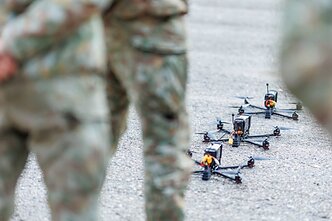
– Vilnius looks at buying Ukrainian Magura sea drones that have reportedly sunk a number of Russian boats and warships, as well as been used to attack installations on Russian-occupied Crimea.
– Lithuania is allocating 300 million euros into its defence industry to get things going, as well as borrowing 400 million euros from the Nordic Investment Bank.
FINTECH PARADISE LOST
You may remember optimistic headlines in the past several years about how Lithuania was vying to become a fintech hub. To some extent, that did take place. But after a series of money laundering and other scandals, some people are having second thoughts. President Nausėda had a say on this issue: “Lithuania wanted to become a fintech paradise, but at the same time, we needed to think about what kind of supervisory system we were capable of offering. It seems to me that the first goal overshadowed the second.”
UNDOCUMENTED MIGRANTS
Irregular migration is back on the agenda – Lithuania has registered dozens of pushbacks for the past several days, with the border guard service (VSAT) reporting several groups detained after they had crossed the border from Belarus. There have been some scuffles – VSAT said their offices had been pelted by rocks and sticks. This is likely a developing story, we will keep an eye on it.
POLITICS
Here are some key political updates over the past week:
– A retired Lithuanian general has founded a populist movement, “Alternative for Lithuania”. We don’t need to tell you where he’s got the inspiration from.
– Despite some protests from the opposition, a presidential adviser was eventually appointed as the country’s auditor general.
– MEP Petras Gražulis, the homophobic firebrand politician, has lost his legal immunity following a request from Lithuanian prosecutors. He’s accused of hate speech but has so far escaped responsibility due to his legal immunity when he was an MP and, later, an MEP.
EDITOR’S PICKS
– You shall be missed, Skype (I can still hear the ringtone).
– What’s it like to be an “amber catcher”?
– What’s it like to survive a “watery hell on earth”?
– There’s a growing market for electromagnetic field (EMF) radiation protection accessories.
– Experience Katarsis at the Eurovision contest.
Would you like to contribute to LRT English? Please send your suggestions, submissions, and pitches to english@lrt.lt
Written by Benas Gerdžiūnas
Edited by Justinas Šuliokas

Newsletter
Every Friday morning.