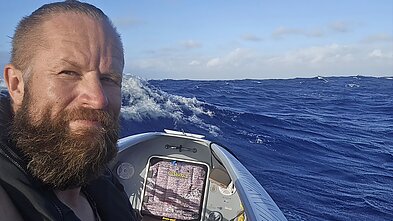
















After multiple exotic and dangerous trips, Aurimas Mockus decided it was time to cross the Pacific Ocean by rowing from San Diego in the United States to Brisbane in Australia. However, he ended up in the epicentre of a typhoon, waiting to be rescued by the Australian military.
“When you’re surrounded by nothing but water and endless distance, the biggest challenge is loneliness,” Mockus says in an interview with LRT.
“There are moments when you really miss your family, your loved ones, the normal life we sometimes try to escape,” he says.
But even after spending four and a half months alone in the ocean, Mockus insists he was not frightened – not by the overwhelming vastness, nor by the kilometres of water beneath him.
“Honestly, I don’t really experience fear. Some might say that’s not normal, that fear is healthy. I know that fear can sometimes make you think more carefully. But before any trip, I try to play chess, so to speak – to plan as many steps ahead as possible,” he says.
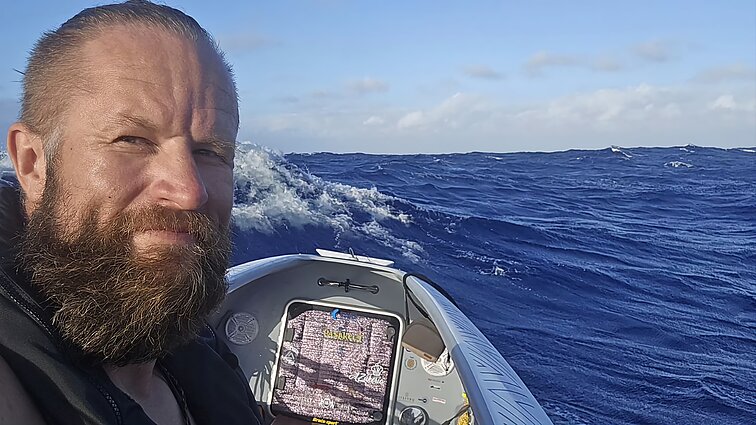
‘A watery hell on earth’
Mockus recalls that 12 hours before encountering a fateful typhoon, his team signalled that it had started moving away from him.
“The typhoon covered the entire Coral Sea. [...] It was moving directly towards Brisbane – exactly where I needed to go. We had calculated that I’d catch the so-called ‘tail’ of the typhoon. [...] Near Guadalcanal, the tail carried me out into the Pacific, so we hoped the favourable wind would take us to Brisbane.
But the batteries ran out, and that day I couldn’t get online. As it turned out, the typhoon had already changed course. It was coming straight at me, and I, totally relaxed, was heading straight into it. And then – it happened. I found myself in the epicentre. of a category four typhoon,” Mockus recalls.
“It was a watery hell on earth. When you don’t even understand what’s happening around you. You just grit your teeth and hope for the best. Everything was going downhill chaotically – devices started failing around, water began to flood the cabin,” says Mockus.
“Everything was smashed around like in a centrifuge, and you’re tossed around with the objects in the boat. On the final day, many of those things went overboard – there was nowhere to put them, and the heavy equipment bouncing around could damage other gear or even injure you,” he adds.
“The first time I hit my head... It was bad. For a moment, I thought I might not drown – but just bleed out. Blood was pouring heavily from my head,” Mockus recalls.
Once he realised that he could no longer get the water out of the boat, he knew it was time to call for help.
“I realised I was sinking. I assessed that the situation was critical, understood that I couldn’t risk it any longer and needed to call for help – at least so they’d know roughly where I was,” he says.
Even after activating the distress signal, Mockus didn’t know whether it had actually worked – the coast guard couldn’t make contact with him. But the rescue team managed to reach his shore-based support crew.
“Since we had already agreed that I would do this only in an absolutely critical situation, they confirmed that a rescue attempt needed to be made – the situation had become serious,” says Mockus.
But even when the coast guard plane arrived, it didn’t find him on the first attempt.

“I saw them flying – while my equipment was still working. A small plane was circling, looking for me, I realised that. I tried sending a distress signal over the radio, as I figured the antennas were broken and it might be hard for them to locate me. After some time, they spotted me,” says Mockus.
Mockus says he never considered the worst-case scenario. He’s an optimist – and he didn’t fully grasp how serious the situation was. Had he known he was in the epicentre of a category four typhoon, he says he would have realised that his chances of survival were far slimmer than he thought.
“I figured it was, at most, category two. And my team told me that to end up in the epicentre, you’d have to be extremely unlucky. Well, it turns out I was extremely unlucky,” he says, smiling.
Rescuers reached Mockus roughly three and a half days after the distress signal.
Although the journey did not end exactly as planned, Mockus crossed the Pacific – and did so at record speed. He now hopes to register two Guinness World Records: the fastest crossing of the Pacific Ocean from any direction, and the fastest crossing from east to west.
“In our case, we can see that we crossed the Pacific in 115 days. The previous fastest crossing took 130 days,” says Mockus.
He calculates that if not for the typhoon and the three days of drifting it caused, he would have needed just three more days to complete the planned route. But the typhoon was unavoidable – and not his first encounter with such storms.
“About 10 days prior, maybe a good week earlier, I’d encountered another typhoon from the opposite direction. But they are completely unpredictable. They disrupt weather patterns so much that forecasts can’t be trusted even half a day ahead – they can change radically,” says Mockus.

Newsletter
Every Friday morning.