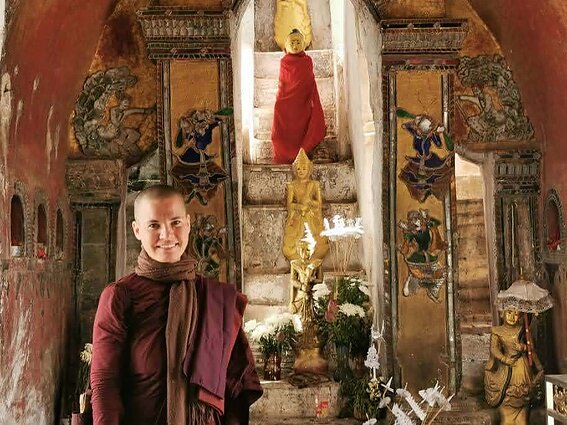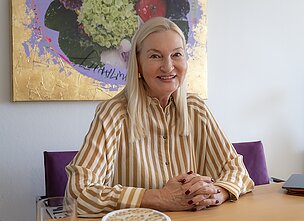














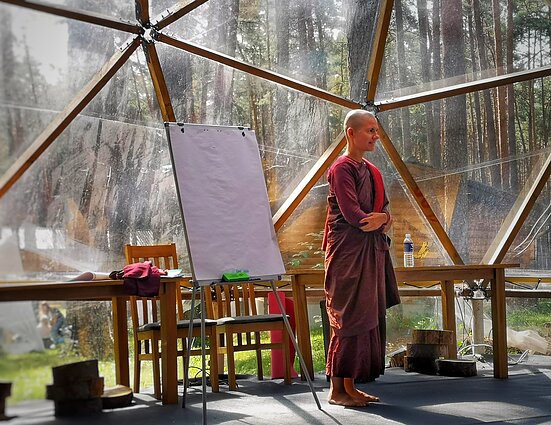
After studying in Myanmar and returning to her hometown of Klaipėda, Piya Dassi shares how she chose to become a Buddhist nun. “I meditated my way into it,” she smiles, adding that she had been seeking spiritual depth since her teenage years.
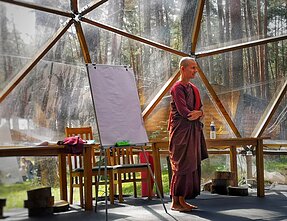
Now, 12 years after taking her monastic vows, Dassi has founded a Buddhist centre in Klaipėda, where people from nearby towns come each evening to escape the stresses of everyday life.
At the time when Dassi was a teenager, spiritual practices and meditation were far less accessible and popular than they are today. Everything changed when she moved to London, where she discovered the opportunity to participate in a 10-day silent meditation retreat.
“Back then, it was nothing like today. I used to run from one lecture or seminar to another. I'd see a flyer on a lamppost and just go. I was going through a lot of inner suffering, which pushed me to take drastic action.
There was a chance to try a 10-day silent meditation retreat. If you’ve never done it before, it’s incredibly intense – 10 hours of meditation a day. Life became much clearer, and I fully immersed myself in the practice when I was 26. Six years later, I became a nun,” she says.
Although Dassi took her vows over a decade ago, her decision was not supported by her family. Her mother, in particular, did not want to hear anything about her daughter’s life as a Buddhist nun.
“When I called my mum to tell her I was becoming a nun the next day, she just said, ‘There she goes again with her ideas.’ My mum got over it, but I didn’t get over being a nun,” Dassi says.
Local generosity left a lasting impression
Taking monastic vows includes the ritual shaving of one’s head. According to Dassi, this symbolises renouncing worldly life – and means no longer worrying about appearances.
“It simplifies life – no need to think about shampoos or styling. It also makes us [Buddhist monks and nuns] more or less the same. The same robes, the same hairstyle – we all look alike. We’re on a path of renunciation, so we let go of how we look. We don’t want to stand out. It’s the exact opposite of what’s valued in the modern world. I think in ancient India it was also just practical – no chance for little creatures to live in your hair,” she laughs.
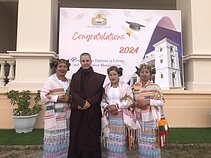
Four years ago, Dassi completed her studies in Pali language and Buddhism at a regional Buddhist university in Shan State, Myanmar. She now translates texts from Pali.
While living in Myanmar, she was moved by the kindness and generosity of the local people. “These are qualities Westerners could really learn from,” Dassi says.
“They don’t grow up as individualists — they have large families and strong traditions. They raise and love each other. They share living spaces. They try not to disturb one another and pay close attention, silently observing so that everyone feels at ease. These are things Westerners have to learn. All of Asia is marked by gratitude and generosity.”
Asked about the importance of meditation in Buddhism, she explains that it is a way to turn inward.
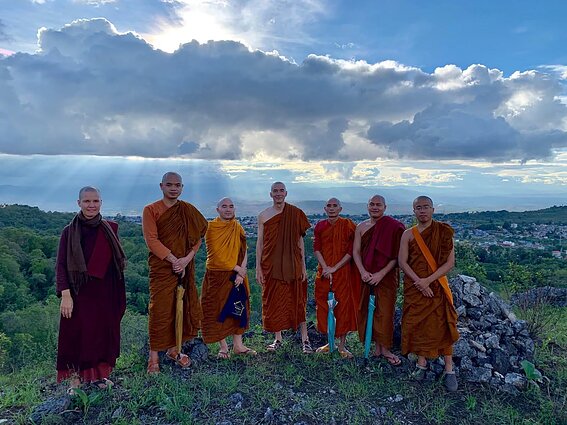
“Buddha taught that the root of all our suffering and misfortune lies within us. Most people tend to blame the outside world. But to see the truth, you have to look inward,” says Dassi.
Meditation gaining popularity in Lithuania
Since returning to Klaipėda four years ago, she notes growing interest in meditation.
“People want to step away from their daily lives and give some time to themselves. For some, it might be a way to get away from their kids, wives or husbands. For others, it’s a space to learn how to live. People come in the evenings to meditate. Klaipėda locals are naturally quite phlegmatic and like to stay home. I also welcome women who want a quiet place to reflect on life, read or meditate,” she explains.
Dassi notes that monastic rules prohibit accepting money directly, but essential items can be donated. She believes money creates a dependency between regular people and monks.
“A monk offers spiritual support, teachings, and their presence. In return, people offer practical help – or as they like to say these days, they collect karma points. For the monk, it's a lesson in how solidarity works,” she says.
Meditation as a path to truth
A Buddhist nun’s day begins around 4:00 in the morning, with chanting and meditation. “Then we have breakfast, do various tasks and organise things. If there’s time and we feel like it, we meditate. In the evening, there’s another formal practice and meditation,” she explains.
Speaking about the increasing number of people drawn to meditation, Dassi cautions that the practice brings up the very things people tend to avoid.
“It’s not something to try just out of curiosity – what comes up can be quite unpleasant. When we start practising, we come face to face with what we’ve been running from – we’re forced to look at the truth. To experience the light, you first have to look at yourself and see all the dirt. People won’t be eager to gaze at the dirt just for fun.
But if someone is suffering, they have no choice. It’s usually people in pain who come. Often, it’s women who say they’ve tried everything else and nothing helped. They need someone to tell them: you have to sit with it,” Dassi says.

Newsletter
Every Friday morning.