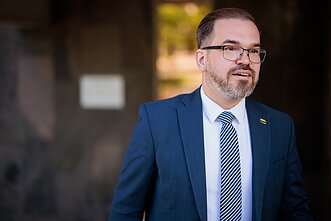








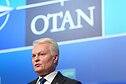





After the United States suspended military aid to Ukraine, Marius Česnulevičius, adviser to the Lithuanian president, says that Washington’s decision did not come as a surprise and that Europe is preparing a response.
“The first thing is that this is not a surprise. The US and President Donald Trump have said in the past that they will try to pressure both sides to come to the negotiating table,” Česnulevičius, President Gitanas Nausėda’s national security adviser, told the Žinių Radijas radio on Tuesday.
“What he is doing is a continuation of the policy that he announced and the signal has been received. This week there will be a European Council summit, there will be a meeting where this issue will certainly be discussed,” he added.
According to Česnulevičius, there is a European consensus that Russia is an existential threat.
“Europe has declared that it will support Ukraine, that it will pool the resources it has in other areas,” the presidential adviser said.

Donald Trump’s decision to halt support for Ukraine was announced on Monday night.
The US administration is thus increasing pressure on Kyiv to start peace negotiations with Russia.
The move comes days after an extraordinary clash between Trump and Ukrainian President Volodymyr Zelensky in front of cameras at the White House.
The New York Times reported that the suspension of military aid took effect immediately and affects hundreds of millions of dollars worth of arms currently being shipped to Ukraine.
European leaders have been discussing for some time how to respond to earlier signals of a change in Washington’s policy.
“It is not true, as some may think, that Europe is asleep and not doing something. There are closed conversations, discussions, calculations, solutions on how to react, and we are currently talking about concrete plans on what we can do to further strengthen Ukraine and [...] weaken Russia, first of all economically,” said Česnulevičius.
It will take “months” for the US decision to withhold aid to be felt on the battlefield in Ukraine, he said, and for Europe to take the necessary decisions in the meantime.
“Maybe they [decisions] will not come in one day as we would like, but we are not at the beginning of the discussions,” the presidential adviser said.
Zelensky said on Monday that he wanted to end the war in his country as soon as possible but urged the West to provide serious security guarantees for Ukraine.
Impetus to act
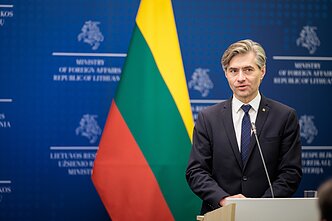
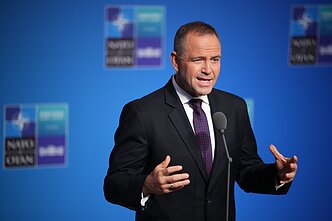
According to Lithuanian Foreign Minister Kęstutis Budrys, the US decision to pause military aid to Ukraine is an impetus for the European Union to act faster.
“The United States has repeatedly urged Europe to increase its military support to Ukraine, including in the context of these efforts to launch peace talks,” he told reporters on Tuesday. “Now is the time for Europe to do so.”
European leaders will meet this week to address the issue, Budrys said.
“This is the place to put money on the table, to put decisions on the table, and Europe can replace the US in terms of support for Ukraine,” the minister said. “Has there been a big change? Yes, things have been accelerated, but the need for Europe to do more and to put decisions on the table has not changed. It just needs to act and move faster.”

Budrys said the EU also needs to continue negotiations with the US to get Washington to resume its support for Kyiv.
“If there is a desire to withdraw certain weapons, ammunition, or enablers, (we need to negotiate) how we can do it in a planned way, without a hard withdrawal, without weakening Ukraine’s ability to defend itself,” he noted.
A special European Council meeting will be held in Brussels on Thursday to discuss Ukraine and European security issues. However, Politico reports that Hungary intends to put the brakes on the additional 20-billion-euro aid package for Ukraine. Such steps by Budapest would not be surprising, according to Budrys.
“We are aware of the obstructions and Hungarian Prime Minister Orban’s preliminary letter that he will not support the decisions. Yes, this is a big obstacle, but it’s not something we cannot overcome,” the foreign minister said.
In his words, the additional support to Ukraine could be provided not by a joint EU decision but through individual national support packages.
“When it comes to support for Ukraine, we can do that as EU25, instead of EU27, as we have one more hesitant country besides Hungary (Slovakia). The 25 countries can put that money together and give that package to Ukraine,” Budrys said.
“We know how much money is needed – at least 20 billion euros, plus what the Americans have given. We need 33–40 billion euros, depending on Ukraine’s costs. This is the amount that is feasible, we distribute it to the countries according to their national income, we have a coefficient, we multiply it, and we see what Lithuania has to do,” he added.
Europe has already earmarked and approved a 60-billion-euro military aid package for Ukraine this year.

Newsletter
Every Friday morning.