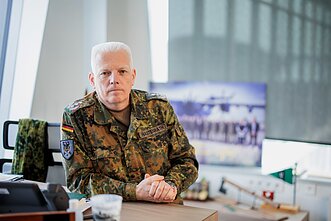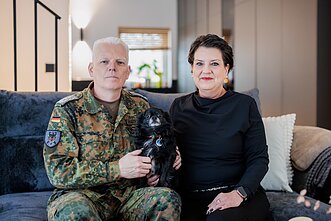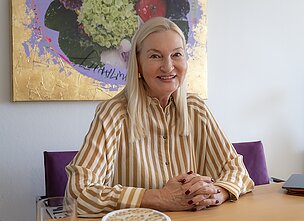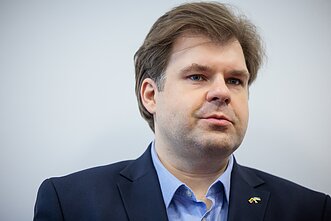


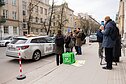
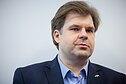



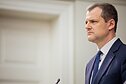



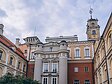

Colonel André Hastenrath, deputy commander of the German Brigade Initial Element, has been living in Vilnius’ Šnipiškės with his wife Verena for almost a year. In an interview with LRT.lt, they talk about integration in Lithuania and how they feel about being part of the historic German military mission.
How is the brigade relocation process going at the moment?
André: We’re in a good phase. We started relocation last April and now there are about 150 soldiers who [...] are responsible for running the brigade headquarters. In total, at the end of the year, there will be 450 troops in Lithuania. It’s good that Germany and Lithuania are sticking to the plan. Whether the infrastructure is ready or not, we’re sticking to it.
Tell us more about the location you chose for the brigade headquarters (on Rinktinės Street in Vilnius). Why did you choose the city centre?
André: It’s not easy to find a place in the capital where several hundred soldiers and civilians can work. We asked the Lithuanian military, and they gave us some suggestions on where to start with the headquarters.
We will be in Rūdninkai in the final composition. But I think the headquarters is a symbol that we are in Vilnius, close to the Lithuanian people. We are more visible. We have made special T-shirts, and you can meet us at the local sports club. It’s a compromise because if we were in the countryside, it would be more convenient from the military side, but it’s a symbol that we’re here and the armoured brigade is coming.
Verena: We also visited the Christmas market. I’m a member of the International Women’s Association in Vilnius, and at the Christmas market we collected donations for charity.
André: Together with the German Embassy, we raised about 12,000 euros for charity. First, it’s a good deed, and our second goal was to show that we are here. We were the only booth with soldiers at the fair. [...]

What do people say to soldiers when they meet them on the street?
André: To be honest, our welcome was incredibly warm. I had the opportunity to work in Lithuania in 2022–2023 when I was in Rukla. I saw already then that the Lithuanian population has a very positive attitude towards the German troops, as they do towards all NATO troops. I can see that the deployment of the brigade is an important symbol for Lithuanians. The Lithuanian army has about 15,000 soldiers, and we will have 5,000. If I am in the city in uniform or military clothing, or if we go for a run in our T-shirts, the reaction of the people is very pleasant. I wish it was the same in Germany.
Do German soldiers want to go to Lithuania to work? How do they imagine the country?
André: It’s difficult to answer because it’s individual. The soldiers who have already been in Lithuania want to come back. Of course, this is not a country that would be on the top of the German holiday charts. If you ask an average person if they have visited Lithuania, I think a lot of them don’t know about it. But our family and friends have been here because we work here. They all say: “Wow, what a spectacular country! There is so much to see.”
The motivation is very different. Germany is creating a new brigade, something that hasn’t happened for 30–40 years. Some just want to be part of this project, part of the security of the eastern flank.
It is known that there will be special schools, kindergartens and even shops for the brigade and their families. What will this infrastructure look like?
André: This is more a question for the future. For the moment, there is a German group called Dinosaurs in a Lithuanian kindergarten. The first child of the group, Ben, came up with the name – he had the honour (smiles). There are already six children in the group, and by the end of March, I think there will be 12.
As far as schools are concerned, currently, the soldiers’ children are going to international schools. In the future, in September, we hope to have a primary school. We will be integrated into the Lithuanian school and we will have a separate section there. There will also be a kindergarten and we will try to create other classes later.

Do soldiers return home often?
André: It depends on whether the soldiers live here with their families or not. For example, we live here, but our daughter stayed in Germany, she is a student. Some go home twice a month.
The German brigade is an armoured brigade, and Lithuania is also going to buy its own tanks, which will be a historic and much-debated step. What advantage can tanks have in modern warfare?
André: [Lithuania is buying] German tanks, that’s a good decision (smiles). There are different arguments. Some say that you have to take into account the terrain. It favours tanks. But the other side says that there are a lot of trees, sand, and water and it is not suitable for tanks. But in the end, if you want to make a military decision, tanks are always needed, just like artillery fire. [...]
Lithuania is buying German Leopard tanks, and this makes it easier to operate – we can use the same infrastructure and ammunition, it is easier to repair and refuel.
What was your own career like? Why did you decide to join the military in the first place?
André: In short, I didn’t really want to study anything after school. I played a lot of sports, and I wanted a job with a lot of challenges and responsibility. My sister worked in a bank, and I didn’t want to do something like that. I tried to get into the police, the border service and the army was my third choice.
In the admissions office, they asked me: where do you want to be? I didn’t know what to say, so I said: wherever the adventure is. I was told mechanised infantry. I agreed, so that was an easy start. I was a company commander, then a battalion commander. I served in missions in Kosovo, Afghanistan, studied economics and warfare in Singapore. My wife and daughter travelled there with me.
And two years ago, I was sent to Lithuania as a contingent commander. I had the honour of being there for a little over six months, and then I spoke to my wife and said, “Let’s go to Lithuania if we get the chance”.
Funnily enough, just then, the German defence minister visited Lithuania and announced that Germany would deploy a brigade here. I was at the airport with my brigade commander at the time, and we were waiting for our flight to Lithuania. I read the news, and I saw: wow, now there will be a German brigade in Lithuania. I want to be here! Then I was chosen to lead the development, and my wife and I decided that we would go together.
Verena, how did you react to this news?
Verena: I was not surprised. We talked about it and I said okay, the next time you go abroad to work, I’ll go with you because our daughter is grown up. She is 22 now. I said okay, it will be a new adventure.

From which parts of Germany do the soldiers come to Lithuania?
André: It’s hard to say. From all over the country.
Verena: When André was working in Germany, our daughter and I were living in Münster, and he was travelling north, south. For ten years, we only saw each other on weekends. Well, ten years later I said: “I want to see you on weekdays, not just weekends.” Weekends are too short to see friends, to travel. Now we have a full week.
André: It may sound strange, but we have more time to be together here than in Germany.
Verena: I have a community of soldiers’ wives here. I’m very proud of that. We started with two, and now there are about 30 of us. We meet once every two to three weeks, we discuss our problems. Not everything is easy, especially when you leave your children and family in Germany. We help each other, we help the newcomers to integrate, we give advice on things like doctors, where to go.
We also have wonderful Lithuanian neighbours. They also help us if we have any questions.
André: Last weekend, I played tennis with our neighbour. He’s 34 or 35 – a bit of an age difference (smiles).
There has been a lot of discussion that it will be difficult for the German soldiers’ spouses to find work and integrate in Lithuania.
André: It’s really difficult, to be honest. On the one hand, we spend on average three years here. And what if your partner or spouse has a job in Germany? They might not want to give it up for three years.
Depending on the profession, you need to know the language. For example, my wife used to work as a consultant in a shop. I know that last year in Lithuania, a decision was made that everyone who works with customers must speak Lithuanian. So, it’s very difficult because if you know German and English, it’s not enough for many jobs. [...] Not everyone is a doctor. For example, some spouses cannot work in Lithuania because they cannot understand their patients. So, there is a language barrier problem that is not easy to overcome. It’s not even about the salary difference between Germany and Lithuania, which also exists. The language issue is more important.
Of course, if you work in IT, maybe it’s easier. But how many people are like that? I would say only a few percent. It’s not easy. But do I have a solution? No.
Verena: Yes, it’s sad. I’m going to be sitting at home this entire month, and if I want to do something, not just see my friends... But I have no choice. Language is a problem.

What percentage of troops come with their families?
André: Around 30 percent – that’s the government’s estimate. At the moment, this percentage is different because a lot of people with families want to see how those who come first are doing. The kindergarten situation is a wonderful example. Mothers hear that everything is great in kindergarten. So, they will be more positive.
Verena: Yes, for example, Ben, the first child in kindergarten, was invited to a birthday party by Lithuanian friends.
André: The children don’t seem to understand anything, but somehow everything is going well.
What can Lithuania and municipalities do to make German soldiers feel more comfortable when they arrive?
André: It’s difficult to answer. We are here to fight, to protect the country. This is a question that comes in third, fourth place. It’s good that there are schools, kindergartens, but we cannot say: we need to do this or that. We have the same problem in Germany – if I go to a supermarket and speak English, not everyone will be able to answer me. It’s not for us to blame anyone now.
But you have to understand that it’s really difficult to settle down with a family. Schools, kindergartens – that will work out. You have fantastic doctors [...]. But social things are difficult.
What reactions do you get from your relatives when you tell them that you are going to Lithuania?
Verena: Sometimes they ask if we are okay, when we are coming back. We say that we are safe, and if something happens here, it is Germany’s business too.
André: Absolutely. There are two aspects: internal security and external security. On the first one, I like living in Vilnius more than, say, Frankfurt. I feel safe. It’s important if you have children, there are no problems in Vilnius or Kaunas. As for the external, I agree with my wife that whatever happens in Lithuania is a war against Europe. We have to be strong to defend it, or rather, I hope that our presence is a strong sign to avoid that.

I would like to ask why your family decided to settle in Šnipiškės, a really special place in Vilnius.
Verena: It’s a funny story. André ruptured his Achilles tendon last January. Then we were planning to move to Lithuania in April or May.
André: It’s good that we make decisions together really quickly (smiles). We made a video call to the agency; they showed us the house. We didn’t know that in Lithuania you could rent a house so quickly. In Germany, you have to wait a long time.
We wouldn’t have thought that in January you could rent a house for April. We thought we were late, but the landlord told us that there was still plenty of time before April.
Do you encounter cultural differences?
Verena: The food is great. I like the borscht soup, the salads, the meat, which is not as expensive as in Germany.
André: Most cars have video recorders. It’s quite unusual. I think we have a different idea of privacy in Germany. Outside, there are cameras every 10 metres... I have nothing to hide, but I feel safer.
Lithuanians are not always open. Sometimes we run and some people look at us suspiciously. But I think it depends on how you grow up and socialise. Young people are a bit different. Other colleagues said that when they say hello in the stairwell to the same person 10 times, they still don’t answer. But then you realise that it’s not rudeness.
It’s the same in Germany. We are from the western part of Germany, but I think there are similarities in East Germany.

In Lithuania, as in Germany, the expansion of compulsory military service is now being considered. Do you think the military is an attractive place for young people?
André: Yes, we are also looking at bringing back compulsory military service. Do I think that is a good decision? Yes, that’s why I am here today.
One thing is that there are many ways to have a career in the military. I also think that the army is a way for a country to grow. Through it, we can all, both men and women, give some time to our country, to unite. In Germany, we had the slogan ‘A Year for Germany’, and I totally agree with it. It is about building a country together and fighting together, especially at the moment, because it is a sign for Russia as well. Ukraine has taught us the same lesson. Everybody fights at the beginning, but who fights a year later, in the second phase of the war? New soldiers are needed. It is not a fun lesson, but it is an important one.

Newsletter
Every Friday morning.