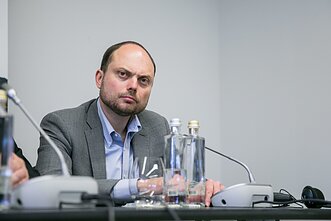






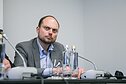


Svetlana Alexievich, Belarusian author, journalist, and Nobel Prize in literature recipient, discusses the war in Ukraine, prospects for Europe and democracy in her own country.
The 76-year-old writer, best known for her oral history books about Soviet soldiers in the Afghanistan war and the victims of the Chernobyl nuclear power plant disaster, is a guest at this year’s Vilnius Book Fair.
It feels like one day we woke up in George Orwell’s world where peace is war, war is peace, democratically elected presidents are called dictators, while real dictators get what they want. What do you think has happened?
That’s a question that no one has an answer to. I don’t even know how [Orwell] managed to predict everything so accurately, but it all turned out exactly as he described.
Maybe he proceeded from human nature or from the current state of the world. I lived in the Soviet era for over 40 years, but even for me it sounded like a scary fable when I first read Orwell.
Either way, this was the case in the past. And today, not only in the former post-Soviet space, but the whole world is changed.
Maybe there is a certain course of history that we don’t quite understand, but in the 1990s we were happy that there was no bloodshed. The empire fell, but without bloodshed.
And it turns out we were naive. Back then, wars were fought only on the margins of the empire, and we thought that was the end of it. But no – the Communists are dead yet it’s all happening again. And there is a lot of blood. In Ukraine, there’s a lot of bloodshed.

There is no answer, we are all confused, especially since the war in Ukraine. I think something has happened to all of us because it is impossible to explain it. The linear course of history, to which we were accustomed, is gone. Now it is impossible to see the future. And I don’t know who will confront it if it’s even worse than Orwell’s.
When the war in Ukraine started, many people said that Putin didn’t understand the Ukrainian people, he underestimated them. And now many are saying that the American president doesn’t understand them either. He thinks that he’s going to say, ‘that’s it, put down your weapons’, and they’ll do it. What can you say about the Ukrainian people? How have they changed over the three years of war?
I’m half Ukrainian myself. My mother is Ukrainian. I spent a lot of time in Ukraine, especially as a teenager. I’m in love with Ukraine, its nature and its people. The embroidered vyshyvankas, the white huts.
When the first Maidan happened, how ecstatic we all were, a million in Kyiv took to the streets, and even the KGB and the army retreated for a while. It was beautiful. Then there was the second Maidan. I admire the Ukrainian people, they made the Maidan happen, they were the first to take the road of freedom and when the whole world thought Ukraine would surrender, it didn’t.
And so much bloodshed. I’d like to see these negotiations be done with Ukraine and with respect for the blood that Ukraine has shed in the name of its freedom. So far, everything that Trump and Putin are doing, I don’t understand it. Neither shows any respect for the spilt Ukrainian blood.

Ukrainians amaze me. There is this long-standing ritual where bodies of people who died in war are transported through villages, and as the convoys are coming, people along the roads kneel and stay like that. Since I’ve seen it, I can’t describe it without tears. Children standing, old people, young people. No, this people cannot be defeated. But it should not be humiliated either.
I think the West is guilty of not giving Ukraine as many weapons as they needed in time, and Putin had time to recover, Putin had time to prepare.
Why do you think Putin is feared in the West?
At first, he kind of intimidated everyone with the prospect of world war three, with dropping the bomb.
I’m not a clairvoyant but I don’t think he would have risked world war three after all. How much of his money is there in Europe, how many properties. I don’t think it’s easy for him to part with them.
And all his cronies. In my opinion, nobody needs this war, not just Ukraine or Europe. But this is politics, this is some kind of gamble. Even now it’s unclear: here comes a new player, Trump, and everything is turned upside down. Before, there was a balance. But a new player comes along and everything changes again. Putin has a new partner with whom he wants to divide the world.

You are talking about specific people – Putin, Trump – but behind them stand nations, the Russian people and the American people. In Lithuania, some say that the Russian people support Putin and the war. Others say that they’re just afraid to say something against the war because those who have spoken out have been shut down. What could you say about the Russian people?
Everyone knows what Putin is. But the Russian people – that’s the big question. I think there are quite a lot of silent people who do not welcome this war. And there are others. I met one such person, he says that he will go to beat the ‘Khokhols’ [a derogatory term in Russian for Ukrainians]. Why will you do it, I asked. ‘I’ll just do it, I don’t like them.’ Is this a normal person? It’s all at the instinctual level.
There’s a journalist, Vladimir Zolkin. He talked a lot with prisoners. Russian people also say terrible things. One of them says: ‘We sat down with my family and decided that I have to go to war. The car is old, the house needs repairs.’ How can one listen to that?
And when Zolkin gives a phone to a captured man and says, ‘Call your parents, your wife, your mum’, it’s frightening to listen to what the wife and the mum say. Sometimes these boys try to tell them: ‘Mum, it's not true what they show on TV. These people are just like us.’ And the wife shouts: ‘Our daughter needs to go to school, bring her a laptop.’ This is the level at which everything is happening.
Human life is worthless, while money is everything?
Yes, you could say that Putin bought off Russia, and it’s strange that he bought it off so easily. I wrote a book about the Afghanistan war called Boys in Zinc. I’ve never seen such depravity in people’s minds as now. Mothers were against communism, against communist bosses, against that war. They’d throw the awards bestowed on their sons back at the generals, saying: ‘Take it, it was gained with blood, I don't need it.’
And now nobody even talks about decorations, they don’t mean much. They give you some money; you sign a contract, and then you get money for ‘work’, that’s what they call it.
And then you hear: ‘We bought a car, and we renovated our house’ – how can you listen to it? When did this happen to people? I don’t know.
They say that propaganda is to blame, but I don’t think that if propaganda and money had come, for example, to Sweden, that people would have gone for it. Remember when they [Russian troops] first entered Ukraine, how they behaved? The cars, the tanks coming back, they were like shops. A washing machine, a carpet, they were carrying everything. It was a scary sight. Why was it so easy to buy off these people? I don’t know.
You also wrote about the Chernobyl disaster, you talked to people who went through it. How did you react to the news that a Russian drone hit the sarcophagus over the Chernobyl reactor?
Yes, that is very scary, very dangerous. I can tell you that a lot of people are concerned about it. I can see it even from the circulation of my books. I wrote a book about Chernobyl [Chernobyl Prayer]. Its sales went up – everyone thought it was history, but it turned out not to be.
I don’t know if there’s going to be world war three, but explosions in nuclear power plants are very dangerous. If there’s fighting there, we can expect an explosion any day.

Yes, there were fears that Putin could blow up the plant, blame it on the Ukrainians, and he wouldn’t even need to waste a nuclear bomb.
I don’t know he’d go that far, not even he. He is a criminal, but he has children too, I hope he is thinking about them because to start a nuclear war just like that… I’d like to believe not even him capable of that.
How do you see Europe today? The history of Europe involved many terrible wars and problems but eventually it came together. Do you think Europe can be united now?
I can only say that I would like it to be united. We would all like that because there is nothing else to pin our hopes on, only Europe. Europe is big, let’s hope that it was not entirely dependent on America. Moreover, Europe has done a lot for Ukraine, because Ukrainians are not only defending themselves, they are defending Europe.
Putin has said many times he might come here, to the Baltic States, Moldova, a lot of independent places he doesn’t like. And so if Europe helps Ukraine, it will also help itself. There are no other ways to defeat Putin.
I’ve always wondered why Russians are so obsessed with the Baltic states. One day they say we are small and insignificant. And the next day they’re throwing tantrums and threatening to deal with us. They also don’t like the fact that there are post-Soviet countries that joined the European Union and NATO.
I think the example of your independence, of course, angers Putin, because you are really independent. Ukraine has just started on this path to independence, and you are independent.

How would you describe the situation in Belarus? You probably stay in touch with ordinary people. How do they live, how do they feel?
It’s very difficult. There were so many people in the streets [after the elections in Belarus in 2020]. And now, seeing that Lukashenko has won, people are beginning to adjust to this life. We shouldn’t think that everyone stays silent only out of fear. Sometimes they stay silent because they simply want to live.
I recently received a letter from a friend. It was some holiday and she says: ‘You know, there are so many people on the street who have money and want to spend it in a fun and good way. Restaurants are all full.’ And the next thing she says: ‘It’s as if you never existed. Half a million people left, but it’s as if you were never here.’
And those who left were, of course, the strongest, the most intelligent people who wanted a different country and knew how to build it. It hurts to hear it, ‘as if you were never here’.
One can only hope that the [remaining] society is not homogenous. There are those who want to spend money and live well. And then there’s the younger generation. I have a granddaughter who is 19. They don’t want to live at home, they all want to leave, it’s their form of protest. They don’t want to die. And they don’t want to be in prison, they don’t want to come out disabled.
Unfortunately, old people have the power, people of a different outlook. We have not had time to take power. And the young are not yet strong enough to change it. The only hope is time. Time cannot be defeated.

Many Belarusians who left the country came to Lithuania, many now live in Vilnius. And many people in Lithuania welcome them. But there are some who are hostile, they say that Belarusians will take away our history, as in the recent controversy over ‘Pahonia’, a heraldic symbol which is very similar to our Vytis. As a Belarusian, what would you tell those Lithuanians? How do Belarusians look at us, at our history?
As far as I know, there’s a lot of debate about this in the academic community. Well, let scholars argue. We must know exactly what we are talking about. But in my opinion, we should have one thing in common, and that thing is freedom. Freedom is the most important thing for us now. You’ll have to defend it, if something happens. We still need to hope at least for a new generation.
Freedom, of course, must be won. But I was not in favour of bloodshed when all this was happening here. My house is located so that I could see military equipment going into the city from five in the morning. Then it was hidden in an alley somewhere. And then people came out with red and white flags [opposition protesters]. And there were young people, a lot of young people. And I thought: ‘We can’t do it.’

Especially when Putin said that ‘we won’t leave Alexander Grigorievich [Lukahsenko]in trouble’, it was clear that you can’t be inviting people into the street to die like in Tiananmen Square. That we needed time to win, that freedom was a long journey. We thought [protest] was a celebration, but I guess it’s not. It’s a long journey, we’re only now realising that.
And back then, even in 2020, we were going to the protests like they were a celebration. We didn’t expect to have such a terrible enemy. We thought we were many, and everything was clear, and he would go away. Yes, we were romantics.
Do you believe that one day Belarus will be a democratic state?
Undoubtedly. The course of history is moving in that direction, towards democracy. On the other hand, there will be stops on the way, there will be steps back. It’s simply a long way. It is a pity that human life is short.