
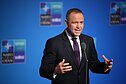












Asta Skaisgirytė, Lithuanian President Gitanas Nausėda’s chief foreign policy adviser, says she sees no problem with the image of a knight on a horse featured on the Belarusian opposition’s “passports”. Her comment came after some conservative politicians criticised the document mock-up for featuring “Lithuanian symbols”.
In Lithuania, the symbol is called Vytis and Pahonia in Belarus. Both derived from the same coat of arms of the Grand Duchy of Lithuania, but some of their elements differ.
“For a long time, the symbol of the Grand Duchy of Lithuania, which also covered the present territory of Belarus, was the Vytis. The Belarusians cannot be condemned for using that historical symbol because they have nothing else, to be honest. All their other symbols are Soviet,” Skaisgirytė told BNS on Thursday.
The mock-up of such a document featuring the knight on a horse was shared by Belarusian opposition leader Sviatlana Tsikhanouskaya on social media earlier this week.

Although this “passport” is not officially recognised as a travel document, the Belarusian politician says she regularly raises this issue in meetings with foreign politicians.
According to Tsikhanouskaya, emigrants who are unable to return to Belarus for political reasons do not have the possibility to obtain identity documents if their passports have expired.
Several members of the opposition conservative Homeland Union–Lithuanian Christian Democrats, including former Defence Minister Laurynas Kasčiūnas, have turned to Foreign Minister Kęstutis Budrys, urging him to ensure that Belarusian documents “do not contain the symbols of the Republic of Lithuania”.
“I find it really funny when you say that the conservatives have decided to complain about it because, as far as I know, Tsikhanouskaya’s office worked very closely with the former government, and they knew what her office was doing,” Skaisgirytė said.

According to her, the problem is that the previous government “did nothing” to ensure that the passports of representatives of Belarusian democratic society are recognised in Lithuania.
“These ‘passports’ are a symbolic marker that a person is a Belarusian who does not live in Belarus but lives abroad and is in favour of democratic ideas. As a marker, it can exist. It is not a travel document of an existing state,” Skaisgirytė said.
“The question is whether to call it a passport, and the question is what kind of symbols this document could feature,” she added.
Remigijus Motuzas, chair of the Seimas Committee on Foreign Affairs, also said Lithuania should not recognise the Belarusian opposition’s passports as he sees their mock-ups as “aspirations aimed at Lithuania’s statehood”.
“We should probably discuss it with the authors as to why they picked that idea. Personally, my initial reaction was negative as this is a kind of aspiration aimed at Lithuania’s statehood or the origins from there,” the social democratic politicians told reporters at the Seimas on Thursday.
“On the other hand, we should talk to the advisers and representatives of Tsikhanouskaya’s office, maybe they just wanted to show that they live here and they are loyal to our symbols,” he added.
Lithuania ‘not involved’
Foreign Minister Budrys noted that the Lithuanian government is not involved in the process of creating “passports” for the Belarusian opposition.
“A democratic and free Belarus is in Lithuania’s national security interest, and Lithuania actively supports the democratic forces in Belarus. The Lithuanian government is not involved in the implementation of the initiative of Belarusian democratic forces on the creation of new passports,” Budrys said in a written comment to BNS on Thursday.
He stressed that Belarusians who reside in Lithuania on humanitarian grounds are issued foreign passports.

According to Budrys, the Vytis is not used on the “passport” of the Belarusian opposition.
“For some time now, propaganda narratives spread by the regime of [Alexander] Lukashenko, which are aimed at creating tension between the Lithuanian and Belarusian democratic forces, have been observed,” Budrys said.
“One of the main propaganda lines is an attempt to pit Lithuanian and Belarusian democratic forces against each other on the issue of state symbols,” he added.
Meanwhile, Lithuania’s Interior Ministry stressed that the Belarusian opposition’s passports have no legal value.
“The above-mentioned documents do not have any legal validity,” the ministry said in a written comment to the Elta news agency on Thursday.
The ministry also noted that no Lithuanian authorities are involved in the initiative of the Belarusian opposition forces to create alternative passports.
This is not the first time that a debate on Belarusian opposition’s “passports” has arisen in Lithuania. At the beginning of last year, photographs of a mock-up of the document, which incorrectly depicted the border between Lithuania and Belarus, were made public.
The Belarusian opposition then said it was a “technical error” and promised to correct it.

Newsletter
Every Friday morning.