















Several hundred Lithuanian households have been paying off an impossible debt in Swiss francs that kept going up instead of down because of the exchange rate. Decade-long litigation with the bank has yet to produce a solution, even though courts have ruled the terms were unfair.
Kamilė’s dream was to live in her own house in a suburb of Vilnius, but she is now living in council housing in the United Kingdom.
“This is not my individual tragedy, it is the tragedy of my entire family,” she tells LRT TV.
Kamilė’s story began in 2008 when Nordea Bank offered to change the currency of her mortgage loan from litas to Swiss francs. It is one of the most stable currencies in the world, she was told, and the interest rate was much lower. At the time, the global financial crisis was putting pressure on the Lithuanian currency and prospects of devaluation had sent interest rates through the roof.
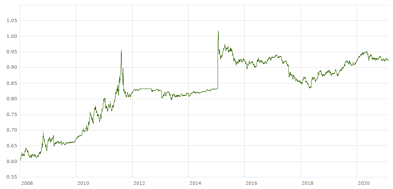
Despite a lower interest rate, however, Kamilė soon realised her debt was going up instead of down because of the exchange rate.
“I had to buy francs every month to pay back my loan in francs. And every month you see the debt going up, up, up, until you start giving away your entire salary to the bank,” she shares.

As the Swiss franc continued to appreciate, her salary was no longer enough. Kamilė’s family sold the apartment they had inherited from their grandparents. Later, they sold her parents’ house. The farmhouse, for which she took out the mortgage, was also gone.
Only then, 14 years later, could she repay her debt to the bank.
Kamilė’s parents now live in a one-room flat and she herself has emigrated. She says she has no idea how much she ended up paying the bank above the original debt.
“It was about 350,000 francs, I think. And since I was repaying it in three chunks and after selling three houses, I can’t even tell you what it turned into. Since my dad and mum were involved, I was just afraid that they’d be thrown out into the street,” she laments.
Some other people in a similar situation are still paying the loans they took out before the 2008 financial crisis.
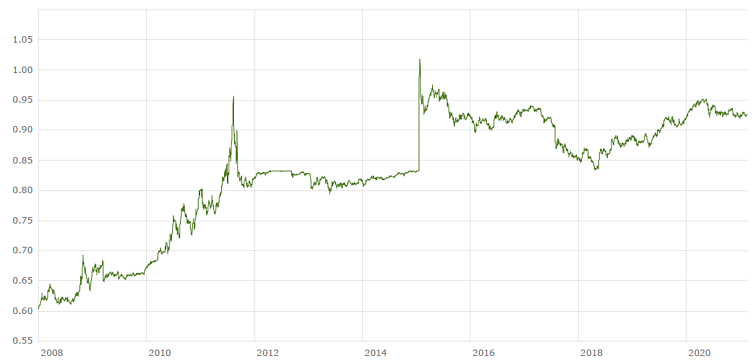
“We can’t sleep at night, because the more we pay, the more the franc goes up,” says another man interviewed by LRT TV. “Donald Trump’s trade wars have sent the franc up again, or rather the euro down. As the euro went down against the franc, six months worth of payments just disappeared.”
The man, who does not want to reveal his identity, says that if he sold his home, he would have nowhere to live. And he would still not have enough money to repay the loan.
Indeed, some debtors discover that, after making repayments for years, they discover that their remaining debt is now bigger than it was in the beginning, says Marius Jansonas, vice president of the Consumer Alliance.
“You know, you took out 100,000 and 10 years later you have 120,000 left. Even though you were paying back for 10 years. This is what’s happening,” he says.
Nineteen households have decided to take legal action against the bank. The lawyer representing them says they first tried to talk to the bank that issued the loans in francs.

The talks broke down and, since 2017, they have been litigating. The case has reached the Supreme Court twice and lower courts four times. The European Court of Justice has also weighed in.
It has been established that the bank was aware of the appreciation of the Swiss franc when issuing the loans but did not disclose this to its customers, which is unfair, according to Marius Navickas, the lawyer representing the debtors.
“The bank’s claims that it was beneficial to borrow in Swiss francs in turbulent times were outright lies,” stresses the lawyer.
The case is now on its way to the Supreme Court again.
“Now that we have a ruling that the terms of the contracts are unfair, the case is about how to get the clients back to the status quo ante,” says Navickas.
At that time, Nordea Bank, now Luminor, was issuing loans in francs for a few months. When the franc started to appreciate, it stopped. In all, it issued around 300 franc-denominated loans.
Jansonas, of the Consumer Alliance, says that the small number of loans may have been part of the problem. In other countries, where the situation affected more people, governments weighed in to settle the issue. In Lithuania, he says, the intervention of the banking authorities would also be welcome.
“My question is: where are they, where are their functions? When people are up against a wall, the courts cannot help. I don’t know – the Bank of Lithuania, the Ministry of Finance, who should help?” Jansonas asks.
Luminor Bank has said it does not comment on ongoing legal cases.

Newsletter
Every Friday morning.