







Recent comments from the prime minister and the parliament speaker sparked speculations about the government stepping back from its commitment to have military spending of at least 5 percent.
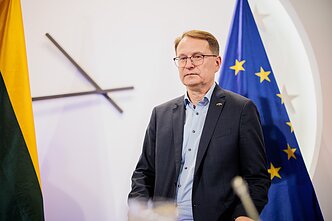
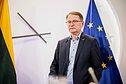
Prime Minister Gintautas Paluckas said after a coalition council meeting on Monday that the target of spending 5–6 percent of GDP on defence over the coming five years is not codified in any agreement, “neither in the government programme or in the coalition agreement”.
His position was later echoed by Parliament Speaker Saulius Skvernelis, saying that there is currently no document on the goal of increasing defence spending.
Their statements raised speculation that the government is moderating its plans that would require up to 12 billion euros by 2030.
The plan was announced in January by President Gitanas Nausėda after a meeting of the so-called State Defence Council (VGT). The council includes the president, the prime minister, the parliament speaker, the defence minister, and the chief of defence.
According to the president, the additional military spending is needed to implement Lithuania’s plans to have a national division in its armed forces by 2030.
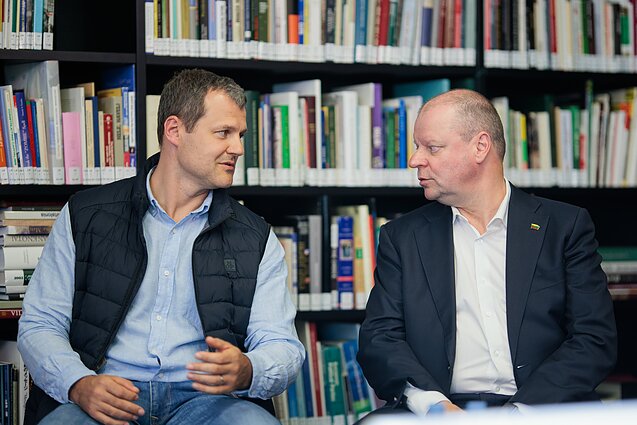
Frederikas Jansonas, and adviser to President Nausėda, says he does not believe that Paluckas’ and Skvernelis’ comments on Monday signal a change of heart.
“I really don’t think that Mr Paluckas is stepping back from Lithuania’s defence needs and has suddenly started thinking that Lithuania doesn’t need a national army division by 2030. This is not the case,” Jansonas told the radio Žiniu Radijas on Tuesday.
According to him, the significant increase in defence spending is not included in the government programme, which was approved in December, simply because the decision based on military advice was made later.
Jansonas says that both Prime Minister Paluckas and Parliament Speaker Skvernelis were briefed on the military advice and the army’s arguments, and the decision was made unanimously by the VST.
One source of debate is where the money should come from. Both the president and the government have ruled out raising taxes, saying much of the funds will be borrowed.
Commenting on Paluckas’ remarks that spending targets cannot be set without explaining the sources of funding, Jansonas said that the country needs the military division.

“In this case, the need is very clear, the division needs 12-14 billion euros [by 2030], we have to raise it because it is vital for Lithuania’s future,” the presidential adviser said.
US President Donald Trump recently stated that he plans to push NATO countries to spend 5 percent of GDP on the military.
Asked why President Nausėda expressed Lithuania’s needs as percentages of GDP rather than specific sums, Jansonas said that “the whole world calculates this way”.
“This is a figure that everybody understands. A billion will seem like a lot to you, it will seem ridiculously small to Donald Trump,” Jansonas said, stressing that the target was not set to please the incoming US administration.
Parliament Speaker Skvernelis also said on Tuesday that the ruling coalition remains committed to the 5–6 percent military spending target.
“I don’t think this is a retreat,” he told reporters on Tuesday in comment on PM Paluckas’ earlier statements. “At least I didn’t see it as a retreat.”

Newsletter
Every Friday morning.