
















On February 9, the Baltic states will synchronise their electricity grids with continental Europe and disconnect from the Moscow-centred zone.
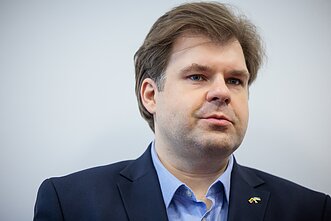
This crowns the process that started in 2007, when the prime ministers of Lithuania, Latvia, and Estonia confirmed their strategic ambition to do so. But former Energy Minister Arvydas Sekmokas says the idea had been entertained even earlier, after Lithuania started building the LitPol Link electric connection with Poland.
“I would compare synchronisation in the energy sector to March 11 [1990], the day of restoration of Lithuania’s independence,” he tells LRT.lt.
Tomas Jermalavičius, head of research at the International Centre for Defence and Security in Estonia, also noted the importance of the event, but added that the Baltic countries need to continue to increase their electricity generation capacity.
Long road
On February 8, Lithuania and the other two Baltic states are due to undergo isolated operation tests of their electricity systems, and the following day they are due to connect their grids to continental Europe.
Until now, the countries have operated in the so-called BRELL ring (Belarus, Russia, Estonia, Latvia, and Lithuania), where Moscow is responsible for maintaining the 50 hertz frequency.
Lithuania wanted to leave this system for many years. In 2012, the Seimas, its parliament, adopted a law to consolidate the goal of integrating the country’s electricity system into the continental European grid.
As former Energy Minister Dainius Kreivys recalls, progress then slowed down and hadn’t picked up before 2018. During the 2016–2020 term, the Ministry of Energy was headed by Žygimantas Vaičiūnas, who is now once again minister of energy.

In January 2019, the European Commission allocated the maximum possible funding for the purpose, 75% of the value of the first phase of the synchronisation projects.
In total, the planned investments by the Lithuanian, Latvian, Estonian and Polish transmission system operators (TSOs), including into the Lithuanian-Polish Harmony Link and other projects to be completed after this month’s synchronisation, are estimated to amount to around €1.6 billion, of which around €1.2 billion would be funded by the EU.
Lithuania has implemented 14 synchronisation projects between 2019 and 2025, which have been granted the status of a project of special national interest.
The synchronous grid of Continental Europe (UCTE) that the Baltics want to join started with synchronisation projects right after the Second World War and included Austria, Belgium, France, West Germany, Italy, Luxembourg, and Hungary. After the first phase, in 1968, more countries synchronised with the system: Portugal, Spain, Yugoslavia, Greece, and the Netherlands. In 1995, after the collapse of the Soviet Union, Poland, the Czech Republic, and Slovakia decided to join. A little later, so did Bulgaria and Romania.
Link with Poland
Former Energy Minister Sekmokas says that the idea of synchronising the Baltic grids with Continental Europe, initially seen as unrealistic, started to show promise with the development of the LitPol Link cable. A feasibility study was carried out in 2000 and operations started in 2015.
“That power line evolved in our mind into synchronisation. That was the logic behind the idea,” he says.
Another former Energy Minister Kreivys notes that it was during Sekmokas’s 2008–2012 term that synchronisation was put firmly on the country’s political agenda.

“Until then, the idea was considered impossible by energy experts. But with Sekmokas, the processes that led to synchronisation started. The construction of interconnectors started, the process was coordinated with the Latvians, Estonians, etc,” he says.
For his part, Sekmokas agrees that the synchronisation processes took too long.
“Lithuania has had different governments and there was not enough ownership of the project. Each party wanted to prioritise their own projects. This is a normal political competition, not only in Lithuania,” he says.
There was not always enough enthusiasm from Europe, Sekmokas adds.
“Synchronisation required a certain amount of European approval, from the European Commission, ENTSO-E, the organisation of European transmission system operators.”

He thinks that Europe’s relations with Russia were also a fctor.
“At the time when this process started, Europe’s relations with Russia were still very warm. Europe was dependent on Russian gas and oil, and nobody wanted to spoil relations too much. The EC insisted that the disconnection could and should only take place with Russia’s agreement, and Russia has completely ignored those negotiations on synchronisation since 2019. Relations had started to deteriorate, but inertia slowed down the process,” Sekmokas says.
Security component
But what exactly are the benefits of disconnecting from BRELL and synchronising with Continental European grids?
Security expert Jermalavičius, of the International Centre for Defence and Security in Estonia, notes that any dependence on “an enemy country” is detrimental to national security.
“Especially if it is in such a sensitive and basic sector as electricity. I think there is no doubt here that the possibility for Moscow to affect the basic function of our state – stability of supply – must be eliminated. In any case, the theoretical possibility has always been there and is increasingly moving towards the practical possibility. In other words, just because a rifle on the wall hasn’t fired yet, doesn’t mean it never will,” he says.
According to Jermalavičius, Russia’s invasion of Ukraine started just as the country was trying to connect to the European electricity grid.

“Russia has tried to exploit a less stable situation. That Russia could do something about Ukraine’s electricity grid was evident at the beginning of the war. It was a concrete threat,” Jermalavičius says.
Reports by his think tank, he notes, identified threats to the Baltic states related to the electricity grid back in 2018.
“Russia, on its side, was taking steps to prepare for desynchronisation and maybe even to get ahead of us, to be ready to disconnect before us. Their network in Kaliningrad has been ring-fenced, isolated from our networks. In the Northeast, there were moves, a kind of race, you could say,” he notes.
Looking ahead, Jermalavičius thinks the Baltic countries should increase their electric production capacity at competitive prices.
“Yes, we have spare capacity, but it is not competitive because of gas prices and it is not good for the climate. Another dependency is on offshore cables. As we can see, it is a risky game. We have to be aware of that – that we can’t protect those cables all the time,” he says. “So investment should go into renewables, perhaps nuclear power.”

Newsletter
Every Friday morning.