











Lithuania’s top general and commander of the armed forces, Raimundas Vaikšnoras, said the country should be ready for total defence, as well as to strike inside Russia if war was imminent.
In an interview with LRT.lt, the commander talks about the country’s view towards a potential armed conflict and the concept of society-wide mobilisation.
Are we a difficult country to defend? Before we joined NATO, it was constantly emphasised that the Baltic states lacked strategic depth. How do we and our partners get around this problem?
Geography determines a lot, you do not choose your neighbours – we have what we have. Over the centuries, we have been at a crossroads between South and North, East and West. But when we joined the NATO alliance, everything changed.
The problem was that at that time our economic indicators were not good, so we relaxed when we joined NATO and we did not pay enough attention to defence. We thought that NATO would come and defend us, and we did not invest in defence ourselves – and Russia itself was different.
Moreover, nobody thought that Belarus would sink to the point where the survival of its dictatorship would depend solely on Russia.
The war in Ukraine has shown that no country is safe with such an aggressive neighbour. Even Sweden and Finland, which had declared neutrality for years, joined NATO, which automatically changed our geography.
In terms of strategic depth, there are limits to how far we can retreat or manoeuvre, but we have allies. Compared to Israel and Ukraine, we have a geographical vulnerability, but because we are part of the alliance, we are in a different league.
Of course, there is a threat that it would take time to crack A2AD's [Anti-access/area denial] capability in Kaliningrad, but it would not be like Ukraine, where they do not have air superiority.
NATO has regional plans, and the allies will come with all their might, with all their strength. It will be a matter of hours before we have that air supremacy again, and automatically everything in the air can be destroyed before it gets to Lithuania's borders – [...] fighter jets, Shahed drones, ballistic missiles.
But all this would be after the activation of Article 5 of the Washington Treaty.
Yes, that is right – the activation of Article 5 gives a complete 100 percent guarantee. Until it is activated, because political decisions in capitals can take time, we will need to respond to incidents ourselves, which is why we need to strengthen our military to have the necessary tools in our toolbox.
We must not be afraid to have and use escalatory instruments that might de-escalate the conflict itself. What do I have in mind? We must be able to strike deep into the enemy's rear, so that we are not fighting a war on our territory, but rather on their territory. There are certain conditions for that.
What are those conditions? Because not every incident is aggression.
This is where the art of establishing the fact of aggression comes in. The Russians have a very sophisticated ability to teeter on the edge – all those cable cuts, the damage to gas pipelines, the explosions in warehouses.
It is very difficult to attribute where all this is coming from, whether it is an accident or aggression. That will be the biggest challenge – to identify exactly. That is why the new government and the defence minister are saying that the allocation and focus on intelligence and counterintelligence must be increased.
It is easy to trace the missiles and easy to hit the place from which they were launched. It is enough for a missile to be over our airspace, for us to shoot it down, and for us to fire another missile at a military facility in Moscow.
Does this mean that we could, if necessary, do something similar to what Turkey did in 2015 when it shot down a Russian Su-26 aircraft?
There were multiple violations and the Turkish air defences were ready. It is all in the hands of the politicians. I would say that we need to have the tools to grow our muscles. We often forget Article 3 of the NATO treaty, that each country must be able to defend itself, invest in its defence, and then collective defence kicks in.
Of course, one incident could be unintentional. We, Lithuanians, are fierce and determined, but to trigger World War Three would be quite a sensitive issue.
We need to have a spine, but the question is in what form. So far, we are limited to diplomatic notes, which are also an important part of diplomatic language. Launching one missile will not solve anything, but if we see that relations are getting worse, that violations are persistent, that we are being bullied, then, based on military advice, politicians will make decisions – whether or not to [assign] blame and whether or not to wait for consultations with the allied capitals, because we have the right to defend ourselves.

Who would make that decision in the end?
In peacetime, only politicians. But we are giving military advice, and we need to assess what the side effects might be because then things can conspire to produce effects that we never imagined.
If the aggression is obvious, there is no need for any decision, I shoot on sight. But if it's close to the threshold, then it has to be considered, because it is possible to make the wrong decision and it can have the wrong effect – not to protect people, but to provoke something bigger.
Unlike Ukraine, we are a small country, sandwiched between Kaliningrad and Belarus. We would not have so much time to prepare to react, because the potential adversary does not need to mobilise such a large force [as around Ukraine] to attack us – some of it is already there.
The time between warning and mobilisation of reserves, mobilisation of capabilities, would be shorter. But the start of the war in Ukraine has shown that allied intelligence is working quite effectively. If even the Ukrainians had received the intelligence, then we, as allies, would have received the warning much earlier.
We can see what is happening on Belarusian territory several hundred kilometres away. When additional troops arrive for exercises – and there has been more than one occasion – we increase our level of vigilance.
If it is an armoured tank battalion, it is not a major threat, but we can also organise our exercises and training at the same time. It is also not a cause for concern when we see more equipment at railway stations.
[...] If we see that the unit [coming for training near our border] is larger than a battalion, bells, whistles, indications, and warnings go off automatically, and we act according to the algorithms – we reshuffle our exercises so that we can have a similar capacity on the ground. This is part of the regular process, all countries do it.
The good thing is that the Russian military in Kaliningrad has lost a lot of blood, most of the infantry is fighting in Ukraine. Although they are rotating them a bit, there is a very small number left, so it would be difficult to talk about any serious [escalation].
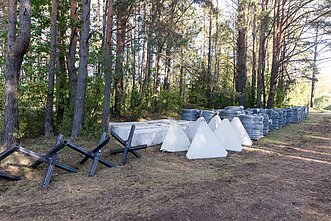
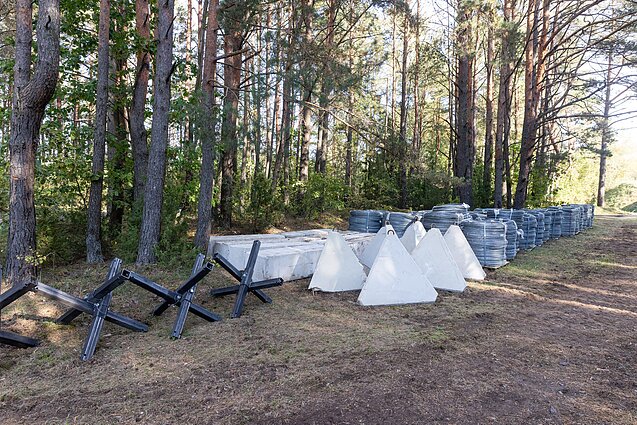
There may be some opportunistic things, but at the moment, while the Ukrainians are fighting, while they are crushing the Russians by the thousands every day, we have time to prepare better. [This is why] we are now creating the counter-mobility parks.

Valdemaras Rupšys, the former head of defence, was quite critical of counter-mobility parks, saying it was merely used to show to the public that something was being done, even if he was not opposed to the idea itself.
I think the criticism was taken out of context. He was not against it, I do not want to quote and discuss what the former commander had in mind, but I think [he was more critical] about fortifying the whole 700-kilometre border.
You could have a wall like the one between North Korea and South Korea, or an Iron Curtain like in Soviet times. But this would mean very big money, we are talking about 600 million euros over ten years, which we could use to create other capacities.
Those counter-mobility parks are a real lifesaver because we concentrate the necessary assets closer to the border so that the commander of the unit responsible for defending the area does not have to transport them for hundreds of kilometres.
If we want to fortify the whole border, we can do it very quickly – within a week or two if we get indications [of a looming crisis]. We can do it with our existing capacity or by requisitioning excavators and bulldozers from construction companies.
But this is private land, so the legal basis needs to be settled in peacetime. Look at what happened with Via Baltica or Rail Baltica projects and the heated discussions surrounding them when it came down to taking a piece of land in the national interest. Or what happened with the [contentious projects for] military training areas in Šilalė and Tauragė? Imagine if we started digging trenches now.
We will take that land if we need it, but not before. Once we have done that, once we have fleets of counter-mobility vehicles, once we have bought mines, we will be able to defend in a complex way with anti-tank and other measures.
Just placing dragon’s teeth, digging a trench [is useless] if you don't defend them – it will stop the enemy for maybe ten minutes. My point of view – and I think that of the commander before me – is that you don't need to fortify everything because it costs a lot of time and money.
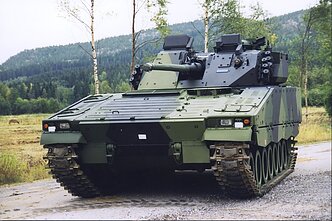
These days we need drones, we need electronic warfare measures, we need armoured vehicles to manoeuvre, to dislodge the enemy. If we say that we will not give up one centimetre of our land, then those tools must be on our priority list.
The former defence minister, Laurynas Kasčiūnas, said that a potential war between the alliance and Moscow would not be like the one in Ukraine, it would be manoeuvre warfare. What does this mean in practice?
We divide the theatre of operations into deep, close, and rear areas. Using different types of weapons, from artillery to drones that destroy equipment 20 to 30 kilometres away, you retreat, then hammer the enemy, and prepare counter-attacks by hitting the enemy in the flanks. This means constant movement, not standing still, and in some cases, you can give up a little territory so that you can strike back and thus dislodge the enemy, which is what the Ukrainians are doing successfully.
When you are in the trenches, as in the First World War, you are a sitting duck, very easy to be picked off. There is a bit of that in Ukraine, where neither side can break through the defences. But the Russians have now set up assault teams of 5 to 6 people, who crawl through the gaps like cockroaches, breaking through the defences, then dig in. The Ukrainians have an antidote to this – FPV drones, which attack every single one of those people.
Because what happened at the beginning of the war? There were not so many means, it was too expensive to use an expensive missile to attack each soldier, so they were targeting areas of concentration of people or equipment.
But technology has developed and become cheaper: civilians now assemble drones in warehouses and deliver them by the thousands to the frontline. It is now possible to hunt down even a single soldier, because, for the Ukrainians, every Russian soldier is a threat. Not to mention the equipment – before it was only tanks, armoured vehicles, and cars that were destroyed, but now it is every moving object. The Russians are doing the same.
So, we must have a whole system, and tanks are one of the components that can help us counterattack and dislodge the enemy if we want to regain our ground.

As long as there are no “boots on the ground”, you can say whatever you want, but you still do not control the territory. There was once an air campaign in Libya – bombing during the day, while local fighters snuck out at night to do their own thing. As long as there is no infantry on the ground, you have no control.
[...] We are in NATO, we have allies in Lithuania, we have an air policing mission, we have an armoured American battalion with an artillery battalion, we have a NATO Enhanced Forward Presence Battlegroup, we have a German brigade coming. We have a big umbrella of systems and we are also trying to negotiate a rotational air defence model.
When the German brigade is fully here in Lithuania, how will it interact with the Lithuanian Armed Forces? In other words, if there is a crisis, but Article 5 of the NATO Treaty has not yet been activated, we, Lithuania, immediately defend ourselves. What does the German brigade do in such a scenario?
It would be necessary to model this, I would not like to speculate. [...] Clearly, it will be according to their decision-making chain. The fact is that the final instructions to do something will come from their capital. But every unit abroad has the right and duty to defend itself.
Hypothetically, there could be a situation where bombs are falling all around and nothing is falling where the German, American, or Portuguese contingent is based. In that case, what are they defending themselves against?
When we talk to the German army commander, I can see that the Germans have a very clear attitude, even taking their families with them to make them feel better. They say that for years they have been the takers of security and now they want to be the providers of security.
We have to take whatever means we can to convince the enemy not to try to [attack]. That is why we must have in our toolbox the means to hit back as soon as a soldier crosses our border, as soon as a tank comes within a metre of our territory, we must start defending ourselves.
At the same time, we must be able to strike hard at their territory, at their concentration areas, at their hubs, at their centres, at their railway junctions, at the places where they have concentrated their supplies, and maybe even at military installations in the capitals.
Moscow and Minsk?
Well, whoever the enemy will be. We have to hit back hard and they need to know it. Even though we are small, it is better to die honourably, but not to surrender, not to allow our resolve to be doubted. That is the task of all of us.
I wanted to ask about the civilian population in a potential conventional war. Is it better for civilians to leave or to stay?
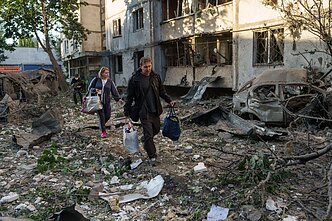
We must not doubt or delude ourselves: if Russia has the determination and the will to attack Lithuania, we will be worse off than Ukrainians in Bucha or Irpin. They will spare no one – neither young nor old, neither women nor children. They still consider the Ukrainians to be Slavs, and we are complete fascists to them.
If they manage to occupy anything, the trenches will be full of corpses. This must give us a very militant attitude, we must have the attitude that every citizen is like a weapon, whether he is armed or not. Everyone can be a supporter or a helper of the military.
There should be no civilians in the frontline. Then there is no need for special protection, no need to evacuate them, no need to waste precious time and resources.
But on the home front, there is a great deal of work that needs to be done for the military to be able to fight successfully. There are saboteurs to fight, there are strategic installations to protect. Also energy installations have to be operational, water supply needs to be protected and food produced. Someone will also have to take care of the refugees, as well as dig trenches in the second and third lines.
What do I want to say? We are approaching the principle of universal defence. Our nation is quite small, so we have to mobilise – every man is a weapon. Everyone will have to do something – cook food, dress wounds, bring ammunition, if necessary. The more we have people with different functions, the stronger we will be. Again, this acts as a deterrent.
[...] To sum up, if it is the front lines, it is better to keep it as empty as possible, to evacuate all the people and the animals, but all the other people must support our total war and our survival. The war in Ukraine has shown that Russia is a brutal, ruthless country that will spare no one.

We talk a lot about the will to defend ourselves, which is a very complex thing that relates to the psychological state of society. A study by researchers at the Institute of International Relations and Political Science at Vilnius University found that 17% of women and 44% of men would take up arms, while 56% of women and 62% of men would not. However, a Defence Ministry survey showed that 61% of respondents do not plan to join the country’s defence in peacetime. What does that say about our will to defend ourselves?
I can answer from the military side – neither our hands nor our knees will tremble. For the sake of society, we need to mobilise all of us. We, the military, can lead by example. But we need to watch what we say, what politicians say about defence. I understand that we are doing well so far, everyone is declaring their commitment and more money is planned for defence.
As we move further towards total defence, more and more initiatives are emerging. The Riflemen’s Union is expanding very strongly, and there will be a change in the law so that, alongside the combat members of the Riflemen’s Union, we will have units assigned to the Commandant’s Offices, as well as specialists like the medics, the cooks and all the others who will be supporting the military. We are now integrating them into the exercises.
There will also be the service of the Commandant’s Offices. There are people who could not do compulsory military service, but are now saying – “where is my rifle?” We are giving those people the opportunity to find their place and make a meaningful contribution to national defence.
For me, as the commander of the military, we want to make sure that our rearguard is protected. It will be up to the Commandant’s Office units, together with the police, to ensure order and discipline, to protect roads, bridges, and strategic installations, and to catch subversives in the rear areas where they would try to create havoc.
You do not necessarily have to go to war with a gun, other times you have to do your job – as an engineer, a medic, or a teacher.

Newsletter
Every Friday morning.