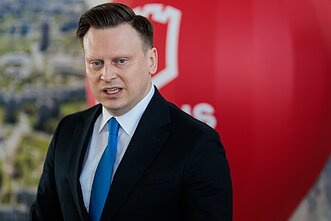








Lithuanian lawmakers approved the 19th government’s programme on Thursday. Social Democratic Prime Minister Gintautas Paluckas and 14 ministers of his center-left cabinet were also sworn in at the parliament.
Eighty-five MPs voted in favour of the government programme, 14 were against, and 28 abstained.
“This programme is certainly a populist one as it affects the majority of people, our society, and not an elitist one, which by definition would apply to a few or a minority,” Paluckas underlined.
Paluckas said he hopes his government will not face the shocks of the previous government, which included the Covid-19 pandemic, the influx of irregular migrants, and the war in Ukraine.
The prime minister-designate said many of the decisions made by the previous government would have to be reviewed, especially in terms of the way they would be funded. He also promised that a culture of dialogue will prevail in his government, “which will apply to all ministries”.
The opposition groups in the Seimas said they did not support the centre-left government’s programme because of the lack of guarantees that the cabinet would deliver on its promises.

They argue that the programme includes a modest increase in budget revenue – around 70 million euros – while the foreseen expenditure needs billions of euros.
Defence, roads, Ukraine
The government programme foresees at least 3.5 percent of GDP in defence funding, in line with military advice. Particular attention is to be paid to the deployment of the German brigade in Lithuania by 2027, as well as to the “manning and equipping” the national division, “the acquisition and formation of a weapons and ammunition reserve, as well as ensuring training and interoperability with allies”.
“We will support Ukraine until its victory and beyond. We will provide Ukraine with full support to accelerate its accession to the European Union and NATO,” the new government’s draft programme reads.
“As the geopolitical situation deteriorates further, we will further expand our military support for Ukraine to reach at least 0.25 percent of GDP,” it adds.
The incoming government calls China “a growing challenge” to Lithuania’s foreign and security policy and vows to develop economic and cultural ties with Taiwan.
It plans to tax the highest incomes at progressive rates, regardless of the type of income, and to link the personal income tax rate to the amount of income received, also regardless of the source.
The new government vows to ensure wage growth in both the public and private sectors, to increase the non-taxable income level each year “with a view to bringing it as close as possible to the minimum monthly wage”.
The government also vows to raise people’s incomes, increase funding for roads, cut red tape, and tighten control over the private education and health sectors.
New cabinet
Following the approval of the government programme, the cabinet of ministers led by Social Democrat Paluckas was sworn in at the Seimas.

Povilas Poderskis took the oath as environment minister, Žygimantas Vaičiūnas as energy minister, Lukas Savickas as economy and innovation minister, Rimantas Šadžius as finance minister, Dovilė Šakalienė as defence minister, Šarūnas Birutis as culture minister, Inga Ruginienė as social security and labour minister, Eugenijus Sabutis as transport minister, Marija Jakubauskienė as health minister, Raminta Popovienė as education, science and sport minister, Rimantas Mockus as justice minister, Kęstutis Budrys as foreign minister, Vladislav Kondratovič as interior minister, and Ignas Hofmanas as agriculture minister.
The centre-left ruling coalition of the Lithuanian Social Democratic Party (LSDP), the Democratic Union “For Lithuania”, and the Nemunas Dawn party has 86 seats in the 141-seat parliament.
Under the coalition agreement, the LSDP has nominated nine, Nemunas Dawn three, and the Democrats “For Lithuania” two ministers.
Further reading

Newsletter
Every Friday morning.