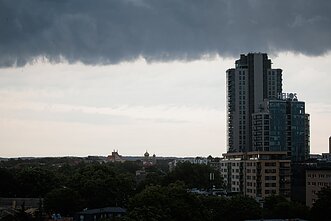

















The Šnipiškės district in Vilnius is better known by its nickname – Shanghai. The old wooden houses in what used to be a slum in the Lithuanian capital stand in stark contrast to the business high-rises next to it, creating a unique and picturesque landscape or, depending on who you ask, an eyesore.
As part of the Lithuanian capital’s development strategy, the area became a cultural landmark, with its wooden architecture character to be preserved and improved.
The new vision, called Wooden Šnipiškės, is being developed together with the local residents, Laura Kairienė, chief architect of Vilnius, told LRT.lt.
“Vilnius City Municipality, together with the owners of the houses, must continue to improve the condition of the wooden buildings, reconstruct the historic streets, establish a community centre and a woodworker’s workshop,” she said.
“At the same time, I see Šnipiškės as a testing ground for contemporary wooden architecture, and I invite developers to create contemporary wooden architecture here,” Kairienė added.

Divergent views
According to the municipality, the local residents value the “village in the city” lifestyle, with the area’s low-rise architecture, green areas, gardens and allotments.
“At first people said it was a slum, Shanghai, but I said it would be like New York with a green park in the city centre,” wrote a Vilnius resident in one of the local Facebook groups.
Others, however, were less positive.
“Instead of a [renovated] area, we have a lot of abandoned ruins. A perfect breeding ground for crime,” wrote another resident.
Yet others echoed the sentiment – “The residents have long expected to sell and move out, and now the municipality's heritage department has unilaterally and without informing the residents, whose lives are directly affected, included them in a heritage conservation area.”

Case reaches courts
Real estate developers stand to be the most affected.
“We filed a lawsuit in court,” Saulius Putrimas, CEO of Estonian capital Merko Statyba, told Verslo Žinios. “Nobody has informed us [of the discussions].”
According to Šarūnas Tarutis, Investment Director of Citus, the housing project management company, the decision meant that the redevelopment of the area has been halted.
“People don’t want to build and invest their money or time in a place where the environment is not changing,” Tarutis said.
“It has remained a disgrace of the city, shown in promotional clips, scaring away potential foreign visitors,” he added in reference to the recent tourism promotion campaign, which showed Šnipiškės as an embodiment of the negative expectations of the Lithuanian capital.

Preserving heritage
“The fact that the municipality has started to review the values and boundaries of Šnipiškės is a positive part,” Vidmantas Bezaras, the director of the Department of Cultural Heritage at the Vilnius Municipality, told LRT.lt.
“It was based on the data of both scientists and researchers. [...] The fact that the business community and, perhaps, the residents had no information shows that the process was probably not widely and properly communicated and that there should probably be more discussions,” he added.
However, protecting the wooden character of the area is important.
“There have been some good developments in [redeveloping] Šnipiškės. I think we really need to reopen the issue again, sit down and look at all sides of the argument,” said Bezaras.

Newsletter
Every Friday morning.