





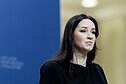


Vilija Blinkevičiūtė, leader of the Lithuanian Social Democratic Party (LSDP), said on Monday that she expects to meet with Ramūnas Karbauskis, leader of the Lithuanian Farmers and Greens Union (LVŽS) to discuss his party’s participation in the new government coalition.
“We hope that once the second-round results are confirmed, we’ll have enough seats to form a coalition of three parties,” she told reporters.
The LSDP leader said she would prefer a ruling coalition with the Democratic Union “For Lithuania” and the LVŽS.
On Sunday night, she met with Saulius Skvernelis, leader of the Democratic Union “For Lithuania”, to shake hands on future cooperation.
Among themselves, the three parties won 33 out of 70 party list seats. Two LSDP candidates secured outright victories in single-member constituencies.
Further reading
“I can’t say for sure yet, but I believe that in the near future; there shouldn't be any problems,” Blinkevičiūtė said when asked when she plans to meet with Karbauskis.
The LSDP leader said on Monday morning that she is optimistic that the coalition would involve the three parties but reiterated that she is not ruling out collaboration with the Liberal Movement.
At the same time, Blinkevičiūtė dismissed the possibility of including the Dawn of the Nemunas (Nemuno Aušra), a newly registered party of Remigijus Žemaitaitis, in the coalition.

“I think the answer is no for now,” she said.
The LSDP leader noted that the Social Democrats have made it to the second round in all major cities and towns, which she said indicates that the party is regaining popularity there.
Social Democratic candidates will compete in 35 out of the 63 constituencies that will hold run-offs between the two front-runners on October 27.
“Some of them are leading, while others are in second place,” said Robertas Duchnevičius, head of the LSDP election headquarters.
With votes from all polling districts counted, the LSDP won over 19 percent of the vote in Sunday’s first round, securing 18 out of the 70 seats allocated in the multi-member constituency, according to preliminary data from the Central Electoral Commission (VRK).
The ruling conservative Homeland Union–Lithuanian Christian Democrats (TS-LKD) came in second in the multi-member constituency by a narrow margin, winning 17 mandates, and the Dawn of the Nemunas finished third with 14 mandates.
The LSDP currently holds 14 seats in the 141-member parliament.
Žemaitaitis: results topped expectations
Remigijus Žemaitaitis, whose Dawn of the Nemunas (Nemuno Aušra) party finished third in the first round of Lithuania’s parliamentary election, said on Monday that the results surpassed his expectations.
“I believe we performed a miracle, something incredible for many of those opinion makers and influencers who said that […] Žemaitaitis is a boogeyman of Lithuania,” Žemaitaitis told a press conference on Monday morning.

“And 15 percent is an amazing result, one of the most fantastic results in my political career,” he added.
Citing polls conducted by his party, Žemaitaitis said that the Dawn of the Nemunas managed to attract new voters who had not previously voted in elections and captured some of the Liberal Movement’s votes in Klaipėda.
“The figures I see now indicate that we have taken an absolute majority of votes away from the Liberal Movement in Klaipėda, and in other regions, I believe we have attracted new voters,” he said.
The Dawn of the Nemunas leader said his party's board will decide on Tuesday evening whom to support in the October 27 run-offs in single-mandate constituencies.
“I’ll especially support those people who behaved humanely and respectfully during the impeachment in the Seimas, when they tried to crack down on me, and didn’t get involved in these processes,” he said.
Earlier this year, the Constitutional Court ruled that Žemaitaitis broke his oath as an MP and violated the constitution by making anti-Semitic statements on social media. However, he avoided impeachment by resigning from the parliament in April.
The leader of the Dawn of the Nemunas reiterated that, based on the current results, the Lithuanian Social Democratic Party (LSDP), the Lithuanian Farmers and Greens Union (LVŽS), and the Democratic Union “For Lithuania” do not have enough votes to form a ruling coalition without him.
“I don’t really understand the numbers on the centre-left. Unless they have some rabbits hidden up their sleeves. If [Social Democratic leader] Blinkevičiūtė has many rabbits, I’d like to see those numbers,” he said.
Žemaitaitis secured an outright victory in his single-member constituency, and 15 other Dawn of the Nemunas candidates made it to the second round.
Conservative leader: real winners will be clear after second round
With the Homeland Union (TS-LKD) having finished second in the first round of the Seimas election, Prime Minister Ingrida Šimonyte says it is too early to say whether the conservatives will be in government or the opposition.

“We are [still] at an early stage to be able to say whose initiative will come first in forming the future coalition. It could be the Social Democrats, but it could also be the TS-LKD, depending on how the results of voting in single-member constituencies turn out,” Šimonytė said during a post-election press conference on Monday.
She said she was reluctant to claim either victory or defeat yet.
Šimonytė stressed that as regards single-mandate constituencies, the conservatives had the largest number of candidates – 32 – who made it to the second round.
The government leader said that even after the second round, both the social democrats and the conservatives might find it difficult to form a “comfortable majority”.
In that case, she said, a minority government could be discussed.
The TS-LKD won 17.96 percent of the vote and 17 out of 70 seats available in the multi-member constituency, according to preliminary data from the Central Electoral Commission (VRK).
Šimonytė herself won a parliamentary seat in the first round in her single-member constituency in Vilnius.
The conservatives currently have 49 seats in the parliament, making them the largest group.
Liberal Movement leader does not rule out joining ‘centre-left’ coalition
Viktorija Čmilytė-Nielsen, leader of the Liberal Movement and speaker of the Seimas of Lithuania, says that her party could join a centre-left ruling coalition, despite quite a lot of ideological differences.
“A centre-left coalition might be theoretically possible, but there are certainly enough differences in terms of values. I am well aware that Saulius Skvernelis and Ramūnas Karbauskis might not want to work together in a coalition,” Čmilyte-Nielsen said during a post-election press conference on Monday.

Skvernelis, chairman of the Democratic Union “For Lithuania”, named the Liberal Movement as a preferred partner in a centre-left coalition earlier on Monday.
According to Čmilyte-Nielsen, the composition of coalitions will be clear after the second round of voting.
Čmilyte-Nielsen said that she had spoken with Skvernelis and some representatives of his team on Sunday night, but it was “more of a courtesy call”.
She stressed that the Liberal Movement would raise human rights issues if it had a strong voice in the new parliament.
The Liberal Movement has grabbed seven seats in the multi-member constituency after winning 7.7 percent of the vote, and nine representatives of the party made it to the second round in single-member constituencies.
Čmilytė-Nielsen herself was elected in the first round in her constituency in Vilnius.
Currently, the party has 11 seats in the parliament.

Meanwhile, Democratic Union “For Lithuania” leader Skvernelis indicated he would prefer a coalition with the Liberal movement rather than the LVŽS.
“When it comes to the reliability and predictability of the ruling majority, the make-up I mentioned is significantly more promising and stable for Lithuania,” Skvernelis said during the post-election press conference.
“At least those three political parties – the Social Democrats, us and the Liberal Movement – are clearly predictable and have the statesmanship gene, but we’ll see how it goes,” he added.
LLRA-KŠS thinks electoral threshold should be lower for ethnic minority parties
Ethnic minority parties in Lithuania should be set a threshold of less than 5 percent to get into parliament, says Jaroslav Narkevič, vice-chairman of the Electoral Action of Poles in Lithuania–Christian Families Alliance (LLRA-KŠS).
“In Lithuania, unfortunately, there is a very high 5-percent bar... This is not a good reflection of democracy, and I think it is desirable that ethnic minority parties have a lower bar,” Narkevič said during a post-election press conference on Monday.

According to him, the threshold set for ethnic minorities in elections is lower in Poland.
Narkevič said it was “premature” to say whether two representatives of the LLRA-KŠS elected so far to the Seimas in single-member constituencies could join other political groups in the parliament.
“There is a possibility that we will not have just two MPs, as we currently have. [Perhaps] we will have five MPs, so we will consider this issue,” he said.
In Sunday’s general election, the LLRA-KŠS received 3.89 percent of the vote and failed to cross the 5-percent threshold to enter the Seimas. However, two of its candidates, Narkevič and Rita Tamašunienė, were elected in their single-member constituencies in the first round.
“We were happy that we defended our strongholds in Vilnius region,” Narkevič said on Monday.
Three of the party’s candidates made it to the second round in single-member constituencies. Currently, the party has two MPs, they sit with the non-attached group.

Newsletter
Every Friday morning.