


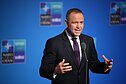






Oana Lungescu has become one of the most recognisable public faces of NATO. She spent thirteen years, from 2010 to 2023, curating the alliance's rhetoric and public narratives. During this time, she also had to respond to the biggest crises since the end of the Cold War.
"I grew up in Romania under communism. Like you, I have an understanding of Russia and its approach to Central and Eastern Europe, which is different from Western colleagues. Nothing surprises me when it comes to Russia," she says in an exclusive interview with LRT.lt.
Crimea 2014 – was there a mental shift about Russia within NATO?
Before the illegal annexation of Crimea, there was still hope and an expectation that we could have a partnership with Russia. Just days before we were preparing together with Russia in the NATO-Russia Council, the first joint military operation under the NATO-Russia Council.
That would have meant Russian and NATO ships together escorting an American ship called the Cape Ray, which was going to destroy Syria's chemical weapons. We were actively preparing for this and that was the spirit at the time, where we were aspiring for a strategic partnership with Russia. Quite a few allies were surprised by Russia's actions.
However, I think a lot has changed in the last decade. NATO's strategic concept makes it very clear that Russia is the most significant immediate threat to the alliance.

Surely not everyone was on board in 2014 and about what line NATO should take, at least publicly, toward Russia?
At the 2014 summit in Wales, there was a much clearer understanding that the relations with Russia had changed. The message of [former secretary-general] Jens Stoltenberg was that we needed strong deterrence to be able to have dialogue with Russia. We realised that you could only have, or try to have, a dialogue with Russia if you were strong.
That's why in 2014, there was the decision that allies have to invest at least 2 percent of GDP into defence. For the first time after the Cold War, instead of cutting defence spending, they would start significantly increasing defence spending.
It’s a very significant shift, because that in itself is a message of deterrence. It's not just about what we say as spokespeople, it's about what we do as NATO allies. So by having strong defence, we were able to show that we would defend every ally and that Russia should not even think about it.
But until the very last minute, until January 2022, we had meetings of the NATO-Russia Council to try to convince Russia that it was on the wrong path and also to show our audiences, including in Western Europe, that NATO was doing all it could to maintain peace.
But we saw that Russia had chosen war. It was important for the audience, which perhaps did not understand the threat of Russia as well as people in Lithuania or the Baltic region or Central and Eastern Europe, to understand that NATO was trying to maintain the peace.

How important to deterrence were your attempts to transmit a coherent message, narrative?
Our approach to Russia and Russia's campaign of disinformation has fundamentally changed over the last ten years. In 2014, NATO was probably the first international organisation to debunk Russia's disinformation narratives through a website, where we examined all the main Russian disinformation narratives and provided the facts.
Whereas in the months before Russia's full-fledged invasion of Ukraine, we took a more proactive approach by pre-bunking, not just debunking. It was unprecedented, because NATO usually is very careful about sharing intelligence, but we decided that it was important to try to declassify as much intelligence as we could to expose what Russia was doing and also make our audiences understand that this was not just an exercise, as Russia falsely claimed.
It was done in order to make it very clear – who was the aggressor and who was the victim, and if the invasion went ahead, Ukraine was the victim and Russia was the aggressor. We called out the false flag operations, we did that also in the NATO-Russia Council together by putting Russia in front of its own plans and lies.
[...] I think there was a real impact of that effort. Together with what allies such as the United States, the United Kingdom and others did in making sure that we had a unity of understanding of the threat and popular support for Ukraine and for NATO's actions.
What do you think about the sentiment, especially in the Baltic states, that NATO is doing enough to make sure that Ukraine doesn't lose, but not enough to make sure Ukraine wins?
We have seen unprecedented support for Ukraine from the start and we need to be prepared to do that for the long term and to do more. That's why it's really important that we are able to mobilise our capabilities so that we're able not just to defend ourselves, but also to continue defending Ukraine.
Again, it's about what we do, it's about how we spend our money. [...] We need to understand that this is for the long term.

In the 2023 Vilnius NATO summit, the consensus, it seemed, was that the alliance was repeating the same mistakes of the 2008 Bucharest summit. Speaking off the record, officials said they would have to sell to their societies the lukewarm promises that Ukraine got as a victory. Was it something you also had to do?
I covered the 2008 summit when I was working for the BBC and I was spokesperson at the 2023 Vilnius summit. There were big differences between those two summits.
There was a strong package of support for Ukraine, including shortening the route to membership by taking out the Membership Action Plan, which had been introduced at the Bucharest Summit in 2008.
[...] At the same time, I think there is confusion between the European Union accession process and the NATO accession processes. For the EU, the invitation to start the accession talks matters, [but] you never know how long that will take and whether you will get there. Whereas for NATO, once a country is invited to join NATO, it's practically sure that they will join.
There has to be an understanding of the difference between these two processes. It's not always easy and I can understand why people in the Baltics would have wanted a stronger signal.
Ultimately, what matters is the practical support we give Ukraine. Because even if there was an invitation for Ukraine, but we were not able to continue supporting Ukraine on the battlefield, frankly, that invitation would not have been worth much.
What matters is that we continue to support Ukraine with what it needs, that we do more and that we do it faster. We have been very deliberate, sometimes perhaps too deliberate in terms of taking time to reflect on when and what sort of support to provide. There is also consideration of escalation management.

What do you remember on a personal level about February 24?
We were expecting the Russian invasion, we were prepared. It was a very short night. We thought the invasion might come a few days later, in the end, it was on February 24.
I remember working with the secretary general days before on his speech where he said that this was the most dangerous moment in European history since World War Two.
It was important that we were not surprised – in 2014 we were surprised [by Russia].
On February 24, we were able to announce that the defence plans were activated, which was a very important signal – the support and unity of international media, which in itself are important not just for communication, but to show that we stand against aggression and with Ukraine.
Were you surprised?
I grew up in Romania under communism. Like you, I have an understanding of Russia and its approach to Central and Eastern Europe, which is different from Western colleagues. Nothing surprises me when it comes to Russia.
I think you could see, even if you go back to speeches that Putin was making in 2007, and what happened in 2008, the road was leading here even if everybody tried to prevent it.
We need to sometimes go back to how we felt that day to the shock, but also the determination of that early morning, and we should continue to support Ukraine. This is the moment we cannot waiver.

Newsletter
Every Friday morning.