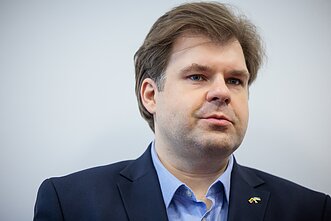



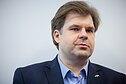









Lithuania has nominated Andrius Kubilius, its former prime minister, to become the country’s next European Commissioner. What portfolio can he expect to get?
Kubilius is often described in Brussels as a fierce Russia critic, a sanctions hawk, and the unofficial ambassador for Ukraine's accession to the European Union. Previously, he indicated that he would like to take the defence or enlargement portfolio,
Presenting his candidacy to the Lithuanian parliament, Kubilius said: “I am not a young man, but I know what new challenges mean.” Meanwhile, European Commission President Ursula von der Leyen has promised to present the new Commission next week.
Tomasz Bielecki, a journalist with Polityka Insight who has worked in Brussels for 15 years, said Kubilius is well known in the EU capital.
“He was Prime Minister of Lithuania, and he has been very active in the European Parliament last year on Ukraine and Russia. He is most closely associated with these Eastern European issues,” said Bielecki.
Observers in Brussels predict that Kubilius will likely take a portfolio related to foreign policy or security.
On Tuesday, Germany’s Die Welt quoted its sources as saying that Latvia’s Valdis Dombrovskis, currently the EU trade commissioner, will take the role of the EU enlargement commissioner.
According to analysts, this would seem plausible.
“The enlargement commissioner will also have to manage the fund for the reconstruction of Ukraine for five years,” Bielecki. “So, you could say that this portfolio is semi-economic because it involves a lot of money for Ukraine, and it is not just about EU accession negotiations and steps.”

Defence commissioner?
Kubilius has also been named as a potential candidate to take up the newly created defence commissioner role. The main task would be to strengthen the EU’s arms industry following Russia’s war against Ukraine.
This will be one of the EU’s key and new priorities for the next five years. In the spring, the European Commission presented the first-ever community defence strategy, which calls for increased investment in the defence industry and closer cooperation between countries.
“Europe needs to spend more [on defence], more efficiently, and to do it in Europe,” previously said von der Leyen.
Sources in Brussels say this portfolio could go to member states in Eastern Europe.
“When it comes to the Baltic countries, all the arrows are pointing to Lithuania because Estonia has Kaja Kallas [the future EU head of diplomacy], while Latvia’s Dombrovskis is more focused on the economic portfolio,” said Politico’s chief correspondent Jacopo Barigazzi.
According to the Politico correspondent, Kubilius’ political experience would make him suitable for the post.
“There were rumours that Finland could also be in the running for the defence commissioner’s portfolio, but their candidate is not as strong as Lithuania’s – Kubilius is a well-known former prime minister in Brussels,” said Barigazzi.

As soon as the defence commissioner’s portfolio was announced, there were rumours in Brussels that Radoslaw Sikorski, Poland’s current foreign minister, could take it. However, he soon denied the rumours, saying he would continue to work in Poland.
“In February-March, this was very seriously discussed, and Sikorski had even mentioned directly to von der Leyen that he could join the new Commission,” said Bielecki.
Some critics said that the role would be too unambitious for Sikorski.
But Bielecki sees other reasons: “I think it's mostly about internal Polish politics. The presidential elections are coming up next year in Poland and he [wants to] become the candidate of [Polish Prime Minister] Donald Tusk’s party.”
Strong voice needed
The main issue is that defence policy is the responsibility of individual member states. It is therefore unclear how much power the newly created defence portfolio will have.
“It will be a major innovation, one of the most desirable portfolios. On the other hand, we can see that countries do not necessarily want this portfolio because there is no defence budget, and if there is one, it will only be for strengthening the defence industry,” said Barigazzi.

LRT sources say the new defence commissioner will have to work closely with Kallas and will have 100 days to present guidelines on how to strengthen EU defences. In other words, as the joke goes in Brussels, he will have to figure out what to do with his portfolio.
“If this portfolio has no budget, the personality and weight of the commissioner will be crucial, as well as his ability to work together with Kallas,” said Politico correspondent Barigazzi.
The duo of Kubilius and Estonia’s Kallas looks attractive. “[But] the inevitable fate of the defence portfolio is a permanent conflict of interest with the EU’s head of diplomacy,” added Bielecki.
But Marija Martišiūtė, an analyst at the Brussels-based European Policy Centre (EPC), disagrees that the defence portfolio will not be influential.
“If Ursula von der Leyen is setting up this portfolio, that means there will be a budget for it. She has already announced in her political roadmap a vision to create an EU defence union and to kick-start defence investment within 100 days. That sounds very ambitious,” said Martišiūtė.
“So I think that this portfolio will be the most attractive and it will be one of the key roles in the Commission because it will be something new, and the scope of this portfolio will only grow,” she added.
The portfolio still needs to be defined, but this is also something that makes it very flexible, according to Martišiūtė.
“Both defence and enlargement are vital areas for the future of the EU and the defence portfolio will be just the beginning,” she added.

Ignoring von der Leyen
Although experience comes first, many countries have ignored Ursula von der Leyen’s request to submit the names of two male and two female candidates. This means that gender may play a role in the pursuit of a more influential portfolio.
According to LRT sources, the EC President has already asked some countries to change their candidates to include women.
However, Kubilius is unlikely to be shunned because Lithuania had a bitter and complicated process in nominating its EU commissioner.
Currently, there are 17 male and 10 female names among the 27 politicians in the cabinet. This proportion may still change when the EP approves or rejects the candidates.
“This does not give the impression of strength,” said Politico’s Barigazzi. “If the gender parity is not achieved, the hearings in the parliament will be a stumbling block.”

Newsletter
Every Friday morning.