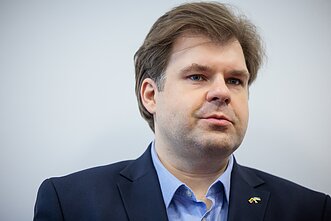




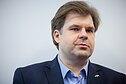




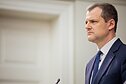



Gabrielius Landsbergis was catapulted onto the world stage when he became the foreign minister of Lithuania at the time of regional upheaval – the Belarus crisis in 2020, followed by Russia’s full-scale invasion of Ukraine. But despite his voice hitting the right chords internationally, he made few friends at home.
His tenure in Vilnius was marked by ongoing disputes with the president, Gitanas Nausėda, as well as clashes with the opposition that is now projected to win the general election later this year.
His standing among the Lithuanian public was also mixed – from being lauded for amplifying Lithuania’s global footprint, to being accused of arrogance and ignoring the country’s society and its problems.
The door to a potential post at the European Commission was closed for Landsbergis in what had become the last in a series of disputes with Nausėda. Without the president’s approval, he had to concede.
Paulina Levickytė, the minister’s spokesperson, relayed a brief comment by Landsbergis to LRT.lt: "I would have loved this job, but I love my country more."
His sign-off repeats almost in verbatim the phrase uttered by Joe Biden, the outgoing president of the United States – "I love this job, but I love my country more."
The political future of Landsbergis, who comes from a line of influential public figures, including the leader of Lithuania’s independence movement, Vytautas Landsbergis, is thus left uncertain.

From Brussels to Vilnius
According to Stefano Braghiroli, a professor at the Johan Skytte Institute at the University of Tartu, Landsbergis would have been a good candidate for the position of European commissioner.
"He has a good understanding of international issues and he can bring some Baltic perspective to the larger European context," Braghiroli said.
He was second only to Estonian Prime Minister Kaja Kallas – and one of two Baltic politicians – whose voice was heard in the European capitals, including London, Berlin, Paris, and Rome.
However, Braghiroli said that the position in Brussels would have required a wider range of knowledge and skills.
Jurgis Razma, an MP from Landsbergis’ conservative Homeland Union (TS-LKD) party, said the foreign minister could take up a post in the parliamentary foreign affairs committee in the future.
"But it is still early to say, we are immediately written off to the opposition. We may still participate in the formation of the government and there would be an opportunity to take important positions in the government," he said. "There are a lot of unknowns, so it is far too early to speculate on who among the more prominent politicians will be involved in politics in the future."
According to Razma, Landsbergis will no longer hold the position of party chairman, as it was his initiative that the chair can only serve two terms.
Eugenijus Gentvilas, leader of the Liberal Movement, part of the Homeland Union-led ruling coalition, was less kind, questioning why the public should care about Landsbergis’ career prospects.
"He didn’t become a European commissioner, what should he do now? Will he now have to become a simple member of parliament?" asked Gentvilas ironically.
Big deal, he added.

MP Agnė Širinskiene in the opposition said Landsbergis had compromised his reputation in Lithuania. This is reflected by the political ratings, where Landsbergis is almost always last, she added.
"We all understand that this makes you a toxic figure in your party. And all that desperation with the attempt to put Landsbergis in Brussels was a very nice attempt by the party to get rid of him just before the Seimas elections so that he wouldn't appear on the list and spoil the conservative party's already poor electoral chances," Širinskienė said.
Landsbergis also has few chances to occupy a more meaningful position in the parliament because of "how many nemesis he has managed to create", she added.
"Neither the ruling party nor other opponents are willing to support [him] with their votes," said Širinskienė.
It’s unlikely that the conservatives are trying to jettison Landsbergis as he is still able to mobilise loyal voters, according to Kaunas Technical University associate professor, Ainius Lašas.
However, the publicly unannounced purchase of a villa in Greece in 2022 and the drama over Brussels appointment could still cast a shadow, Lašas added.
"Maybe something will change after the elections, but now it would be a huge risk to remove Landsbergis as the party leader," Lašas added.

Silver platter
Vytautas Dumbliauskas, a political scientist and lecturer at Mykolas Romeris University, said that Landsbergis was given his political career on a "silver platter" due to his family’s heritage.
He got early into the bureaucratic apparatus (corrected 2024-08-27, 14:04)* as a civil servant, winning a competition for the job. Since then, "he got everything on a plate just because of his surname," Dumbliauskas said.
"Landsbergis became a Member of the European Parliament for no merit whatsoever. Then he became president of the party, again, for no merit," he added.
Now, according to Dumbliauskas, he will have to accomplish everything on his own.
"Landsbergis will now become an ordinary member of the Seimas and will have to fight for his place under the sun," he added.

Newsletter
Every Friday morning.
* This text was edited. A factual error has been corrected.