
















LRT.lt spoke to five sources active in the Belarusian political exile community in Vilnius to understand the ramifications of defections and the ongoing threat of KGB infiltrations. All of them spoke on the condition of anonymity due to the threat to themselves, their colleagues or family members.
On August 9, several hundred people gathered with red and white flags in the backdrop of the iconic cathedral in Vilnius. Chanting “thank you, Lithuania” and singing the national anthem – one outlawed by the regime of Alexander Lukashenko – the exiles marked the fourth anniversary of the short-lived revolution in Belarus.
Since then, the mood of resistance has shifted. Thousands of people remain imprisoned in Minsk, while the exiled members of the opposition have to fight off attempts by the KGB to infiltrate their ranks.
They have not always been successful.
Olga Tishkevich, an activist and member of an opposition Belarusian social democratic party "Narodnaya Hramada", surfaced on a regime-controlled channel ONT in late July. She had been reportedly missing for several weeks amid what other activists said were ongoing financial and personal relationship issues.
In Vilnius, her presence was everywhere – she helped organise some of the Belarusian protests that normally draw together dozens or hundreds of exiles in the Lithuanian capital.

She had been a member of the persecuted social democrat party since 2010. After the repression following the 2020 protests, she fled to Poland and later moved to Lithuania, where she continued her opposition activities.
Tishkevich decided to return to politics more actively this year, trying to run in the elections to the opposition Coordination Council. She was removed from the ballot in May after Belarusian cyber activists leaked data showing she reported a fellow activist to the KGB in 2018. Then, she was also kicked out of the party.
Tishkevich maintained it had all been a set up and she had never made the report.
Being ostracised from the community allegedly left her struggling to cope mentally, with several sources suggesting she may have broken psychologically.
Two sources said she may have been blackmailed via her son. According to one activist, the secret services routinely pressure families to entrap opposition members.
"When she was uncovered [as having cooperated with the KGB], everyone stopped talking to her, so there was nothing left for her to do," a "Narodnaya Hramada" party member told LRT.lt in Vilnius. "Perhaps she faced deportation, so her only solution was to go back."
"It is not good to see such people in the party structure. On the other hand, we have to understand that this can happen at any time because we are dealing with an authoritarian regime," the source added.

Recruiting on Telegram
Andrei Ostapovich is a former criminal investigator and representative of BELPOL, an organisation uniting former regime officers who have switched sides. Together with other activists, they have obtained leaked KGB and other Minsk databases. This allows them to trace whether a person may be collaborating with the regime.
According to him, the Belarusian regime is trying to recruit Belarusians abroad, as well as foreign citizens. One of their techniques involves the use of "foreign flags" when security operatives pretend to represent international organisations to gather incriminating material.
Another way involves posting job ads on the Telegram channels of the Belarusian diaspora in Lithuania or Poland. According to Ostapovich, the job might involve transporting a parcel from Lithuania to Poland, which is then used to blackmail the target.
"A person transports a shipment, earns money from it, and then [officers] write to him: you have transported explosives or secret files and if you don’t cooperate with us, we will report you [to local secret services]," Ostapovich said. "If this information gets to the intelligence services, you will either be imprisoned there or extradited to us, and that will be even worse for you."
According to Ostapovich, these methods are used to obtain information about Belarusian activists living abroad, opposition organisations, as well as to carry out provocations and collect data on intelligence services in other countries.
Nasha Niva, an independent Belarusian media, previously reported that the Minsk regime uses Telegram to recruit people to photograph various objects or protests and activities by the Belarusian diaspora.
In one example, Nasha Niva reporters responded to a job ad, which ultimately led to a request to photograph licence plates of cars parked outside the State Security Department (VSD) intelligence agency building in Lithuania.
When blackmail fails, the regime tried to intimate activists to break their ties with the opposition organisations.
"[This is done] to keep people away from their community. It targets people who cannot be successfully recruited," said Ostapovich. "Belarusian services demand that the person disappears from democratic movement structures, otherwise there will be problems. They use this method when they see that the person will not cooperate."

Forced confessions?
Chat groups on the encrypted Telegram app have been the key to coordinating and organising Belarusian activists, both at the height of the protests in 2020 and later in exile. Many of the channels are branded "terrorist" or "extremist", making anyone part of them liable to lengthy prison sentences.
Thus, revealing the details of the channels can carry severe repercussions.
According to one source, there had been several cases of Telegram channel administrators being detained in Belarus and later appearing in pro-regime propaganda where they would "confess" about their work with the opposition. However, it’s impossible to know whether they had defected, or were simply arrested during a misjudged return home.
Such cases followed the regime establishing a so-called commission for the diaspora, which drafted officers from various institutions to coerce activists to back to Belarus. Under the promised agreement, disenchanted activists can trade confessions – real or trumped up – in exchange for a return to Belarus without facing lengthy prison sentences.
Andrey from BELPOL said there have been less than a dozen such cases in the past years and dismissed it as a failed initiative.
People have also been receiving calls from the security services in Belarus, offering them to record pro-regime video messages in return for coming back, Adrei added.
"It's a weak method, but when it's done systematically and with the huge resources of an entire state, they can call even 400,000 people who have left the country and even if just 0.01 percent of people say yes, that’s hundreds of people," he said.
If a person is already vulnerable, facing financial and labour issues, and is already on the verge, then such calls can be effective, Andrey added.

Few collaborators to date
Even so, there have only been just three known, high-profile defections to date. This number is dwarfed by the size of the community in Lithuania of some 60,000 Belarusians, many of them political exiles even if not officially registered as refugees.
The first prominent case of defection surrounded Ilya Begun, an IT worker. Then, a former OMON officer Andrey Abramenka turned up in Belarus after first fleeing to Lithuania following the 2020 crackdown in the wake of the fraudulent elections.
"Vigilance needs to be everywhere, but there’s no need to create panic," Vytis Jurkonis, the head of Freedom House who has been working with Belarusian civil society for the past two decades, previously told LRT.lt.
"These security issues are real and require a review of security protocols by Belarusian communities and civil society initiatives," he said.
Many Belarusian organisations have internal protocols to weed out potential KGB collaborators, including checking the leaked databases of the secret services or undergoing a polygraph – lie detector – test. However, members of "Narodnaya Hrramada" admitted that they had no internal protocols for checking new members.
"At the same time, the Belarusian services are trying to look for cracks [not only among Belarusians]," said Jurkonis. "There is no need to pretend that only Belarusian citizens are vulnerable."
One of the most damaging cases, according to Belarusian activists, involved a Lithuanian lawyer Tomas Danielius who handed over files and information to the regime. He was later sentenced to two years in prison for forging documents. The espionage case, where he is facing 11 years in prison, continues.

According to Franak Viačorka, a senior adviser to an opposition leader Sviatlana Tsikhanouskaya, the KGB has also hired Lithuanian speakers working in Belarus for its disinformation campaigns.
"We identify them, [we now] have an extensive list of the people involved which we pass on to Brussels, Vilnius, Washington. Most of them are already subject to individual sanctions," he previously told LRT RADIO.
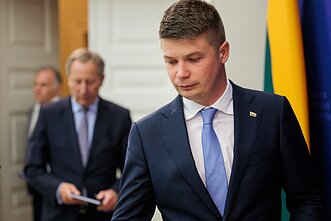
Lithuania’s Deputy Interior Minister Arnoldas Abramavičius also told LRT that asylum applications of Belarusians are being checked more carefully because of the KGB infiltration threat.
"The regime might act in different ways – it can use individuals who had been infiltrated from the beginning, or they could identify weaknesses among loved ones, relatives," he said.
"Those who wanted to flee the country did so immediately after the elections. Everyone else is checked very closely – we are more rigorously checking refugee claimants who say they are members of the Belarusian democratic opposition," Abramavičius added.

Newsletter
Every Friday morning.