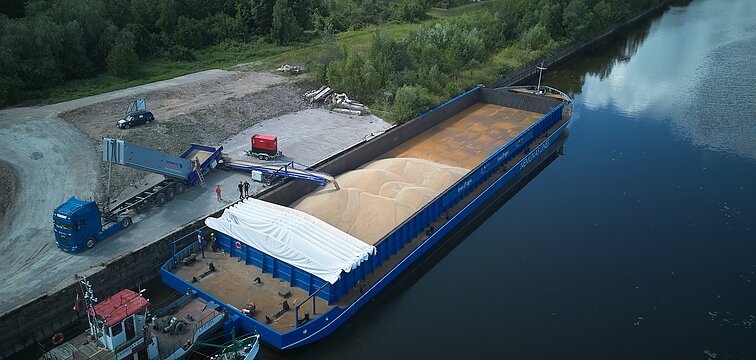
















The first barge carrying a cargo of Lithuanian grain designated for export and transported by the river Nemunas arrived at the seaport of Klaipėda on Thursday.
The port authority expects such grain shipments from Jurbarkas to Klaipėda to be carried out by the river on a regular basis using two vessels, each carrying 1,000–1,300 tons of grain.
“This is a new stage, this is a project that allows us to think that in the future, inland waters will be used more and more to transport cargo from that part of Lithuania to Klaipėda,” Algis Latakas, CEO of the port authority, told reporters in Klaipėda on Thursday.
“We can bring a large part of the cargo in one go by waterway to the port, where that cargo can then be transferred to bigger ships and those ships can then sail to the country where the cargo is to be sent,” he said.
The port authority estimates that one voyage on the Nemunas River will carry about the same amount of grain as 40–54 trucks, which should reduce the amount of truck traffic on the roads and in the streets of Klaipėda.
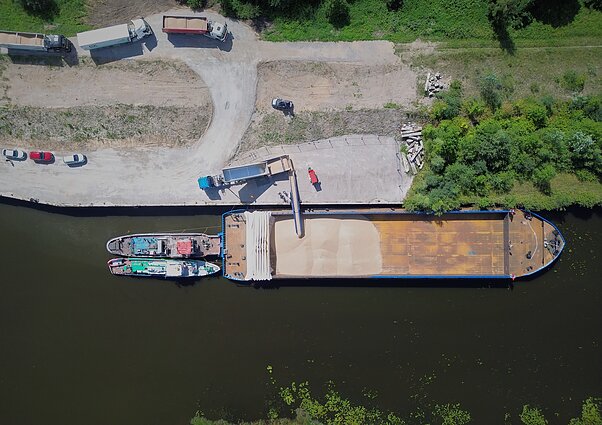
Vladimiras Vinokurovas, director of the Inland Waterways Authority, said that it took about 16 hours to deliver the 1,000-ton cargo of grain from Jurbarkas to Klaipėda but in the future, the barges could reach the port in 13 hours while sailing at night.
The grain transported to the port by the river Nemunas will be shipped to high-tonnage vessels by Bega, a Klaipėda-based stevedoring company.
Laimonas Rimkus, the company’s CEO, said that the company has been loading grain from barges for twelve years, so it would not need to make any additional preparations.
“This is a typical method of unloading; it is not complicated. It is only important that the barge has its own schedule,” Rimkus told reporters.
According to him, the company can unload 1,000 tons of grain in about one hour.
Andrius Armonaitis of Akola Group (formerly known as Linas Agro Group), a Lithuanian agriculture, food production, and trade company and the supplier of the first grain cargo transported to the port by the river Nemunas, said that transporting grain by water is much cheaper than by road transport.
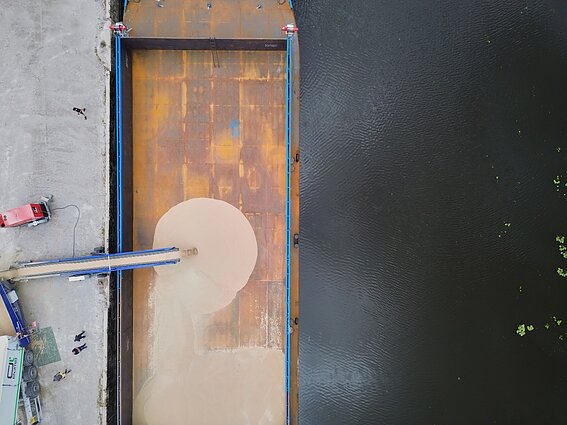
He told reporters that the company aimed to ship about 30,000 tons of grain annually by the river Nemunas.
For his part, Latakas said that in the future, the waterway could be extended to Jonava to carry fertiliser cargoes from Achema to Klaipėda.
According to Latakas, attempts were made in the past to transport gravel from Jurbarkas by barges, and in recent years, oversized cargo and containers were transported along the Nemunas, but such journeys were not regular.

Newsletter
Every Friday morning.