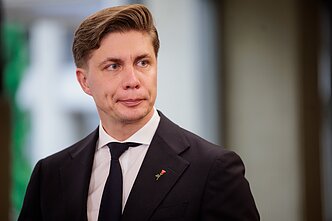









The Chief of Defence of the Netherlands, Gen. Onno Eichelsheim, who visited Lithuania last weekend, said in an exclusive interview with LRT TV that the Patriot air defence systems brought to the country not only contribute to the rotational air defence but also allow the alliance to prepare to protect its airspace.
Gen. Eichelsheim spoke about the situation with the F-16 fighter jets, the support to Ukraine and the first steps to be taken by NATO’s new Secretary General Mark Rutte of the Netherlands.
Let’s start with fresh news: the Netherlands has brought Patriot systems to Lithuania and is contributing to the air defence rotation model. We know that this is not an easy decision – in Europe, air defence systems are being allocated to Ukraine, and manufacturers are not able to provide them to all countries. Why did you decide to contribute to the rotational model?
I think it is a very important step to join the rotational model. On the one hand, we are showing that we are united and can integrate air defence systems. The Dutch Patriot systems add to the existing systems in Lithuania and strengthen air defence.
There are also Spanish and Portuguese units participating in the air policing mission. Together, we can train, improve manoeuvrability and agility by including Patriot systems.

It is important for the alliance to show that you cannot do everything alone. It is important to work together. That is why we have sent Patriot systems to Lithuania for the next few weeks.
In these coming weeks, the aim is to improve interoperability, manoeuvre and partnership between different NATO members?
Yes, because we see that Russia is violating NATO airspace more often. We want to practise to be able to manoeuvre from anywhere in the alliance to the Eastern Front. That is what we are doing now.
This is the first step – to bring Patriot in quickly, to integrate it immediately into Lithuania’s air defence control systems, and to be able to fight alongside fighter jets. If we do not know how to do this, we will never be able to show our opponents that we are serious.

The Netherlands will soon take over the command of the NATO Forward Presence Battalion in Lithuania. What are your objectives and how will this differ from the tasks of the Germans who have led the battalion so far?
It means that we are increasing our capabilities together with Germany. We are committed for the long term. We are working together with the Germans, who will deploy a brigade here. We will be able to rotate with them in larger formations than in the past. This also means that we will be able to deepen our interaction with Lithuanian and German troops.
As for Russia and its tactics in Ukraine: can Russia be expected to fight the same way in the event of a conflict with NATO? Or should we expect a completely different war from the one we’re seeing in Ukraine?
I think we must always be prepared for the unexpected. I do not think that Russia should be judged by the way it fights in Ukraine. However, we can expect a few similar things: they will use cyber and disinformation – they are really good at that.

I also think that they will integrate their operations more quickly than they have done in the past – I mean air, cyber, land and sea. It will be used more intelligently, so we must be prepared. And they will certainly use a lot of drones and electronic warfare, which we did not see at the beginning of the war in Ukraine, but which they are now developing relentlessly.
We need to prepare for a fight that will not be very massive, that will start in completely different spheres, not on land.
Have you noticed a change in the Netherlands’ assessment of drones in the light of the situation in Ukraine?
It is important not to stay too long in discussions – we need to act. What we are doing, by the way, here in Lithuania, is experimenting with drones and electronic warfare. We are learning from each other quite quickly. We are buying a lot of drones, we are experimenting with the ground forces and we are looking at ways of defeating drones.
It is important that the industry behind us keeps up and develops new technologies faster and that we apply the lessons from the front. This is how we look at the issue and we have come to Lithuania to try it out.

President Volodymyr Zelensky recently said that Ukraine’s Western allies are too slow in training pilots for the F-16 programme. How do you see this: are we doing the best we can, or is this the president trying to exert pressure on the West to provide support, to not forget Ukraine?
We are all very well aware that we must support Ukraine every day, every hour, every minute. They are on the front lines ensuring, in fact, our security. It is good that President Zelensky is constantly raising such issues, and it really increases the pressure on us to continue to support.
The Netherlands will support Ukraine throughout this fight. We do not really need the additional pressure, but I understand why he is doing it. We are doing everything we can to make sure that they have the F-16s in time to be able to use them in the near future. We are also sending Patriot systems to Ukraine.
There is another development concerning the Netherlands – a huge responsibility falls on the shoulders of Mark Rutte, the new secretary general of NATO. Should we expect a change in NATO policy with a new man at the helm after many years?
Let us try to put as much pressure on him as possible – that is the first thing we must do. I am joking, of course. Former Prime Minister Mark Rutte is the man best suited for the job. Why? He has a defence background because he has seen the situation in Ukraine. He understands that the North-East and the South of the alliance have to be defended, he knows how to get along, and he will have to “build bridges” in the future because the alliance will be under pressure to support Ukraine.

He will continue to build on what Jens Stoltenberg has been building, especially on finance. We need him to go even further in mobilising support for Ukraine. That, I think, is the first step that Rutte will take.
The second is to build partnerships, not only in Europe but also in the Pacific. He is very well aware that the rules-based world order is under threat. These are the two steps that he will definitely take.

Newsletter
Every Friday morning.