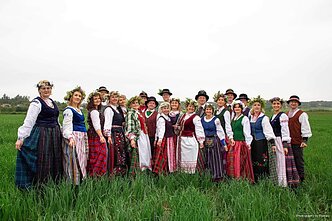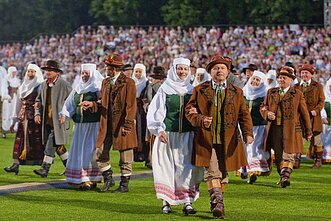














Not only folk ensembles and choirs from all over Lithuania but also from all over the world are flocking to Vilnius ahead of the centenary Lithuanian Song Celebration. The tradition unites generations of expat Lithuanians and is a way to connect to their homeland.
Over 2,000 Lithuanian expats from 21 foreign countries are expected to participate in the centenary Lithuanian Song Celebration. Lithuanians living in the US, Canada, and Norway tell LRT.lt about their preparation for the event and its meaning.
Generational tradition
Dainius Vaičekonis has been living in the US for almost 30 years, and for 10 years, he has been a professor and head of the piano department at Seattle Pacific University. In 2009, together with his wife Asta, he founded the choir Vakarai in Seattle. This year’s Lithuanian Song Celebration will be the choir’s fifth.
“My wife Asta and I were the only professional musicians in the Lithuanian community in Seattle. It was painful when February 16 was commemorated with dances but without songs. Someone had to take the initiative and form a choir. That’s what we did,” Vaičekonis shares.
According to him, the Lithuanian Song Celebration has always had a significant place in his family. The tradition of taking part in this event, which has been passed down from generation to generation, was started by Vaičekonis’ grandfather. In 1924, he took part in the first Song Celebration in Kaunas.
“My grandfather and grandmother met singing in the choir of the Pasvalys church. My grandfather was a volunteer in the Lithuanian Armed Forces, who returned from the Lithuanian Independence struggle in 1919–1922. From my grandparents’ accounts of the Song Celebration in 1924, as recounted by my dad, it was a great and exciting event, full of enthusiasm and joy,” the man says.

His father was a choirmaster and also took part in Song Celebrations. Now, Vaičekonis’ daughters also sing in the choir Vakarai. “It means a lot to my wife and me, but they didn’t really have a choice,” he smiles.
In his words, the Song Celebration is important to his family and other Lithuanians living in the US because it connects them with their compatriots and homeland, gives them the opportunity to preserve their Lithuanian roots, and nurtures the Lithuanian language.
“I’ve lived in the US for almost 30 years. I can tell you what makes our culture interesting and impressive to the world – not the famous performers who play music from other countries but our authentic songs and music,” says the director of Seattle’s Vakarai choir.
Asked how the choir has been preparing for the centenary Song Celebration, Vaičekonis says that the rehearsals started last June.
“The song repertoire was not easy compared to previous Song Celebrations. It was a huge job to learn the repertoire of the festival, especially since directing the choir is not our profession or paid job,” he explains, adding, however, that many songs in the repertoire are very touching.
Connecting through songs
Jūratė Neimanienė, who lives in Toronto, Canada, is also looking forward to the centenary Lithuanian Song Celebration. She will perform with the Toronto mixed choir Volungė, where she sings with her husband and son.
Growing up in Toronto in a family that nurtured Lithuanian identity, Neimanienė recalls singing Lithuanian songs with her dad as a child.
“My parents instilled in me a love for my homeland Lithuania from an early age, taught me to be proud of my origins and fight for its freedom because there was still hope that when my homeland was free, we would go back home. The seed was planted, and my parents did not need to encourage me to take an interest in Lithuania or the Song Celebration,” the woman says.

According to her, the Song Celebration is an opportunity for expat Lithuanians to connect to Lithuania through songs.
“We may be separated by the Atlantic Ocean and everyday life, but our love for our homeland and Lithuanian song binds us into one family. We passed on the spirit that our parents had instilled in us to our son. In 1998, we came to the festival – I sang, and my son danced with the Toronto ensemble Gintaras. At the next celebration, my son danced again. Now, we will sing together,” Neimanienė says.
“We are happy that generation after generation wants to be Lithuanians and that by coming here, they are putting down roots in their native land. Now, we will try to show our grandchildren at least a part of Lithuania so that they too will want to know and love the land of their great-grandparents,” she continues.
Past, present, and future
Elena Valiulienė, who lives in Norway, will take part in the Song Celebration for the 13th time. She says that the tradition came naturally to her family: her dad had participated in the event several times, she herself attended music school, used to play music with her sisters, and first took part in the Song Celebration in 1980.
This year, for the first time, Valiulienė will lead the Oslo Lithuanian folklore ensemble Gabija, which, she says, was born in 2019 out of a longing for the homeland.
“In a short time, the ensemble has become active and well-known throughout Norway, not only among Lithuanians,” she says.
“Not only the mind but also the heart told us that something was missing and something was needed to enjoy life in a foreign country. So, together with my husband Skirmantas, we decided to create an ensemble. He used to dance in the folk dance ensemble Sietuva in Vilnius and was a good dancer, so it was not difficult to decide who would be responsible for what. People came to the first rehearsal with tears in their eyes,” Valiulienė shares.

According to her, the ensemble has been actively preparing for its first Song Celebration.
“The idea that this will be the ensemble’s first Song Celebration drove everyone forward. [...] We are very pleased with the active participation of the people, the determination to go forward together and to learn the songs and to perform them as well as possible,” she says.
Valiulienė is happy that the centenary Lithuanian Song Celebration will bring together compatriots from all over the world. She believes that this event is not only a sign of respect for the past but also a symbol of national unity and cultural identity in the present and future.
“This celebration is very important to me and touches the most sensitive strings of my soul every time. It is proof of how united and strong a nation can be when it comes together for one purpose,” the woman says.
Further reading

Newsletter
Every Friday morning.