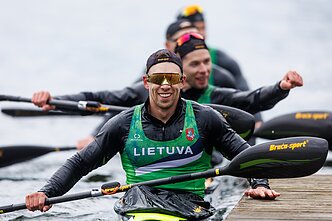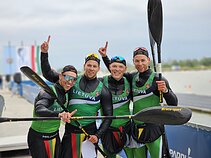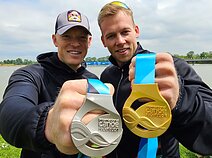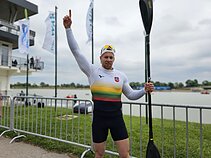
















Lithuanian canoeists have participated in every Olympic Games since their country’s independence and will be competing in Paris. This time, the team is much bigger.
In the run-up to the Paris Olympic Games, LRT is launching a special series “Lithuania’s Olympians”, made to get to know the country’s representatives in the games.
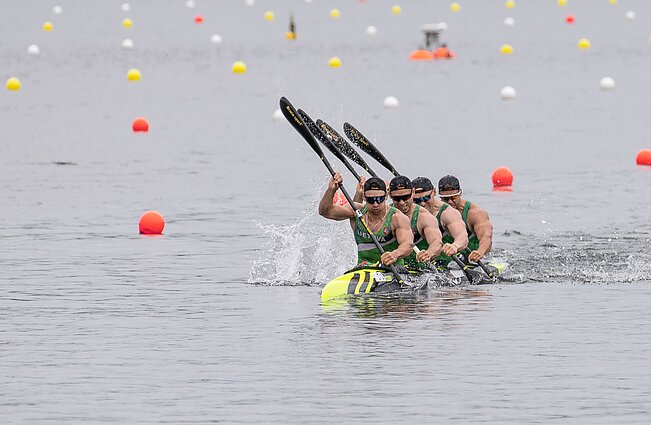
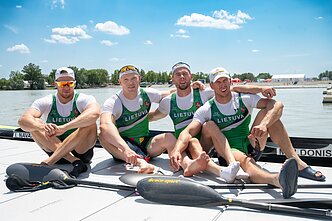
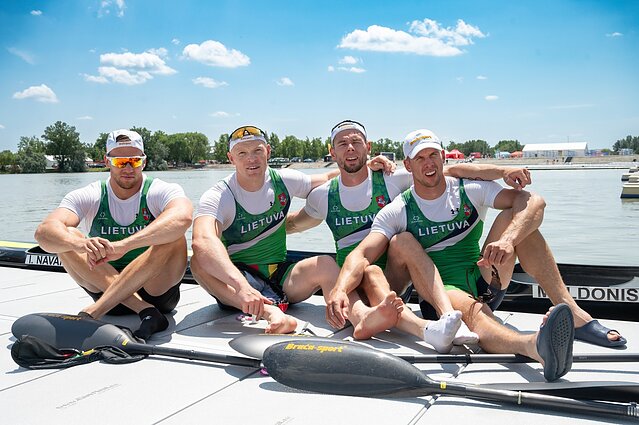
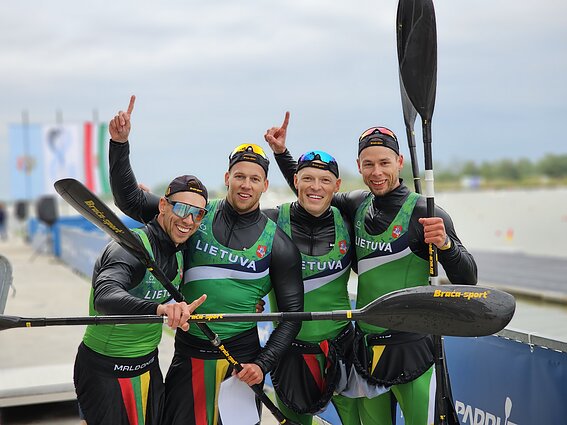
Lithuanian Mindaugas Maldonis was the only canoeist in the Tokyo games three years ago, while the team in France has five athletes. The quad team includes brothers Mindaugas and Simonas Maldonis, Ignas Navakauskas and Artūras Seja, who competed and placed sixth at the world championship in Duisburg last August.
The competition was fierce there, as only 10 top quad teams made it to the Olympics. Canoeing coach Romas Petrukanecas believes that the success was due to experience and a cohesive team, which was altered by the coronavirus.
“Lankas and Ramanauskas were there, Maldonis, Navakauskas were supposed to compete, but before going to the World Championships in 202, they took the Covid-19 tests, Edvinas and Aurimas got positive results and couldn’t go. Then Maldonis and Seja had to be put in the quad. And they did well – they came fifth, whereas the best result before that had been ninth. Then, for a couple of years, we did all sorts of tinkering and searched for the best option. In the end, we ended up with the crew we have now. That’s who made it to the Games,” the coach recalls.
For about six months, the canoeists train in Trakai, and when there are no conditions in Lithuania, they look for opportunities abroad. Although they will be competing as a quad in Paris, about 80 percent of their training is as singles. According to Petrukanecas, the preparation of the canoeists is different from that of the athletes in academic rowing.
“In our sport, it’s not like the more you row, the better your results get. Here, as in life, you have to find a state of mind where you are both willing and able. In academic rowing, the quads are rowing all day every day, tilling like clockwork, so to speak, but in canoeing, it’s a bit different. I still don’t know why,” Petrukanecas shares.
Navakauskas has already taken part in the Olympic Games in Rio de Janeiro and Mindaugas Maldonis in Tokyo. Both competed in the sprint single canoe event. Navakauskas finished 9th in the 200 metres and Maldonis was 10th.
However, this event is no longer available at the Olympic Games. In Paris, they will compete in the 500 metres in quad, while Maldonis will compete in doubles over the same distance.
The 33-year-old athlete has also achieved another dream – his younger brother Simonas will be rowing together at the Olympic Games.
“Because I’m older, I started earlier. It was quite a long walk, 10–15 minutes. For me, it felt like an eternity to walk to training, so I used to take my brother to walk with me. After three months, he started training too,” said Maldonis.
Almost two years younger, Simonas believes that the rivalry between brothers, which has been going on for two decades, is what drives them to get better.
“Training is a competition. He tries to get away from me, I try to catch him. There is constant competition, healthy competition. That’s probably how we bring each other up because we had each other around. The roles have changed, I’m stronger in some aspects, he’s stronger in others, but that’s how we’ve brought each other up to the level that we are now,” says Simonas Maldonis.
He will be joined at the Olympics by another very important person, his long-time partner Viktorija Senkutė, who will be taking part in the single sculls rowing event.
“We are both athletes, so we understand each other, we get along well. Our schedules are also very well matched – we do sports almost at the same time and rest at the same time. [...] I think we motivate each other as a couple,” says the athlete, adding that he will probably be more excited about his girlfriend doing well at the Olympics than himself.
Although Simonas Maldonis, like Seja, will be experiencing the Olympic spirit for the first time, he is an old hand in the quad.
“I’ve been in the quad since the beginning. I’m probably the only one on the team who hasn’t missed a single European or World Championship. My strength, as I say, is that I am the person with the most experience in the quad. I may not be as titled as Navakauskas, Seja, or my brother, but I’ve got a lot of experience since 2017,” smiles the canoeist ahead of his Olympic debut.
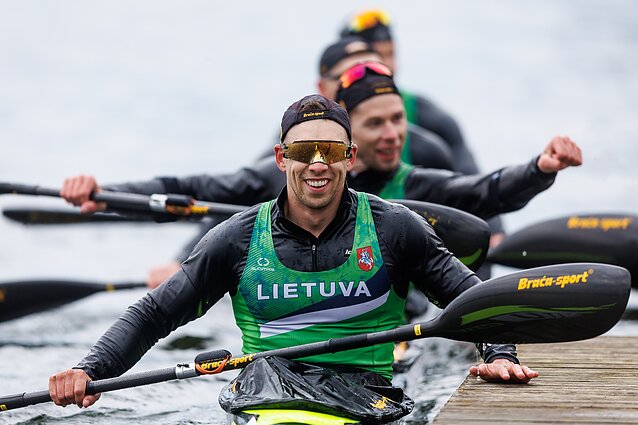
Seja and Navakauskas, who won a number of resounding victories in the 200m sprint, say they are disappointed that this event is no longer in the Olympic programme, as it was an attractive and popular event not only for the athletes but also for the spectators.
The athletes admit it was not easy to adapt to a distance one and a half times longer.
“The last hundred or two hundred metres are really tough. It’s all dark and you’re out of breath. After the finish, you can be lying on the bridge for almost an hour,” says Seja, who won the 200-metre sprint at the World Championships last year.
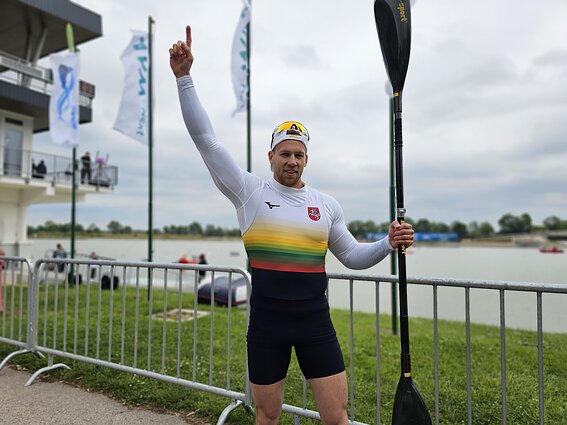
Navakauskas, who came back from the World Cup in May with a gold medal, agrees: “It’s not easy, especially the last metres. You don’t hear anything around you, you just do your best to cross the finish line as quickly as possible.”
The canoeists have recently competed in the European Championships and now devote all their time to preparing for the Olympics.
“My goal is to do my best during training. I want to work hard so that I don’t regret something I didn’t do. And in the Olympics, I just want to do my best and not make any mistakes. Both at the start and at the finish. Whatever the place, I will be happy with any place, the most important thing is that I make no mistakes,” says Navakauskas.
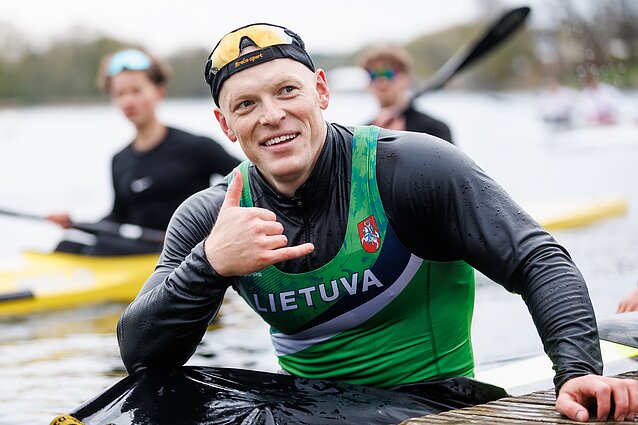
According to Simonas Maldonis, guessing the results in quad races is very difficult, since differences between teams come down to tenths or even hundredths of a second.
“One day you can be champion, the next you can be only in the top ten. [...] It only takes one wrong stroke or one perfect stroke at the start and that can determine whether you are a medallist or just a finalist,” Simonas Maldonis shares.
According to coach Petrukanecas, success in the Olympic Games will be very much down to psychological preparation, which is why he tries not to emphasise the importance of the competition.
“Psychology is a big factor in the Olympics in all sports because only the best qualify for the Games. That means they have a good function and are usually in good shape during the Games. What hinders and what helps is the motivation. It drives some people, it stops others.
“You come here to win a medal or to come first, and here you are faced with something you have never experienced before: media attention, spectators, big stands. For first-timers, it sometimes throws them off their feet and prevents them from doing their best. I think that psychology really determines about 40 percent of the final result,” says Petrukanecas, who made his own debut at the Athens Olympics 20 years ago.
Translated by Monika Jurevičius.

Newsletter
Every Friday morning.