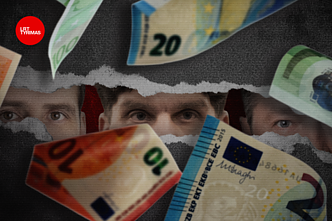








Lithuania has dropped six positions, to 13th place, in the Reporters Without Borders (RSF) 2024 World Press Freedom Index. According to media representatives, it has to do with politicians exerting influence on the public broadcaster LRT and the complicated procedures for journalists to obtain data from state institutions.
Despite shortcomings in the legal system, financial problems, and tensions with the authorities, Lithuanian journalists work in relatively favourable conditions, Reporters Without Borders (RSF) said on Friday.
Lithuania scored 81.73 points in this year’s index. In 2023, it scored 86.79 point and ranked seventh, the highest position it ever held.
“Let’s start with the status of the public service broadcaster and the fact that its governance is still politicised. This has been mentioned in previous reports as well,” Dainius Radzevičius, chairman of the Lithuanian Union of Journalists, told BNS on Friday.
Meanwhile, Birutė Davidonytė, chairwoman of the Association of Journalism Professionals, said she believes that journalists still face problems in obtaining data from the authorities.
“I think that in comparison with other European countries and with some other European registers, this could be detrimental to our overall position in the media freedom index,” she told BNS.

Politicians in the LRT Council
According to RSF, the Lithuanian media continues to be dominated by the national broadcaster LRT and big commercial media groups TV3 and LNK. However, some online media outlets are focusing on investigative journalism and attracting younger audiences.
According to the report, the relationship between the government and the media is characterised by tensions, which increase with each new crisis, be it political, social, or health. However, RSF notes that political attacks on journalists are rare.
Still, state institutions often refuse to provide information to the media without any explanation, the report says.
The report notes that media watchdogs are “relatively free” from political pressure, with the exception of the LRT Council, whose members are delegated by politicians.

The LRT Council is made up of 12 people. Four members are appointed by the president, four by the parliament, and four by the Lithuanian Science Council, the Lithuanian Education Council, the Lithuanian Artists Association and the Lithuanian Bishops' Conference each. New members are appointed at different times.
Last year, the current head of LRT, Monika Garbačiauskaitė-Budrienė, was re-elected for a second term, but it took three attempts to break a deadlock in the Council vote.
To prevent situation from recurring, the parliament started to amend the rules for selecting the LRT director general.
Media freedom situation unchanged
According to the leaders of journalists’ organisations, the drop in the index could also have something to do with relative improvements or deteriorations in other countries.
“The situation of media freedom in Lithuania remains quite similar [to last year],” said Davidonytė.

“We are not in the top ten, we are in the second ten, so in general that still means we are among the freest countries in the world,” said Radzevičius.
The chairman of the Lithuanian Union of Journalists pointed out that Lithuania’s media freedom index is much higher than some EU countries and the United States.
The United States ranks 55th in the index, compared to 45th last year.
According to Davidonytė, the decline in Lithuania’s media freedom rating may have been caused by politicians’ statements about the media, as well as by the complicated financing of regional media.
Estonia ranked sixth in the index, while Latvia was 12th.

Lack of funding for local media
According to RSF, Lithuania’s legal framework lacks clarity and does not always help protect journalists’ rights.
“Ethical issues are subject to self-regulation, under supervision of an association mandated by the courts, something that some call into question. Courts sometimes prioritise the protection of personal data over freedom of the press,” the report states.
The report also says that local journalism “has been crippled by a systematic lack of funding”.
It notes that the funding model for local media has recently been revamped. “The newly established Media Support Fund promises to focus on independent and cultural journalism. However, surviving in the market is still very difficult, especially for small media outlets.”
According to the report, while there are no systematic attempts to censor quality journalism in Lithuania, journalists face self-censorship when writing about certain historical and gender issues.
As in previous years, Scandinavian countries dominate the top of the ranking. Norway remains in first place, followed by Denmark in second place, Sweden in third, the Netherlands in fourth and Finland in fifth.
The Paris-based NGO Reporters Without Borders ranked a total of 180 countries in its annual survey.

Newsletter
Every Friday morning.