









On February 24, Marius Gružauskas became the first Lithuanian to climb the Cerro Torre peak of the Southern Patagonian Ice Field in South America. He shares his experience with LRT.lt readers.
Cerro Torre (3,128 m), one of the region’s main peaks, is known for its distinctive pointed shape. Situated between the Pacific and Atlantic oceans, the mountain has a frosted top, like a snow mushroom, due to the special climatic conditions. As you admire the magnificent spectacle of snow and mountains from afar, you realise that it won’t be easy to climb. Climbing it requires specific equipment, and sometimes you need to climb vertical ice caves. Strong winds and high rainfall mean that the summit is constantly being reshaped. Nature creates a different shape of snow and ice every year. There are seasons when the conditions are insurmountable.
My teammates, Kazakhstani Omar Asserbekov and Grigoriy Chshukin, and I waited almost 20 days for the right conditions on the mountain and a long enough “weather window” during which it was safe to climb. On this climb, the conditions that were too sunny and warm were not good for us. In such weather, the route becomes dangerous: rocks start to crumble, snow and ice are soft, and hanging mushrooms at the top can start to break.

Waiting for suitable weather, we managed to climb three other peaks: Mojon Rojo, Aguja Poincenot, and Aguja Medialuna. This warm-up was not a waste of time as it helped us to get to know the region, the weather, the ice and rock conditions, and to gather additional information from local climbers about our planned main summit.
It took six days for us to climb the peak of Cerro Torre. First, we had to cover over 50 kilometres with heavy rucksacks to get closer to the mountain. The road led through mountain fields and forests and stone moraines. We had to cross a river, climb a mountain pass, and descend onto the very large and wide Viedma Glacier, where we had to find the shortest way to the mountain by wandering through the crevasses of the ice. This took two days.
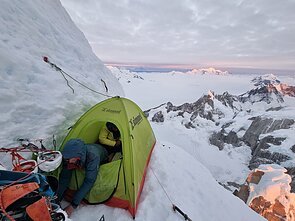
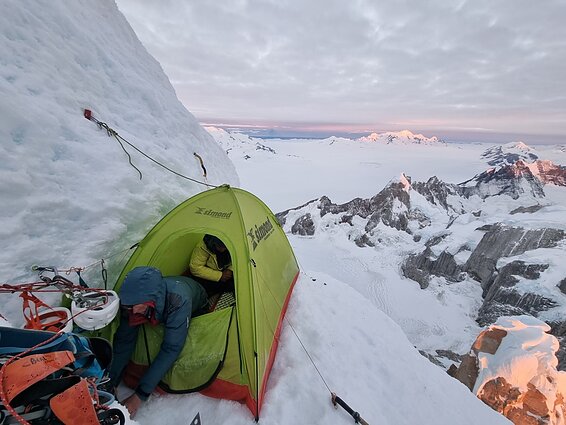
The actual climb to the top, which requires mountaineering skills and specific equipment, took three days. On the way up, we had to sleep like birds for two nights, with tents folded up on small ledges, a pitch dug out, and ropes tied around.
The route the team climbed was Ragni. It is one of the most unique routes in the world, rated at the highest difficulty level 6 or ‘extremely difficult’. It is ice combined with rocks. The average steepness is around 70 degrees, with 90 degrees in some places.
The most difficult part was overcoming the frosted snow mushrooms. Here, the team was faced with the limited possibility to organise safety points, and some of the mushrooms were more “hanging” than vertical. On February 24, at 15:31 Lithuanian time, the team successfully reached the actual summit and, after raising their national flags, descended along the same route. The descent procedures are technically quicker, so we were already at the campsite on the Viedma Glacier by the evening of the same day.
The next day, although the fatigue of the climb was palpable and the heavy rucksacks weighed on our shoulders, the team spirit was great, and we reached the town in 14 hours. The last kilometres down were monotonous. Descending on the same road, the terrain is familiar, but the thought that “we really didn’t go that far” almost always comes to mind. A few kilometres before the town, in the darkness of the night, the animal’s eyes fixed on us and illuminated by a spotlight dispelled all fatigue. When we got closer, we realised from the silhouette that it was a puma! This encounter was like a good cup of espresso for the team, waking us up for the urgent final kilometres.

The Cerro Torre Ragni route was first climbed exactly 50 years ago. It was done by Italian climbers Daniele Chiappa, Mario Conti, Casimiro Ferrari, and Pino Negri. My friends and I became the 3rd team to reach the summit this season. And for the first time, the Lithuanian tricolour was hoisted on the summit!

Newsletter
Every Friday morning.