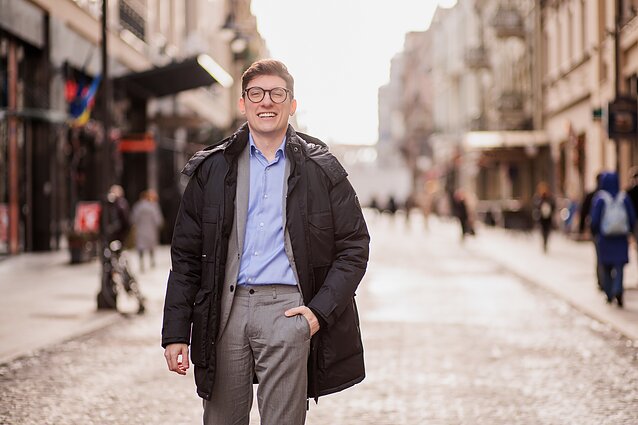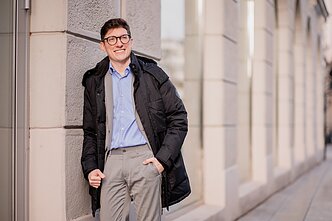














Brazilian Ricardo Schmitz, who has been living in Vilnius for about three years, says he enjoys a safe and peaceful life in Lithuania. According to him, salaries in Lithuania are lower compared to Western European countries, but there are plenty of career prospects here.
Recently, Business Insider published an article about you and your life in Lithuania. How did you come to their attention?
I think it was a chain of events. The company I work for likes to announce that we have colleagues from all over the world. There were also social media posts from Mykolas Romeris University, where I work and study.
You are currently lecturing and pursuing your PhD. What is your area of expertise?
My field is international tax law. I teach these subjects at university and my thesis is very much related to tax law. I am now teaching finance and tax law, which is an introductory course for undergraduate students. In the autumn semester, I teach international tax law, which is a master’s subject, so it’s a broader subject, taught from an international perspective.
You first came to Vilnius as an Erasmus+ student. Where did you study at first?
At the University of Lisbon in Portugal. My PhD is still linked to this university – it’s a double degree programme.

You have lived in Vilnius for almost three years. What do you like about this city?
I find Vilnius to be the perfect combination of capital, city, and country life. I’ve always lived in bigger cities, so it’s a bit more stressful, more crowded. Here, I feel like there are a lot of entertainment, cultural opportunities, and wonderful places that I can visit just by walking around the city.
What else do you like about Lithuania?
I feel safe here. For example, if I came to my hometown in Brazil and wanted to go to a restaurant 500 metres away, I would drive there. I wouldn’t randomly go to a park to watch the sunset. I would never take my phone out on the street and start a video chat with my friends on the way home from work. If I drove in Brazil, I would do so with car windows closed. If I stopped at a red light, I would look around nervously to see if it was safe.
You currently work for the consulting company Deloitte in Vilnius. How did you get a job there?
It all started when I was an Erasmus+ student. I moved from Brazil to Portugal, then from Portugal to Vilnius. I was working as a lawyer remotely for a Brazilian company, but I wanted some changes in my life, so I wanted to try consultancy work.
I saw that Deloitte had vacancies, so we scheduled an interview. Then the company decided to hire me, even though I didn’t speak Lithuanian. I did an internship there for three months and then returned to Brazil. But soon, I decided to come back because the university invited me to teach a class.
What is your daily work routine like in Lithuania?
My work is related to international tax. For example, when Lithuanian companies want to do business abroad, they need our help. The same applies when you have international companies coming to Lithuania.
When people hear that my work is related to tax, they usually think that it is boring, that I do a lot of calculations on an Excel sheet. But my work is very dynamic because every situation is different. What we do in the tax area depends very much on how the business works, how it is structured, and every group and company work differently.
What do you think of the work culture in Lithuania?
If we compare the company I work for in Lithuania, Poland, France, or the US, we are much smaller in terms of team size here. However, I have a lot of support, and we are very integrated into the Baltic team.
Sometimes I go to other offices for work. For example, in Portugal, a lower-level employee wore a suit, whereas, in Lithuania, I wear a suit only when I have meetings scheduled. In the office, I just wear a jumper to be comfortable.
Of course, there are downsides. If you compare salaries, they are lower in Lithuania than in a similar position in a bigger country. Also, in Portugal, I was paid the 13th salary not because of the company I worked for but because it is the country’s law.
How do you assess the cost of living in Vilnius compared to Brazil or Portugal?
I recently moved to a new apartment. I come from a very big Brazilian city Recife. It’s much bigger than Vilnius, but the cost of rent is much lower, and food is cheaper there.
Compared to Portugal, I would say the rent is cheaper here, but it is getting more expensive. I live in the Old Town, so it was difficult to find accommodation within my and my girlfriend’s budget. It was much easier when I moved to Vilnius in 2021. Although I managed to find a place I wanted in the end, it took a lot of time and effort.

Have you experienced any discrimination when renting in Vilnius because you are a foreigner?
I haven’t experienced discrimination myself. I used to rent from an Italian guy, and now we rent from Lithuanians, so there was a bit more bureaucracy. However, I have heard that some landlords sometimes ask for a higher deposit when renting to people from poor countries, even though you can prove that you earn enough money.
What cultural differences do you see between Brazil and Lithuania?
The population here is very different. When you get to know someone in Lithuania, the gap narrows, but at first, Lithuanians keep their distance. In Brazil, when you get into an elevator, you talk to other people about yesterday’s football match, the weather, etc. That is not the case here, and people sometimes find these conversations a bit intrusive or strange.
When you say hello in Lithuania, you just shake hands, but in Brazil, we hug as if we have known each other for a long time. If you shook hands in Brazil, it would be a bit rude. I would wonder why you cannot hug me, is there a problem? It’s a different perception of politeness.

Newsletter
Every Friday morning.