











A stained glass piece by the Lithuanian artist Kazys Morkūnas, created in 1974 and considered to be lost, has been discovered in a private room of a strip club in Vilnius.
The discovery of the piece, called Three Muses, was made by Žydrūnas Mirinavičius, a lecturer at the Vilnius Academy of Arts, and an alumna of the same school.
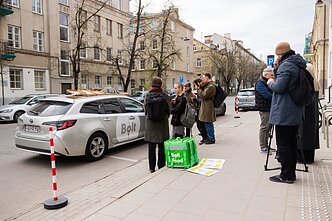
According to a press release by the Academy, the work of art was discovered accidentally, when a film crew was scouting shooting locations for a scene set in a strip club. They chanced upon one near Rotušės Square in central Vilnius, located in a building that housed a restaurant in the 1970s.
“And there it was, Three Muses by Kazys Morkūnas. It is not located in the club’s main area, but in a private dance room,” Martynas Arlauskas, a coordinator at the Vilnius Academy of Arts, is quoted in the press release.
Three Muses was commissioned for the basement of what was then the Laumė restaurant. In the absence of natural light, artificial lighting was installed behind the piece.

According to the Vilnius Academy of Art, the work is one of the masterpieces of the Lithuanian twentieth-century stained glass art.
After the restaurant closed, Three Muses was considered lost.
“There have been talks that the stained glass piece was boarded up, plastered over or even destroyed – unfortunately, such is the fate of many works of Lithuanian monumental art from the second half of the 20th century. This discovery is therefore a great joy for fans of Lithuanian stained glass art,” says the Vilnius Academy of Arts.
Professor Kazys Morkūnas (1925–2014) was an accomplished Lithuanian artist, the founder of the Lithuanian school of stained glass. During his career that spanned six decades, he created some of the best known pieces of Lithuanian stained glass art.

His other works can be seen in the Ministry of Culture, the Kryžkalnis Memorial, the Eglė Sanatorium in Druskininkai, the Ninth Fort complex in Kaunas, and the Lithuanian parliament.
Morkūnas also created stained glass for the 1970 World Exhibition in Osaka, Japan.
The artist’s work is characterised by monumentality, architectural thinking, expressive stylisation of figures, deep colours, dynamic forms, flying figures, and active rhythm.

Newsletter
Every Friday morning.