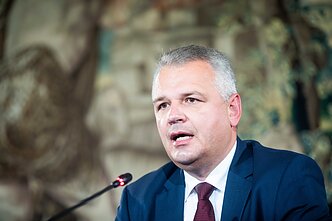

















The investment fund’s manager allegedly stealing and spending in casinos between 16 and 30 million euros throws into sharp relief the inadequacies of financial oversight and gambling regulation in the Baltic states.
BaltCap, an Estonia-based investment fund best known in Lithuania as the developer of the National Stadium in Vilnius, first announced that it was firing one of its partners, Šarūnas Stepukonis, back in November, quoting “financial mismanagement”. Although it turned to law enforcement over a suspected misappropriation of assets, the story only exploded in the media in late January when more details emerged.
The fund revealed that Stepukonis may have embezzled 16.5 million euros and, what’s more, gambled it away in casinos. BaltCap, therefore, was suing not only its former partner, but also Olympic Casino Group Baltija.
Further reading
The latter has insisted it did all it was required to ensure the legitimacy of the money Stepukonis’ was losing. Meanwhile, Lithuania’s central bank says that since BaltCap is registered in Estonia, it was Estonia’s financial authorities that had to supervise whatever went wrong.
Be that as it may, BaltCap was the first link that had to notice one of its partners was stealing large sums of money – the fund’s managing partner Simonas Gustainis now says it could have been more than 30 million euros. He did so, according to Gustainis, by forging documents and signatures.
Asked how it is possible that internal safeguards at the company did not work and nobody noticed anything for so long, Gustainis says that it is customary in the investment business for a fund partner to be given a credit of trust and much power in the management of companies and their finances.
“The system itself is built on the assumption that the person with authority respects the law. If a person deliberately chooses to break the law, to embezzle money, to falsify information and documents, he or she is circumventing the system of safeguards. In this case, the former fund manager and partner succeeded in doing so and the scheme he created worked for some time,” Gustainis says.

But experts are surprised that one person could be given that much power.
“There are strict requirements for fund managers, and generally no one fund manager can make decisions. [...] Their decision has to be backed by another person, there has to be a four-eyes principle, which is primarily BaltCap’s problem,” says Vaidas Cibas, director of the Financial Services and Markets Oversight Department at the Bank of Lithuania.
“It would be naive to expect that one person could move such amounts of money. Perhaps, either consciously or unconsciously, more financiers were involved in the scheme,” says Mantas Janavičius, a board member of the Investors’ Association.
The Estonian Financial Inspectorate, Finantsinspektsioon, which is responsible for the supervision of BaltCap, says the money could have been taken from the company since as early as 2018.
Finantsinspektsioon specified that it issued AS BaltCap a licence to operate as a fund manager last year on August 7. The possible violations therefore occurred at a time when BaltCap did not yet have a licence from Finantsinspektsioon. [Supplemented Feb 6, 13:15]

According to the sources of the news website Delfi, the amount of money that Stepukonis suspectedly gambled away in Lithuania is relatively small, 3 million euros, while around 10 million was lost in Estonia. If this is true, where the rest of the money went remains to be seen.
Before reaching the casino, the BaltCap money should have passed Stepukonis’ bank accounts. If so, the flow of millions of euros should have set off safeguards in banks.
“Financial institutions should have been involved here, the funds should have been transferred from one institution to another, the operations should have been carried out, the safeguards should have been triggered, and the third safeguard – the gambling company – should have seen that there were unusual operations,” argues Mindaugas Petrauskas, head of financial crime prevention at Amlyze, a fintech software company.
But nobody there saw it either. The Gambling Supervisory Authority explains that when a new gambler starts gambling, the casino has to assess his or her level of risk: to see whether the sums they’re gambling on are consistent with their income. If it sees a discrepancy, it has to report it to the authorities.
“Neither the Gambling Supervision Authority nor the FNTT [Financial Crimes Investigation Service] is involved in this process, so they do not have the data from the gambling operators,” says Arnoldas Dilba, spokesman for the Gambling Supervision Authority.

The gambling companies themselves say that a gambler’s income is considered when he or she deposits or wins more than 1,000 euros.
“When the sum of one or more transactions within a day exceeds 1,000 euros, internal control procedures must be activated, records should be kept, suspicions raised, and substantiation of funds asked for,” says Mantas Zakarka, director of the Gaming Business Association.
But it is very easy to confirm that you are gambling with your own money, says Skirmantas Malinauskas, a video blogger who has conducted several investigations into gambling.
“When you’re gambling [online], a window pops up asking if it’s your money or borrowed. You click ‘my money’ and that’s accepted as substantiation. [...] Or someone calls you and you verbally explain it – without any documentation,” says Malinauskas.
Gambling companies and regulators say they cannot stop a gambler if they suspect they have a gambling problem.
“If a person has an income, they can afford to lose a million or 100,000. If you see him sitting up at night, this meets the criteria of immoderate gambling, but unfortunately there is no obligation to do anything,” adds Dilba, spokesman for the Gambling Supervision Authority.

In fact, says BaltCap managing partner Gustainis, his former colleague could not in any way legitimately afford to gamble away millions of euros, he was not making anywhere near that. Even though Olympic Casino Group Baltija insists that they have checked and Stepukonis was able to substantiate the provenance of the money.
“His gambling was conducted in non-cash money over the internet, over a relatively long period of time, the money was transferred to the gambling account from accounts in financial institutions operating in Lithuania, and the origin of the money was substantiated. [...] In relation to this particular case, we have previously received requests for additional information from a bank operating in the country, the State Tax Inspectorate and the FNTT, which we have immediately forwarded,” commented Tomas Palevičius, CEO of Olympic Casino Group Baltija.
The State Tax Inspectorate replied that it was only interested in whether taxes were paid on the winnings, while the FNTT, when asked when and why it had contacted the casino and why it had not investigated the case earlier, replied that it could not provide the requested information at the moment.
Gustainis estimates that Stepukonis’ gambling amounted to a quarter of the annual turnover of Olympic Casino. It was therefore probably in the casino’s interest to let him keep going.
However, one of the first to make the story public, Vilnius Council member Aleksandras Nemunaitis, says the casino can feel at ease. If Stepukonis was forging documents in order to appropriate BaltCap’s funds, “it is not the casino’s business to check”. “I think the responsibility is with the law enforcement authorities,” says Nemunaitis.
On Friday, the European Public Prosecutor’s Office announced an international search for Stepukonis, saying that his whereabouts are currently unknown.
He may be in Ukraine, as Stepukonis is a former volunteer soldier.

“The same sources, which I have no reason to distrust, give information and say that he is in Ukraine as a volunteer, fighting on the Ukrainian side,” according to Nemunaitis.
Although there are still many questions, the damage done to BaltCap and its investors is becoming clearer.
The Bank of Lithuania says that the value of the pension funds of SEB and Swedbank fell by 3 million euros as a result of the BaltCap affair. At the same time, the central bank reassures that the pension system is sound.
Regarding the construction of the National Stadium, BaltCap initially explained that the alleged embezzlement would not affect the project, but the company would go ahead only if the municipality and the government agreed to index construction costs.
On Friday, however, one week after the scandal broke, BaltCap announced it was pulling out of the project due to reputational damage. It will be replaced by Hanner, a real estate developer led by Arvydas Avulis.
Meanwhile, the scale of Stepukonis’ alleged embezzlement keeps growing. Initially estimated at 16.5 million euros, it can be as high as 30 million, managing partner Gustainis has confirmed. The European Public Prosecutor’s Office has launched an international search for Stepukonis quoting suspicions of embezzling at least 27 million.
The article was supplemented on February 6, 13:15, with a specification from Finantsinspektsioon about when it issued a license to BaltCap.
Further reading

Newsletter
Every Friday morning.