










From the coming September, Lithuanian schools will have to teach integrated classes, that is, include special needs children with everyone else. LRT Solutions looked into how these challenges have been dealt with in Iceland.
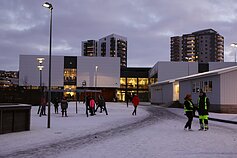
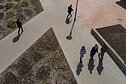
I arrive at Hörðuvallaskóli at half past eleven during break. The children are wandering around the still dark schoolyard. The sun will rise in half an hour. This school is in Koupavogur, in the region of Iceland’s capital Reykjavik. It has 660 pupils in grades one to seven.
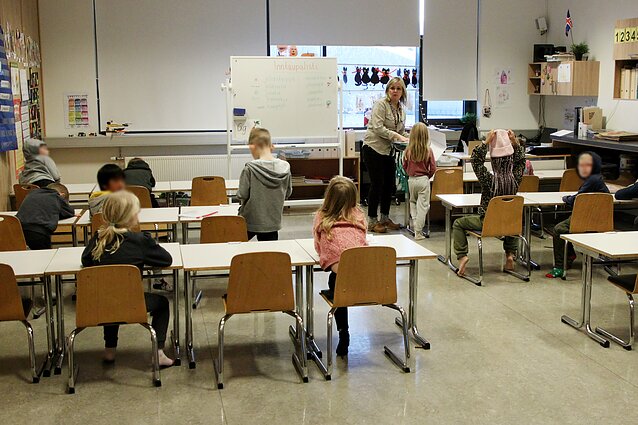
Oddrun, the school’s office manager, shows a classroom where pupils with behavioural or emotional difficulties can come to calm down and relax. Soft music is playing in the background and a boxing pear hangs on the side. Another classroom is dedicated to special education, with a cosy, cushioned reading area, and shared and individual learning spaces. In this classroom, a teacher and a child play Uno cards in peace. According to Oddrun, a development therapist and a teacher’s assistant are also present.
Íris Björk Eysteinsdóttir, deputy director, notes that children do not stay in these spaces long and return to their regular classroom quite quickly. Hörðuvallaskóli has been implementing inclusive education since the school was founded in 2007.
“It is important to us that all children are equal. It doesn’t matter what background they come from, what language they speak, or whether they have a medical, mental or physical condition or disability. The school environment must be equally welcoming to all children. We see children with special needs as having a superpower,” says Eysteinsdóttir.

According to her, the school works to build on the strengths of children with special needs.
“If you look at research, autistic children can often concentrate particularly well on what they find interesting. Maybe we can find what they are interested in and reinforce this ability and teach other things through it?
“Children with ADHD are often very creative or good at sports. So we are looking at how we can play to their strengths and ensure that they are assessed in the national curriculum,” she says.
According to the deputy director, around a tenth of the school’s pupils have ADHD, a smaller proportion are autistic and a fifth have a reading disorder. Eysteinsdóttir says that she does not make light of these figures, stressing that the school looks at the situation from the child’s perspective.
“First of all, when you meet a child, you have to get to know them. If the child has a sensory impairment, we have to make sure that the classroom is properly lit, we have to see if we should touch the child when we hear him or her, or if the child needs something else,” says Eystensdóttir.

The deputy director recalls the school’s decisions regarding a pupil with severe visual and hearing impairment.
“Experts visited the school before she arrived. This pupil was given a larger tablet with which it is easy to enlarge the image. Teachers learned how to write properly on the board: what size letters to use, what colours to use. After all, if it works for this pupil, it will work for everyone else,” she stresses.
The school receives extra funding for enrolling this student and employs a teaching assistant to help her.
Planning trips to football games
Hörðuvallaskóli uses team teaching. Here’s an example: there are 100 sixth-formers in the school, divided into four groups. They are taught by four main teachers and one additional teacher, and there are other ways to divide the team.
The sixth-graders are also helped by one or two teaching assistants. The school also has a language specialist, a psychologist, a nurse and a motor skills specialist. They advise teachers and parents as needed.

“I think we have enough help. Although, of course, it would always be better to have more help and for the teacher to have fewer pupils. But the way things are now is also effective,” says Orri Steingrímsson, a sixth-form teacher.
He stresses that the school seeks to find and nurture each child’s individual strengths, which is supported by project activities.
“Fifty percent of our classroom activities are old-school: books, the Icelandic language, maths and other subjects. The rest of the time is dedicated to thematic projects, where the children work in groups or alone. We try to work on projects that are more realistic so that the children are more involved,” says Steingrímsson.
The teacher and the deputy director give examples of different thematic projects undertaken by sixth-form pupils. One of them is when students spend four weeks exploring Scandinavia, planning a detailed trip to see their favourite football teams play.
A few weeks ago, children were calculating how much Christmas presents will cost for relatives. Steingrímsson says it is fun for pupils to get involved in projects that are related to their hobbies and real life.
The teacher stresses that in inclusive education, it is crucial to build a relationship with the child, so that there is mutual respect and trust. Close cooperation with parents is also necessary.
“There are always parents who feel that their child needs more help from teachers. We are in regular contact with them. There are about 10–12 pupils in this class, and we meet their parents every month to talk about how their children are doing in school. I think good communication between teachers and parents is key to this process,” says Steingrímsson.
School as a smaller version of society
At school, I talk to Auður. She introduces herself as a regular Icelandic mum, a teacher at another school. Auður has three children, one of whom has ADHD.
The child, she says, did well in the first grades because learning was still very playful. However, in years four and five, when specific subjects became important, there were difficulties, the child found himself in a bit of a hole, unable to use his creativity.

“The last two years were very difficult, but this year is very different. I feel that in a way I have regained him. He’s much happier at school now, completely different. He says: Mum, I know everything. You don’t have to teach me! – Are you sure? – Yes!
“I think the most important mental change has happened. He has more confidence. He has regained it, and that is important,” stresses Auður.
One of the main reasons for the change, she says, is the project activities.
“They have time where they focus on maths, Icelandic and so on. Later on, they take some time off from these subjects and move towards more child-centred, creative teaching. I think that has helped him a lot. I also think that today’s teachers are more tolerant of different children,” she says.
While Auður is pleased with her son’s welfare at school, she also notes that the system in general is changing too slowly, which is why it is still difficult for parents with children with special needs in Iceland. More specialists are needed in schools, she says. She says she understands some parents’ concerns that teachers may need to spend a little more time with children who have special needs.
“Of course, some children need more space than others. Like mine, because he is open, he says what he thinks. So he can definitely get more attention. But we should think of school as a smaller version of society. And also about the kind of society we would like to see in the future.
“After all, we should be able to work with everybody, to be compassionate, to be tolerant. This is a place where children learn all that because they are here almost all day. Of course, they have to learn from their parents too, but it is also important to get practice,” stresses Auður.
Iceland is ranked eighth and Lithuania 25th on the 2022 Social Progress Index for social inclusion. Icelandic education experts stress that inclusive education is not only important for children with special educational needs, but also for those growing up in families at risk, as well as for non-native speakers.
The latter are growing more numerous in Iceland. In one of the Hörðuvallaskóli classrooms, we even greeted a girl from Lithuania in Lithuanian.

Different inclusive education
As Edda Óskarsdóttir, associate professor at the School of Education at the University of Iceland, points out, inclusive education is understood and implemented differently in Iceland.
“For example, there may be a municipality in a region that does not have the resources that Reykjavik has. Then they may not get all the help they need that is available in a larger community.
“When a child lives in a smaller community and lacks this support, parents may have to move elsewhere. On the other hand, in such municipalities, the authorities may try to do everything possible to keep the child and the family here,” says Óskarsdóttir.
How inclusive education is implemented in Iceland also depends on the culture of individual schools, the type of building they occupy, she says. New school buildings are often designed according to the open school principle, with an open layout, says Óskarsdóttir. Older schools are more rigidly divided into classrooms, teaching spaces, support areas, etc.

According to Óskarsdóttir, most children in the country attend regular schools closest to their home, there are very few special schools left. In Reykjavik, for example, there is one such school exclusively for children with very severe and complex disabilities. The expert also stresses that support for teachers is crucial in this process.
“We need to focus not only on the professionals who work with the children, but also on those who work with the teachers – so that they have support and know how to deal with this diverse group in their classrooms,” says Óskarsdóttir.
And there are different ways to support teachers: if there are more children in the class, there should be two teachers, or a team of teachers, so that they can support each other and share responsibilities. It is also important to ensure continuous professional development.
We can’t put all responsibility on teachers
Iceland’s Minister for Education and Children Ásmundur Einar Daðason stresses that inclusive education must not leave teachers alone. He agrees that one of the remaining challenges is the shortage of specialists. However, the minister believes that this problem needs to be tackled by strengthening cooperation between different sectors.
“The new law that we are implementing now is also focused on this – when a child is put at the centre, he or she must have support from different areas. I think this is what we have lacked so far. The different sectors were not talking to each other, they were only looking after their own affairs.

“But if we want an inclusive society, if we want schools for all, we have to be honest and understand that teachers do not have all the solutions. We have to give them solutions from different areas. We cannot put all this responsibility on the shoulders of teachers alone,” stresses the minister.
The idea that children should be educated in inclusive schools was enshrined in Icelandic law back in 2008, but the first steps were taken even earlier. However, Daðason stresses that changes took time.
“We have faced challenges in this area. But in my opinion, they were the right steps. We see that schools are now becoming more inclusive, even though there were initially people who said that this was not the right way to go because schools were not ready to work with different groups of pupils.
“Over the last five or six years, we have been reforming to help schools be inclusive. It is one thing to say that schools must be inclusive, but it is another to support them to become truly inclusive,” says Iceland’s minister for education and children.
Daðason says he has been in contact with Lithuanian politicians and sees the country’s action on inclusive education as positive progress. Lithuanian schools and kindergartens will have to accept all children, including those with special needs, from September, if their parents, after consulting specialists, decide that it is best course of action.
This article has been produced in partnership with Transitions as part of a programme to support solutions journalism.

Newsletter
Every Friday morning.