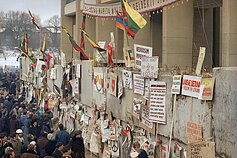

During the so-called January events, international partners and common people supported the newly independent Lithuania. From coming to defend Lithuanian statehood or organising support rallies to sending humanitarian aid, the world demonstrated that the country was not alone.
On January 13, 14 people were killed and around 1,000 were injured when Soviet troops stormed the Vilnius TV Tower and the Radio and Television Committee building. The Soviets attempted to overthrow by military force the legitimate government of Lithuania after the country declared its independence from the Soviet Union on March 11, 1990.
During these events, a number of foreigners stood in solidarity with Lithuanians in front of the parliament, the Press House, the TV tower, and the LRT building. The Scottish director Glen Hamish, who was in Vilnius to stage a play at the Youth Theatre, was one of them.
“If a Scotsman or other representative of a small nation does not stand with you, then nobody will,” said Hamish, recalling the events of that night.
Iceland’s Foreign Minister Jón Baldwin Hannibalsson also travelled to Vilnius to help Lithuanians defend their freedom in January 1991. As did a number of Ukrainians. Over fifty Ukrainian students were assigned to guard the radio station in the parliament – the only place from which Lithuania informed the world about the events in the country after the Soviet army seized the main radio facilities.

Individual Ukrainians also came to Vilnius and gathered around the strategic buildings chanting “Литва, будь вільною!” (Lithuania, be free!).
Media attention
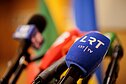
In January and February 1991, all eyes of the international media were on Lithuania. Dozens of journalists flocked to Vilnius from all over the world to report on the situation in the country.
Although not a reporter, Julian Wysznyski-Trzywdar happened to celebrate Christmas and New Year in Lithuania that year. He became one of the few Western Europeans who reported the January events in Lithuania to the German audience.
“Even though I didn’t speak Lithuanian, I soon realised that something important was happening – the announcement of the price hikes, the demonstrations, and the political upheaval began to alarm me and awakened my instincts of a political commentator,” he said in an interview in Berlin in 2000.
The Latvian documentary filmmaker Juris Podnieks also visited Vilnius in January 1991. He and his fellow cameraman filmed tanks driving into a crowd and the violence of Soviet soldiers against the unarmed people. His footage was broadcast on news channels around the world.

Solidarity rallies
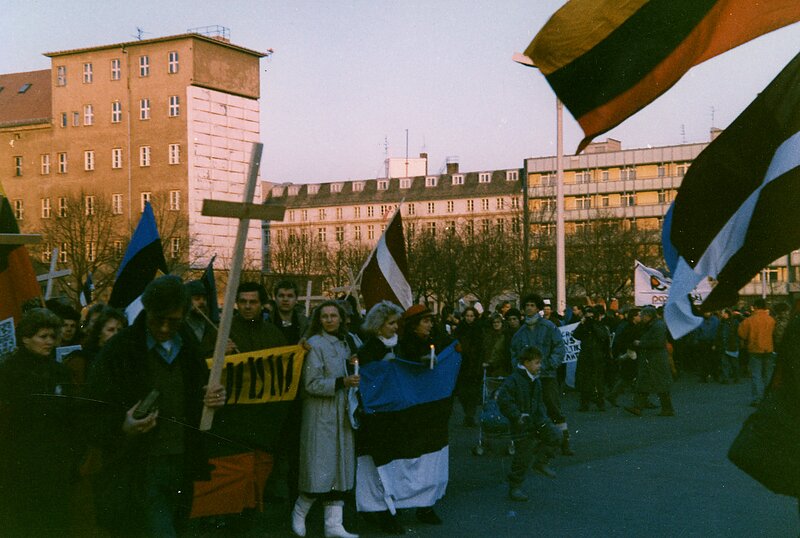
In the turbulent beginning of 1991, a wave of demonstrations in solidarity with Lithuania also swept outside the country. Rallied in various parts of the world took place at the initiative of the Lithuanian diaspora and called for international support for independent Lithuania.
The largest number of such demonstrations took place in the US. The organisers printed flyers with information about Lithuania and handed them out to passers-by. One of the largest demonstrations in the US took place on January 19, attracting around 3,000 people not only from Lithuania but also from Ukraine, Moldova, Cuba, Croatia, Poland, Romania, Latvia, and Estonia.
A number of pro-Lithuania demonstrations were also held in Germany, Italy, France, the UK, and even Australia.
In January, two solidarity rallies took place at the Soviet Embassy and at the Soviet Consulate in Rome. The Italian Greens demonstrated at the embassy, while the Lithuanian community and representatives of various Italian organisations gathered outside the consulate.

On January 14, a demonstration outside the Soviet Embassy in Paris attracted around 500 people, including French deputies and senators.
However, the largest demonstrations took place in countries on the eastern side of the Iron Curtain, including Poland, Czechoslovakia, Latvia, and Ukraine. The demonstration in Riga on January 13 drew around 500,000 people. On this day, barricades were erected around the main state and public buildings in the Latvian capital, and the streets were blocked with heavy machinery.
The demonstrations in Ukraine were also numerous. On January 13, a rally in Lviv was attended by around 70,000 people, while a similar number of demonstrators gathered in Kyiv on the same day. The Ukrainian government representatives who spoke at this event were later fined for taking part in the pro-Lithuanian demonstration.
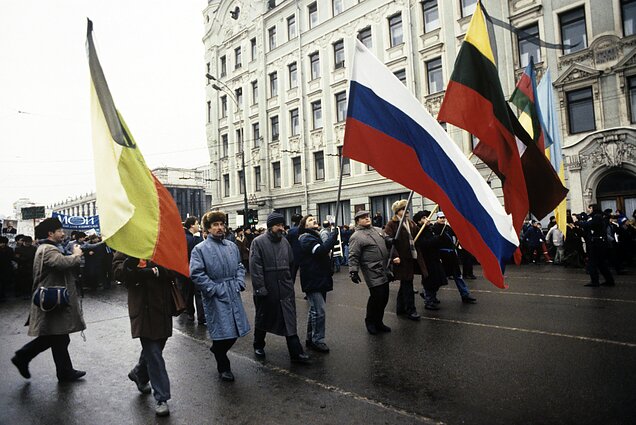
Several large rallies were also held in Russia. A demonstration organised by the Moscow City Council attracted 300,000 people and was believed to be the largest anti-communist demonstration since the Russian Revolution of 1917.
Humanitarian aid
Many countries also reacted to the January events in Lithuania by sending humanitarian aid.
Already on the morning of January 14, two trucks with four tonnes of medicines arrived from Poland and two planes full of medicines from Finland. Canadian Lithuanians shipped surgical supplies, antibiotics, and painkillers worth around 15,000 dollars, and Latvians delivered eight litres of frozen blood plasma from around 40 donors.
There were also fundraising campaigns. During one of the first rallies in Ukraine in January, Ukrainians donated around 10,000 roubles to Lithuania. Meanwhile, in February 1991, Norwegian Foreign Minister Thorvald Stoltenberg announced that Norway was allocating 9 million kroner in economic aid to the Baltic states.

Newsletter
Every Friday morning.