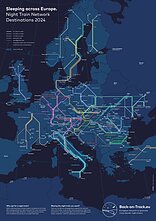
















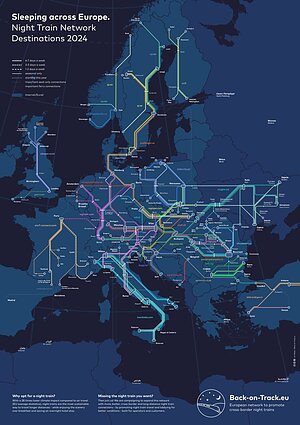
In the European Night Train Map, published by Back-on-Track.eu, the Baltic states are a blank spot. Does this need to change?
New train timetables are drawn every year, said Kotryna Dzikaraitė-Misiūnė, a spokesperson for Lietuvos Geležinkeliai (Lithuanian Railways, LTG). They are prepared considering passenger flows, market trends, infrastructure capacity, and the available train fleet.
According to her, night trains are usually relevant and convenient for longer international journeys.
With the implementation of the Rail Baltica project, connecting Estonia, Latvia, Lithuania, and Poland, trains will also run from early morning to late evening on the new European standard-gauge track. If there is a need for passenger trains to run at night, this will be taken into account, Dzikaraitė-Misiūnė said.
“Night trains will also be able to run on Rail Baltica if the need arises. This will be decided by the train operators. It will be possible on the entire Rail Baltica line from Tallinn to Warsaw,” she noted.
For the time being, LTG plans to continue organising train schedules on the basis of the available data on passenger numbers. For example, late Vilnius-Kaunas services are only available on Fridays and Saturdays.
“It is observed that on weekdays, 21:00-21:30 is the optimal time for the last train of the day,” said Dzikaraitė-Misiūnė.
Although Lithuania’s public railway infrastructure is designed to carry passengers and freight at all times of the year and day, passenger trains are prioritised over freight trains during the day. At night, freight trains take priority, the LTG spokesperson added.
Used to run at night
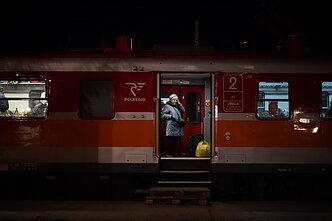
Night trains are a convenient means of travel for tourists. There used to be such trains in Lithuania, but over time, the need for them has diminished, according to Gediminas Vaičiūnas, an associate professor at VILNIUS TECH.
Although night trains have their advantages, they also require appropriate maintenance and operation, he stressed.
“If we look at it from the operator’s point of view, this requires a technical base: the train must have special carriages with sleeping places. These carriages have to be maintained and operated accordingly,” Vaičiūnas said.
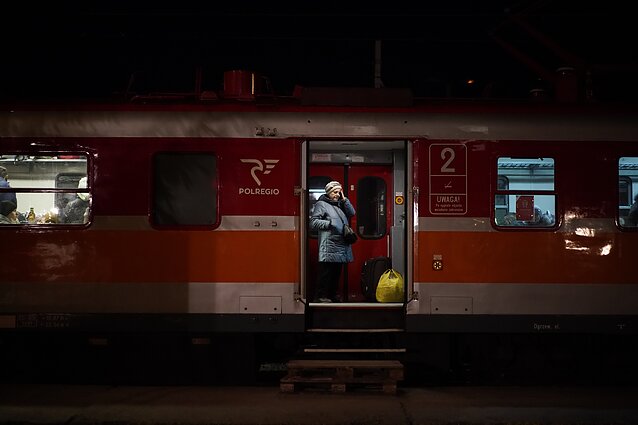
He also pointed out that a person usually needs at least six hours of sleep, so the night train journeys are usually extended accordingly.
“There used to be a night train from Vilnius to Klaipėda. Its journey time was slightly longer than that of the day train. It used to leave in the evening and arrive in the morning. But the question is whether this is needed in Lithuania,” he said.
Vaičiūnas also stressed that after the Rail Baltica project is completed, it might be possible to run night trains in the Baltic states again.
“Night trains need slightly more time, not 2-3 hours, as most journeys in Lithuania,” he said.

Newsletter
Every Friday morning.