















After the parliament voted down amendments to a controversial anti-LGBTQ+ information law, Lithuania may be facing EU sanctions in addition to reputational damage, argues the justice minister. Not everyone agrees.
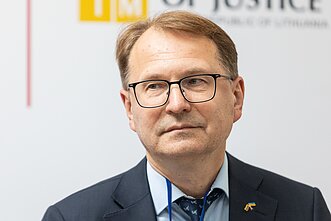
On Tuesday, Justice Minister Ewelina Dobrowolska submitted an amendment to the parliament which, if adopted, would have removed from the Law on the Protection of Minors against the Negative Effects of Public Information the provision that information about same-sex marriages is harmful to children.
The amendment follows a ruling by the European Court of Human Rights (ECHR) that Lithuania violated the principle of freedom of expression guaranteed by the Convention for the Protection of Human Rights and Fundamental Freedoms with this law that was used to censor the children’s book Amber Heart in 2013.
Further reading
However, the amendment, which had earlier been approved by the cabinet, was voted down by MPs. This is the second time that the Lithuanian parliament, Seimas, has defied an ECHR ruling – previously, it refused to grant state recognition to the pagan religious community Romuva.
Both Justice Minister Dobrowolska and Seimas Speaker Viktorija Čmilytė-Nielsen argue that the rejection of the amendment was damaging to Lithuania’s reputation and that there was no way to get away from the issue. Dainius Žalimas, dean of the Faculty of Law at Vytautas Magnus University (VMU) and former president of the Constitutional Court, agrees.
Meanwhile, opposition MP Agnė Širinskienė, who leads the non-affiliated group in the Seimas, insists that the ECHR has not indicated that Lithuania must change legislation in order to implement its ruling. The country, she believes, is not facing any legal consequences.
Further reading
Questions to the president
According to Justice Minister Dobrowolska, the Seimas will have to revisit the issue of amending the Protection of Minors Law eventually. The ECHR ruling is what it is and if Lithuania refuses to abide by it, the country will not escape the infringement procedure.
“If the European Commission treats Lithuania’s regulation like it did Hungary’s, we will not escape the infringement procedure. This is simply postponing the issue until later,” she told LRT.lt.
Moreover, she added, passing the amendment would have been “a very clear message to our people that talking about the fact that families are different” is important.
“Well, today we behaved like Hungary,” according to Dobrawolska.

She believes that President Gitanas Nausėda – who indicated before the vote that he did not support the amendment – and other state leaders will receive questions about the law during European Council meetings and other international events.
Parliament Speaker Čmilytė-Nielsen emphasised that the situation was detrimental to Lithuania’s international image. The issue, she said, should have been discussed as a legal matter, but instead it turned into a discussion about values.
“Just as in the Romuva case, the discussion is now turning slightly in the wrong direction. I myself voted in favour [of the amendment], but that was the will of the Seimas. [...] Yes, it does some damage [to the reputation],” said Čmilytė-Nielsen.
No obligation to change the law
However, opposition MP Širinskienė, the leader of the non-affiliated group, categorically rejects the reproaches, arguing that the ECHR ruling does not put any obligation on Lithuania to change the law.
“There is not a single word where the court says that the law must be changed in order to implement the ECHR decision. In many cases, for example, in the Paksas case, where the court sees that the law needs to be changed, it says so very clearly,” Širinskienė commented, referring to the 2011 ruling which found that a lifetime ban for Lithuania’s former impeached President Rolandas Paksas from any elected office was disproportionate.

Moreover, according to Širinskienė, the Law on the Protection of Minors does not prohibit information about LGBTQ+ people.
“There are two prohibitions in the law. One is to denigrate family values in the presence of minors, and the other is to encourage minors to enter into marriages other than those defined in the Constitution,” she said. Lithuania’s Constitution states that marriage is only between a man and a woman.
Širinskienė argued that the ban on the book Amber Heart was not an “adequate” interpretation of the law. “If the state had acted adequately with regard to that book and there had been no bans, […] the case might have ended differently,” she believes.
As to whether Lithuania could face any sanctions from the European Commission after rejecting the amendment, Širinskienė is convinced: “There can be no consequences.”
Further reading
Financial penalties
Former President of the Constitutional Court Žalimas disagrees. According to him, unless Lithuania solves the situation, it is facing be negative consequences in the long term.
“First of all, political ones, because Lithuania is almost in the same ranks as Hungary in the Council of Europe and the European Union in this area. It could be, as against Hungary, that the European Commission may at some point start infringement proceedings,” Žalimas told LRT.lt.
Moreover, this will affect Lithuania’s rating in terms of the rule of law, since its failure to comply with the ECHR’s rulings is a clear disregard for the rule of law.

“This is an effect that will not be seen in one day. [...] We are now talking about commitments in the Council of Europe, but this is also about commitments in the European Union,” he said.
The European Union can decide that Lithuania’s Law on the Protection of Minors violates EU legislation and impose sanctions that “can be financial”, according to Žalimas.
However, this will not happen quickly, which is why politicians can afford to exploit the issue for political gain. But future governments and parliaments will be forced to return to the issue, he believes.

Newsletter
Every Friday morning.