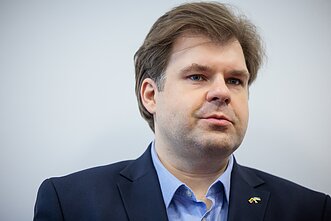















Misled by over-optimism, the West believed that a counter-offensive by the Ukrainian forces would lead to immediate liberation of Russian-occupied territories. But with Russian troops sticking to their positions and showing ability to learn from past mistakes, Kyiv is likely to have to give up its goal of liberating the Donbass and Crimea, says Frank Ledwidge, a lecturer in military history at the University of Portsmouth in the UK.
Dr Ledwidge is a lawyer, a former British military intelligence officer who served in Iraq and the Balkans, and author of several books on warfare, the theory and history of war. He has visited Ukraine several times.
“I think the Ukrainians need to be made clear that we will not be helping them retake Crimea. That won’t be done publicly, it will be done privately. And I think it has been done privately already,” says Ledwdge in an interview with LRT.lt. In exchange, Ukraine would get NATO membership, which would be a significant strategic victory.
You’ve argued that Western leaders were overly optimistic about Ukraine’s counteroffensive, expecting big breakthroughs by the end of the year, even taking control of Crimea. Why do you think it didn’t materialise?
If you speak to expert military personnel here, who admittedly have no experience of the high end combat we see in Ukraine, most of them are very clear that without air dominance or control of the air and really good coordination and command, control and coordination, very well trained people and a preponderance of numbers, usually three to one, you’re going to find it very difficult to breach prepared defences. I was talking to a British military engineer officer who said it would be a tall order, but really tall order, very difficult. And so it is.

It was wrong of commentators in the West. I don’t think necessarily the Ukrainians were expecting to take Berdyansk or Mariupol again, or Melitopol. Their minimal objectives were to at least get to Tokmak in that western area and probably a little further on in the east of that zone of Zaporizhzhia, perhaps retake Bakhmut. Fairly limited objectives.
They didn’t achieve those because, let’s be candid, they were defeated in the field by the Russian army, which is also learning. A lot of people don’t speak about the Russian army and its history in this context. I said this very early on in the campaign, the Russians learned, the general shape of wars in which the Russian army is a combatant – whether it’s the First World War, the Second World War, the Finnish War, and even the Afghan War, first, second, third Chechen wars and so forth – is that they start terribly, are defeated in the field in one form or another, but not defeated strategically. So they learn, and they’re learning now.
Let’s take the case of Verbove in the west, which the Ukrainians regularly say they are nearly taking but never do. It’s quite apparent that their offensive has stalled there. And for reasons that are fairly clear.
Plus, the Russians have learned, they’re training people, just as the Ukrainians are, they are replacing equipment just as Ukrainians are, they are conducting deep battle, probably more effectively than the Ukrainians, for the simple reason that they have more equipment. We don't hear about that.

Do you think that the chance for the Ukrainians to reach a major breakthrough has passed and now we are facing this grinding warfare, smaller battles, without either side reaching a decisive victory for years to come?
War is contingent on millions of separate incidents and it’s essentially political in nature. So the war, one way or another, will be decided on that political level. So if there is an event in Moscow wherein the leadership chain of the Kremlin changes, then clearly that will have an effect. I don’t really know much about that because I’m not capable of looking into the future. I prefer to talk about what’s happening now.
Officials in the West have been fairly clear that they do not expect a breakthrough of any kind this winter. That seems to me reasonable. And this is from people who tended to be optimistic.
Depending on the politics in America, certainly in Russia and elsewhere, we will see another attempt by the Ukrainians to retake more land in the springtime, perhaps even over the winter. But I can’t see it making any particular progress, at least this winter. And by progress I mean a significant victory, which is what politically the Ukrainians needed and need now. Taking Tokmak or Melitopol, which is much further on, or perhaps a daring strike at Berdyansk or something like that. But I can’t see that happening this winter.
There has been some blame game, with the Ukrainians saying that the West were too slow to give them advanced weapons systems, while the West were saying that the Ukrainians were not using the tactics they were advising. Do you think the situation could have been different if from the beginning, the West would have given more weapons systems, which they eventually did anyway?
Yeah, it would be different, I don’t know if it would be decisively different. We hear a lot about armoured vehicles, and the US has released a couple of hundred Bradley armoured vehicles, 30 or so of their tanks. But the US has thousands of these in storage and they could have been released earlier. And why not? Now they would be on the battlefield. I’ve been saying this for over a year.
To be fair to the Europeans, Europe is so underinvested in defence for 20 years because of the hopeless and stupid wars it’s been fighting on behalf of the Americans and a lack of focus. Certainly my country, the UK, we’ve been conducting displacement activities in these hopeless Middle Eastern wars and left ourselves with no significant capability to fight wars like this one in Ukraine.

The British, the French, the Germans have done what they can. The Americans, however, I think could have done a lot more. But then you need to train the people to use it. Credible military officers will tell you that it’s unfair to blame the Ukrainians for not using highly complex tactics, which for us would take years of professional soldiers training time. And it would be difficult for the Americans to conduct a campaign which would breach the Surovikin line at this point, especially with reinforced Russian lines.
So I think it’s inappropriate to blame the Ukrainians as it is also for the Ukrainians to blame the Europeans – I’m not sure they do particularly – for their failure. War is contingent. You fight the war, you take your chances. This was always going to be a very difficult fight, as the Ukrainians always said. In fact, senior Ukrainian officials that I was listening to earlier in the year, just before the counteroffensive, were saying, this will not be one offence, it will be several. They did not expect this to be a sweeping success like Kherson or the Kharkiv Oblast. What we see is the contingency of the battlefield. It was always going to be difficult.
I think, however, the mistake we do make is underestimating the Russian army and its ability to learn and adapt. This is not the Iraqis, they have far more depth in their military culture, in their arsenal, also in manpower. They have reserves of resources that are not comparable to any enemies we fought for decades.

Poland and Slovakia have already said they’ve given all military equipment they can to Ukraine. Will other Western countries also reduce and eventually stop military support, since the war production never took off?
Poland and Slovakia are right, they don’t have anything left, and the Slovaks had little in the first place. And they did dig into their arsenal, their air force and particularly air defences, their artillery, which is excellent, perhaps that significant numerically, but very high quality.
And for the Poles, they have an understandable priority now to use their increasing defence budget to rearm themselves. And of course there are internal political problems in Poland. Poland will be the most significant military power in Europe within five years. And I won’t count the Baltics, they are simply too small, or places like Italy that are not huge givers.
But we’re looking here at Britain and France. I can only really speak with knowledge of Britain, I’m at a loss at what else can we give? I think we may have 20 or 30 artillery units or some more multi-launch rocket systems which are hidden away, but then we have already problems. In fact, before the war started, the British had problems in artillery, our artillery is 12 percent what it was in 1989. The British could help a little bit with basic training and they are. But in terms of equipment, I don’t think there’s much more we can give.

Moving across to America, there’s a lot more the Americans can give. And that’s going to be a political decision.
Will the aid stop? No it won’t. It will slow down for now. And then I suspect the two key elements which the Ukrainians have asked for, ammunition and air defences, will start to uptick. Early next year, mid next year, as the production which is being ordered now starts to get into gear.
The Ukrainians always expected this winter to be really hard. One former senior defence official told me that he felt the supplies would fall off a cliff at about this time in autumn, not because of political reasons, but simply because the arsenals were running dry. The production would then start to catch up early next year. There’s going to be this dip, a difficult time over the winter, but they’ll manage. Next year things will be in a better position for them in terms of ammunition.
The question which is often ignored is artillery tubes, the guns themselves which will be wearing out. I’m not sure what reserves there are, but certainly that’s an issue. There hasn’t been such an artillery battle since the Second World War. And in that time you needed constantly to replace your artillery tubes.
I think the Ukrainians may have a problem with supply of long-range missiles, such as Scalp or Storm Shadow, over the winter, and that’s a limited supply and it won’t be renewed.
What do you make of the Ukrainian capacity in the area of drone war. They have shown their new naval drones that they use to attack targets in the Black Sea and in Crimea. Do you see that as a game changer?
I think that will only get better for the Ukrainians. Clearly, they’re reverse engineering a lot of the Chinese stuff which they’re getting, the DJI now have been compromised by the electronic warfare. But the smaller drones will find ways around that. Russian electronic warfare is very strong.

That fight will go on and there’ll be ebbs and flows. But in terms of long-range drones, the Ukrainians are going to get better at that. They will start reverse engineering the Western drones they get. They have the shorter range Phoenix, Ghost or the British ones that have come in. They’re creating their own. Currently, these are very small, they don’t do much damage, but they have psychological impact. They’re engaging all elements of society and, for them it’s a total war.
And look at what the drone war has done already. To my amazement, Russia withdrew the Black Sea Fleet from Sevastopol. This is amazing, a very great victory which really offsets the lack of success In Verbove or Bakhmut.
The significance of the Ukrainian drones isn’t that they knock out or damage. They don’t knock out much, but they damage ships or buildings. They start to erode the leading and major asset that the Russians have, which is their air defence system. And if you can start knocking that out, that’s a really major success. And they’re in the process of doing that. They will have very great success against Russian air defences, which is important for all of us.

You argue that the West needs a plan for what it wants to achieve in Ukraine, what can be achieved. But the Ukrainians are not thinking about any kind of agreements or compromises with the Kremlin. So what can be achieved? Or should the West just listen to the Ukrainians and play along?
You’re talking about the strategic angle, the political angle. And my view is that in NATO and the EU, and the US separately, there is developing – I don’t think it was there before – the realisation which I’ve always had that they’re not going to retake Donbas and they’re not going to retake Crimea. That’s not happening.
Short of some black swan event, death of Putin, his replacement by a liberal Navalny-led alternative. And by the way, if Navalny takes over, they won’t be taking Crimea either, because Navalny is firmly of the view that Crimea belongs to Russia.
So I think the Ukrainians need to be made clear that we will not be helping them retake Crimea. That won’t be done publicly, it will be done privately. And I think it has been done privately already. I’ve good reason to believe that the Ukrainians have been told we will not help you retake Crimea if you get that far, for obvious reasons.

So there’s a start for where things might settle. None of this can be conducted publicly at the moment. We do see signs from some leaks from the higher ends of NATO that a realisation is developing that Ukraine may have to settle for the loss of some land. And that might be a success and a victory for Ukraine, membership of NATO in exchange for Crimea and Donbas.
They would lose a lot of problems, get on and live on because they are not retaking those militarily. And if they do, those will be insecure and a constant bleeding ulcer for them, but they’re not going to retake them anyway.
Exchanging those for membership in NATO would be a major success. It would be a real strategic victory for them. And of course, EU membership too would give them security. Yes, there’s a trade-off.
Those discussions cannot be had publicly at the moment and even privately maybe, given the huge casualties Ukraine is taking, but at some point there will have to be very serious conversations about where the West will stop support. Or what end state the West will support. And I think that point is going to arrive over the winter as the US election process starts. That will be a very positive development because it will indicate that people are thinking strategically and not like they were thinking in Afghanistan, that we can keep this going as long as we can and see what happens. That’s not a strategy.

Add one other thing. There is a very crucial election happening in Taiwan in January. If the current party wins, there’s very likely to be some form of conflict there in the next year or two, maybe two and a half. Account has to be taken for that, because the US will start looking even more seriously at the Western Pacific and will want to get out of Europe and get out of its commitments in Europe, if that happens. Which has also an impact on the Ukraine war. This is a global war and NATO, the EU and the US have to have a strategy to deal with it at that level.
And that strategy may involve, unfortunately, giving up land or major concessions for the Russians, if Ukraine could gain membership of NATO, which would secure Ukraine into the foreseeable future.
But do you think that would make Ukraine and eastern NATO members secure? As you say, we have underestimated Russia’s abilities to learn and regenerate its power. Will NATO be able to credibly deter aggression?
Right now yes, but only because most of the Russian army is engaged in Ukraine.
Another aspect worth considering is that the new NATO members in the Baltic are really formidable. The Finns have a far more significant army than the British or the French, in fact both British and the French combined. Finland, despite its small population and vulnerable location, is way more capable – I’m talking here in the context of the Baltics, of Estonia, Latvia, Lithuania. It’s much more important to you at the moment than Britain. And Poland as well. And all of those countries would together or on their own, I think, defeat any foreseeable Russian army. But with the help of France, Britain, the US, they would defeat the Russians, I’m sure of it, even in the later part of this decade. I’m certain they would. And that provides a very great level of deterrence for a re-energised and rebuilt Russian army.

Newsletter
Every Friday morning.