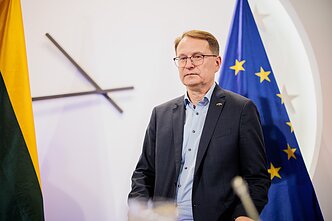






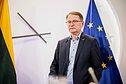





If Putin is not stopped in Ukraine, Russia will attack the Baltic states or Georgia, according to the country’s president Salome Zurabishvili.
In an interview with LRT TV in late September, she spoke about internal turmoil in Tbilisi and the region’s future outlook.
Was your visit to Lithuania approved by the Georgian government?
No, it was not approved by the Georgian government for a reason that I don't understand. We, the president, government, MPs, should be doing everything we can [...] to convince our partners that we need to get the status of [EU] candidate by the end of the year. That's what I'm doing and I'm regretting very much that I'm not formally authorised to do so. [but] I consider myself mandated by the people of Georgia for that.
The Georgian parliament has initiated impeachment proceedings against you. It is mostly because you visited EU countries without the government’s approval. How would you explain the situation?
I can explain it, as opposed to those that have started this. Usually, impeachment procedures are for very serious crimes, including treason. I don't know of any country that would start an impeachment procedure because the president is doing its duty of trying to get the country where the country itself wants to go, which is integration in the European Union, on which Georgia has been steadily working since its independence,

It has been the country’s main objective, the main priority and the main perspective and hope of the Georgian people forever. [The pro-EU direction] has been endorsed by more than 80 percent of our population in all the opinion polls that have been taken in the last 30 years of our independence.
Georgia knows better than anyone what it means to be attacked by Russia. Are you hoping to ever get the country’s territories back?
First of all, I would say that every Georgian hopes to be reunited. We have already announced it [and] it's in every Georgian’s [mind] that we do not want to use force to regain those territories because we want to regain the populations that live there. And I think that the one serious way in which that can happen is exactly the one we are pursuing, which is the European Union.
It's by opening this perspective, our citizens that live in occupied Abkhazia, in occupied [Ossetia], that we can give them a perspective, a future where their identity will be preserved, their rights will be preserved, their peace will be preserved. These are all the things that Russia has not delivered for them while occupying them.
What do you think would happen if Russia is not stopped in Ukraine, who would be next?
You or us. But we are already next – if Russia is not stopped in Ukraine, we already have military bases in our occupied territories. [...] It's the whole of Europe that is at stake and the future of democracy. [...] Ukraine, with its resilience, with its courage and that of its president, has managed to show to the world that they can defy and resist and bring the Russian army to humiliation.
Everything that has happened, the changes of military commanders, the changes of strategies endlessly, the Prigozhin affair, all of that shows that the Russian president has not succeeded in what he has started and continues to be a KGB type of war, not a military war.
Now Ukraine needs to win and the [victory] will mean peace and stability for all of us, very egotistically speaking. The security of the Black Sea is indispensable for Europe today, and that is at play and stake in the war in Ukraine.
[...] Public opinions have remained steady, which is very rare in today's world, and for such a long time this solidarity remains at a very high level, including in the media, which is even rarer. The support of the United States has again been repeated during the recent visit of Volodymyr Zelensky to Washington. That again was not what the president of Russia was expecting.

I would like to ask you about the situation in your neighbouring countries, and the bloodshed in Armenia and Azerbaijan over the last three decades. There were two wars over Nagorno-Karabakh. Is the recent outcome a message to the world that such conflicts can only be resolved by force?
I hope not. In the case of Georgia, we have two occupied territories and we have decided that we will not use force because we want that to be the will of the populations that live there and not the will of the force that is used.
There were chances over time to have a peaceful solution between Azerbaijan and Armenia. Unfortunately, Russia has played a very negative role between those two countries to not allow the emergence of an agreed settlement on this issue.
We have the result that we have, which has a very clear consequence today, and that is firstly a human tragedy, which is painful for everybody that lives in this region, that has those people as neighbours.
But also it has profoundly changed the attitude of the Armenian population toward its friends and enemies. The old conviction that only Russia could be a security guarantee for this small country that had Azerbaijan and Turkey on its borders and the very dire historical experience that has been evaporated.
Now, the Armenian population is looking to [...] the West. We share with Armenia the same civilizational values, which are very much based on European values and Christianity. The only perspective for Armenia now is to look to the West, to the EU. [Brussels] has been involved very much, including its monitoring mission, as we have one in Georgia, and there is also one in Armenia.
We need more EU engagement and more engagement of the Americans who have been showing recently that they want to send a humanitarian mission and be more present.
Armenia is changing and it is changing for the better. I hope that the very courageous president will hold onto this path. And while he has recognised that Russia cannot be trusted any longer, what the population recognised by protesting by the Russian military bases, he knows that it's a difficult path, but he seems to be steady on it.

Why is Georgia turning toward Russia? I'm talking about economic relations, about the refusal to impose sanctions and allowing Russians to enter Georgia.
I would challenge that very much because Georgia as such, which means the Georgian population, will never turn to Russia. We have learned our history as you have. [...] There have been some inflexions in the policy of the authorities, but the mandates that the Georgian people gave to its government, or me, was a European mandate and not a Russian mandate.
I doubt very much that any Georgian population would mandate any government or the president or party to turn to Russia. That's my very firm conviction and that's why I'm here, and that's why I will be in every European capital to testify for those people who have elected me and they have elected me only for one thing – to help this country to be where it has to be at the end of this long and difficult road [to] Europe.
Mikheil Saakashvili is still in prison and poor health. This puts Georgia under international pressure, but your pardon could change the situation. Did you consider this option?
No, it could not change the situation. That's what I've been repeating. But it's difficult to get this message through because he's been sentenced for many other things and the authorities can at any time reimpose [a sentence] the very same day when I would pardon him. They would impose a new sentence on him so he would not even see the light of the day.
It's up to the government to do what it has to do to find other ways to make Saakashvili pay for his faults or guilts, [...] but something that is in line with the presidential function. But I'm not sure that it will happen because they think that he’s one of the major instruments in the hands [of the ruling party] to win the elections.

Newsletter
Every Friday morning.