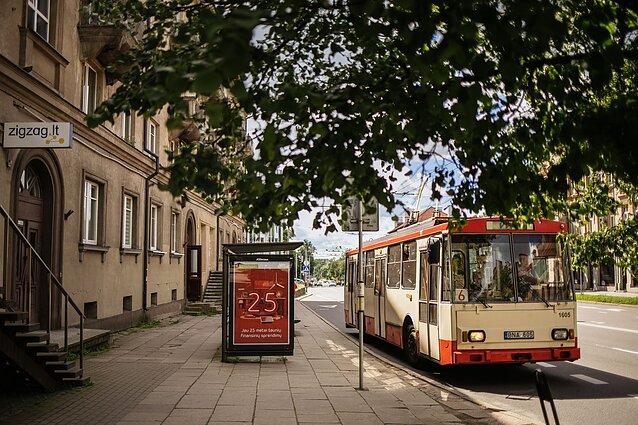

















Vilnius and Kaunas are testing hydrogen buses. Both cities say these are the first steps before trying to integrate hydrogen-powered vehicles into the public transport system.
From diesel to hydrogen
On Monday, the municipal public transport company Kauno Autobusai (Kaunas Buses) had the chance to test a new generation hydrogen bus in its fleet. Like electric buses, these do not make any sound and do not pollute the air – the by-product of hydrogen is water.
A technology once hailed as the backbone of the future of transportation, today still remains in the shadow of electric vehicles. According to Mindaugas Grigelis, CEO of Kauno Autobusai, the costs of both buses are similar, but decisions take time.
“We are currently analysing, calculating how much a kilometre will cost, how much a bus will cost, how to fill it with hydrogen. When we add up all the figures, we will evaluate and make a decision. I think this is the future, but it still needs to be developed,” said Grigelis.

Vilnius, for its part, has taken more decisive steps. It has announced plans to buy 16 hydrogen-powered buses and to produce the hydrogen locally. The municipal energy company Vilniaus Šilumos Tinklai is preparing to build a 3 MW electrolyser, enough to produce hydrogen gas for around 40 buses. Vilnius is planning to start producing hydrogen in 2026.
“Having some hydrogen technology in our portfolio is really good for the city,” says Vilnius Mayor Valdas Benkunskas.
The mayor believes that hydrogen-powered buses could make up only a part of the total bus fleet and it would not be the priority direction for developing public transport.
However, hydrogen-powered and electric buses should not be seen as competitors, says the president of the Hydrogen Energy Association.
“I see them as complementary, as both have their advantages,” according to Šarūnas Varnagiris. “The advantages of a hydrogen bus and transport are that it can travel longer distances, the bus itself is lighter and charging is faster.”

Hydrogen is the present, not the future
The Ministry of Energy has allocated 50 million euros for the development of green hydrogen production capacity, with the aim of significantly reducing the dependence of industry and transport on fossil fuels.
According to Minister Dainius Kreivis, hydrogen is the present, not the future. As the hydrogen production infrastructure is increasingly developed, it will be possible to produce synthetic environmentally-friendly fuels specifically for heavy transport and shipping.
There are also plans to export hydrogen products.
“For Lithuania, which has a strong potential for renewable energy – both offshore and onshore – this will be a stepping stone from which we will produce high added-value products. Like aviation fuel, synthetic methanol and methane, we will export them to where they are most needed, such as Germany,” said Energy Minister Kreivys.
At the beginning of the year, an all-hydrogen train made its first official journey in France. Hydrogen cells were installed on the roof of the train. It runs as silently as if it were electric and emits only water and steam.
The French authorities hope that hydrogen trains will soon be able to replace diesel trains on some sections. In France, electric trains can only run on just over half of all routes, so the French are trying to find ways to keep up with the European Union’s climate requirements.
Germany has built the first hydrogen-powered train for the French, which is already in use, and is testing the technology at home.

Newsletter
Every Friday morning.