
















Lithuanians pride themselves on purportedly having a special insight into the workings of the Russian soul and, by extension, the Russian state. “I told you so” was uttered many a time following Moscow’s attack on Ukraine last year – but is this kind of boastfulness justified?
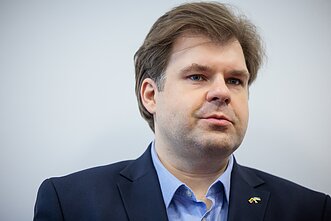
Although Lithuanians claim to understand Russia better and do not shy away from lecturing the West, Lithuania does not actually invest in scholarship on Russia or have any competent Russian analysts, says Kęstutis Girnius, associate professor at Vilnius University.
In his recent commentary published on Delfi.lt, Girnius argued that Lithuanians overestimate their understanding of Russian politics, much of which is based less on analysis than on prejudice.
“We have people who may be quite knowledgeable about specific problems in Kaliningrad […], we also have people who know about Belarusian dissidents, but we don’t have people who are experts on Russian politics, who know how decisions are made, what the situation is like there,” Girnius tells LRT.lt.
Very few Lithuanian researchers actually visit Russia and interact with people there, he adds. Overall, Russia analyses published in the Lithuanian media are not based on facts but rather on preconceived notions, Girnius argues. Lithuanians hold the view that they know Russia and Russians thanks to the decades of Soviet and tsarist occupation and believe that Russians have not changed since then and are an “eternally evil people”.

“I doubt very much whether specialists from Western European countries ask Lithuanian specialists to explain anything [about Russia],” Girnius says.
While Western politicians may say “yes, we were wrong, Lithuanians and other Eastern Europeans saw the threat more accurately”, this is more about political gesturing than about actual appreciation of expertise, he believes.
Hawkish Lithuanian observers and politicians have been warning about Russia’s imminent aggression for decades, Girnius notes, most of the time without much merit, based as these warnings were on speculation and “unconfirmed prejudices” rather than knowledge.
“How many people are writing dissertations on Russia?” Girnius asks. “If you wanted to do a normal dissertation, you’d have to go there and do research. How many reporters do we have [in Russia]? CNN, BBC, The Guardian – they all have their own correspondents.”

Instinctive knowledge substitute for research?
Dovilė Budrytė, political science and international studies professor at Georgia Gwinnett College (GGC), agrees that Lithuanians may lack academic expertise about the neighbouring country, but theirs is a collective “experience-based” knowledge that is also valuable.
“Collective knowledge is also based on emotions, and historical memory and experience are also very important. If we talk about this local knowledge, both Lithuania and other countries in the region have something to say about Russia,” Budrytė tells LRT.lt, stressing she is expressing her personal opinion and not the position of GGC. “One should not underestimate historical experience and memory, Russia’s footprint in this territory, in the other Baltic states, and even in the whole region.”

Edward Lucas, vice-president of the Center for European Policy Analysis thinktank, says that Lithuanians have “great instincts” about Russia.
“You understand what others don’t understand, you see what others don’t see, you smell what others don’t smell. You understand Russia deeply and instinctively,” Lucas tells LRT.lt.
Granted, he adds, if one wanted a detailed and comprehensive analysis of, say, the Russian military, one would turn to the Swedish Defence University or the Pentagon. For a more general understanding of what Russia is, Lucas says, “the Lithuanians along with the Latvians and the Estonians are the ones to ask”.
Aušra Park, international relations professor at Siena College in the US, notes that even traditional scholarly expertise does not always help make accurate judgements. She gives an example of President Barack Obama’s attempts to “reset” the US-Russian relations in 2009.
“Obama’s reset policy was a total failure,” believes Park. “Many thinktanks in Washington judged this policy by Obama and, to some extent, Biden to be a catastrophe. I don’t agree that the US understands Russia better.”

Difficulties of studying Russia from up close
Budrytė, of GGC, says sending students to Russia is impracticable at the moment.
“This cannot be done for different reasons, political and emotional,” she says. “Associating with the official Russian authorities is indeed problematic.”
Still, she adds, knowing one’s enemy is a matter of national security: “Without good intelligence about Russia, there is a danger to the Lithuanian state.”
Park agrees that Russia knowledge is of vital importance to Lithuania, but it may not have enough resources to study Russia from within.
Lucas believes that sending people to study in Russia “would be absurd”, but Lithuania would do well to keep teaching its students Russian so they can study primary sources.

Newsletter
Every Friday morning.