













One of the most beautiful 19th-century wooden houses in Užupis, central Vilnius, is now home to the Museum of Wooden Urban Architecture. It has been named the best renovation project in the National Architecture Awards.
The wooden house in Užupis – was constructed in 1876 according to a building project approved by the Vilnius City Council on a plot of land leased from the Vilnius Orthodox Monastery of the Holy Spirit.
Fifty years later, Michal Czep was recorded as the tenant of the plot, and his son Jan Czep bought the plot from the monastery.
In 2018, the Vilnius City Council decided to convert the building, which had been standing abandoned for decades, into a museum. For a year now, one of the most beautiful historic wooden buildings in Vilnius has been home to the Museum of Wooden Urban Architecture.


“The house was built as a family dwelling, then rented out. When you enter through the front door, you enter a beautiful corridor with decorated walls, so that guests are welcomed in a very luxurious way, both then and now,” Indrė Užuotaitė, the head of the Museum of Wooden City Architecture, guides us through the house. “On the left, we have a space that was once a living room, as well as more representative rooms. In the interwar period, by the way, there was a two-room apartment here, where Jan Czep, the owner, lived.”
In the period between the two world wars, the wooden house was divided into multiple apartments and rented out. After WW2, the Soviet authorities nationalised it, but kept as a residential building.

An expert examination in 2012 found that the building was in a state of disrepair and was not suitable for living. However, only five years later were the residents moved out, after the municipality had bought the apartments.
A couple of years later, with funding secured, reconstruction began under the direction of the firm Vilniaus Planas.
Its architect Vincas Brezgys says that the focus was on keeping as many authentic details as possible. The restaurateurs succeeded in preserving about 80 percent of the façade’s decorative elements and about 70 percent of the authentic walls and other important structures. Based on polychrome studies, the interior décor has also been partially restored.
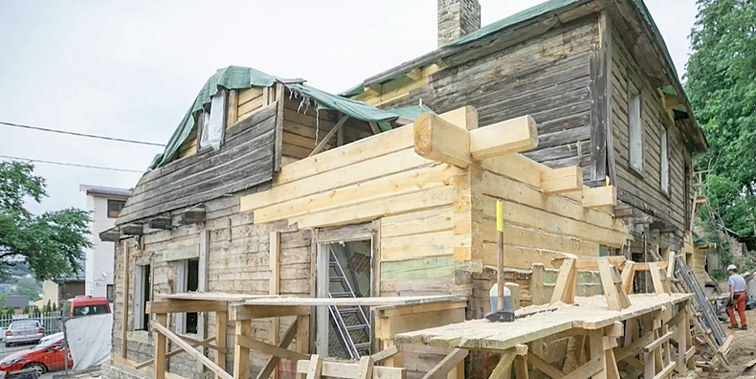

“We have preserved all the timbered walls as they have been shaped throughout history. Only in some places did we have to replace them, where the timber was completely rotten,” says Brezgys.
The intricately decorated mezzanine was not in the original design but was added later, after one of the building’s reconstructions.

“We had set ourselves the goal of keeping the original log texture on the facade,” explains project manager, architect Brezgys.
The flooring on the second floor remains in good condition – the restaurateurs removed them in panels and reinstalled after restoration, using an authentic method of joining the floorboards together. The floor now emits the authentic creaking sound that has accompanied the house’s residents over all the years of its existence.

The Vilniaus Planas team, which carried out the reconstruction, has been awarded the National Architecture Award for the renovation of a cultural heritage site, as well as the Europa Nostra International Award for the Preservation of Cultural Heritage for its high level of craftsmanship and authentic techniques.

Newsletter
Every Friday morning.