











This week, Lithuania plans to sign a letter of intent with German manufacturers on the acquisition of Leopard tanks, the defence minister has said.
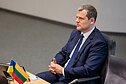
“This week, we will sign a letter of intent with German manufacturers,” Arvydas Anušauskas told reporters after a meeting of the State Defence Council (VGT) on Monday.
He said that he could not comment on the details for the time being because “it is a letter of intent”.
“The details are a matter for the future because sustainable financial sources are needed,” the minister said.
Asked why a German manufacturer was chosen, the minister said he would not elaborate, because “military advice precedes political decision”.
Lithuania is acquiring tanks to create a division in its Armed Forces.
The related legislative amendments were due to be presented in June, but are now planned for September, when the Seimas convenes for its fall session.
“This is a working process. We will, in any case, include the division in our laws. Because if we don’t write it into our laws, we will not be able to develop the activity,” Anušauskas said.
Speaking about the acquisitions needed for the division, the defence minister said that Lithuania was discussing with its partners “additional support units that could support us for a while until we have them”.

A division is the main tactical formation of many countries’ militaries, consisting of 2-4 brigades or regiments and 10,000-20,000 troops.
Early in May, the State Defence Council approved a proposal to establish a division-level unit in the Lithuanian Armed Forces.
The Defence Ministry estimates that the cost of creating the division will amount to an average of 200 million euros annually.
More training areas
The VGT has also proposed to set up yet another military training area in Lithuania, Kęstutis Budrys, the chief national security advisor to Lithuanian President Gitanas Nausėda, said on Monday.
“The conclusion is that we need yet another training area in Lithuania where we could carry out a manoeuvre of a brigade-size unit, and that is why today, the VGT recommended the government to implement the works related to the establishment of such a training area,” he told reporters after the Council’s meeting.
According to Budrys, the Council spoke about “a military training area, a manoeuvre area, not a shooting area”, so the requirements for the establishment of such a training ground would be lower.
“This means that all the technical and security requirements are significantly lower, and the chances of finding such a site in Lithuania are higher,” he noted.
According to the presidential adviser, Lithuania will need more training areas as the allied and national capabilities grow.
“By 2030, we will not only have a division, but we will also have a German brigade deployed on the territory of Lithuania, we will also maintain the forces we have now, there are also US forces, there is a NATO Forward Presence Battle Group, we will grow our own Armed Forces, and we will need to have more space to train ourselves,” Budrys said.
As part of preparations for hosting the allies, the State Defence Council decided a couple of years ago to rebuild the Rūdninkai training area in Šalčininkai District on the basis of the training base of the Public Security Service.

LRT English Newsletter
Every Friday morning.