









Visaginas, formerly a nuclear town with the most international population in the country, is negotiating its identity and future amid tensions stoked by the Ukraine war.
The Vilnius-Turmantas train pulls into the Visaginas Station just over two hours after departing the capital. The village of Sniečkus, named after the first secretary of the Lithuanian Communist Party Antanas Sniečkus, received the town status after Lithuania gained independence from the USSR and was renamed Visaginas, leaving the Soviet past behind.
The town around the Ignalina Nuclear Power Plant (INPP) was built by people who came from all over the Soviet Union: at one time its population represented 45 nationalities. Today, more than half of Visaginas is Russian-speaking, and national media has long labelled the town as “Russian”, if not “pro-Russian”.
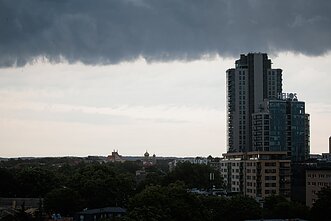
In a local bus, which sets off from the railway station, women in their 40s are sitting next to each other, talking in Lithuanian. A bit further, two older ladies are discussing their children – a daughter in Germany, a son in Moscow –in Russian. That is not at all so different from what might encounter in the main cities of Lithuania: Vilnius, Kaunas or Klaipėda. The town is situated in the middle of a pine forest, on the shore of a lake, and it seems that nature prevails over man here.
In Visaginas, more than half of the population was not born in Lithuania, which is four times more than elsewhere in Lithuania.

Ups and downs
The youngest Lithuanian town has seen its fair share of crises in the last 47 years. Due to the Chernobyl accident, the construction of INPP Unit 3 was suspended, and in 2001 Lithuanian authorities began decommissioning the first reactor, due to concerns about the safety of the plan as a condition for EU accession.
In 2010, the second unit was shut down. The town, which once generated more than 85 percent of the country’s electricity, lost its strategic importance to the central government. At the same time, thousands of local residents lost their jobs and the town’s population shrank by almost half, from 36,000 to 18,000 today. But Visaginas is not dead, reports to the contrary notwithstanding.
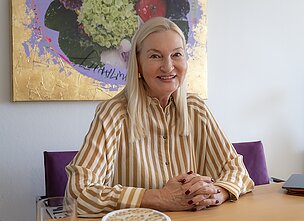
Elena Urazova came to the town in 1986 from Novovoronezh, her husband was assigned to work here. All of Elena’s family is in one way or another connected with nuclear power: her brother worked at the Leningrad nuclear power plant, her friends left for Zaporizhzhia. Despite her specialised education, Elena was not hired by INPP and ended up working as a kindergarten teacher, an occupation she stayed in for 17 years.

“And then a window to Europe opened up,” she says. After Lithuania’s accession to the EU in 2004, it became possible to travel freely and live in Europe. Elena spend time living in Italy, France, England and Germany.
But when she returned to Lithuania, she rediscovered Visaginas and its nature. “Look how many young people there are,” the woman points to the promenade by the lake. “There are children, children are walking around, I think everything will be fine!”
‘I think in Russian, I am Russian’
Elena Urazova obtained Lithuanian citizenship a long time ago, not entirely by choice, she says. “Working in a kindergarten, we were presented with a fact: either you keep working and accept Lithuanian citizenship, or you quit,” she recalls.
Elena got used to being a Lithuanian citizen, even though she considers herself Russian. “I speak Russian, I am close to both Russian culture and the Russian language. Probably because I think in Russian, I am Russian.”

However, Elena gets her information mainly from the internet and social media. She never had special TV packages to watch Russian channels when they were still available. Russian TV channels were banned in the country following Russia’s invasion of Ukraine.
Speaking about Russia’s war on Ukraine, Elena is categorical: no one in her entourage wanted war, no one supported it.
Her son Alexei, 40, has been engaged in social activities in Visaginas for the last few years, running the art residence Tochka. He spent his childhood in Visaginas, graduated from school here. After 9th grade, he went to a gymnasium, where instruction was exclusively in Lithuanian. “I did it purposefully. I didn’t understand anything for half a year, I got lowest marks, but then I started to adjust and get used to it,” he recalls. In three years, he managed to learn Lithuanian and successfully completed his studies.
Alexei Urazov considers himself “100-percent Lithuanian” who speaks fluent Russian, English, Italian and Lithuanian. “I identify myself as a happy resident of this country,” he adds.
His girlfriend Vilija, 31, is from Klaipėda and moved to Visaginas six years ago. She did not speak any Russian at all, but today she is fluent. Russian is an important tool for her.

“There is no point in being afraid of the language. War or no war, knowing any language is useful and important. And to forget the language because the occupiers speak it is senseless,” she is convinced.
She says that there are many people in the town who “are not occupiers, who are not evil” – she speaks with them in Russian and is able to communicate.
‘Post-colonial product’
Vilija understands that self-identification is an acute issue in Visaginas.
While for her, a native Lithuanian, everything about her national identity was obvious, many in the town have not yet answered the question clearly for themselves.
Another employee of the art residence Tochka is 24-year-old Maxim. He was born and raised in Visaginas. After graduating from school he went to study in Denmark.

“After graduating, I could understand Lithuanian, but I was self-conscious about speaking it, and I didn’t read in it. My English was better, for example. So going to study abroad was a natural decision,” says Maxim.
He is the first in his family to speak Lithuanian.
After graduating from University, the young man decided to return to Visaginas, where he saw more opportunities for self-realisation. “It’s virgin land here and I understand people better,” he says.
He sees his future in Lithuania, although when asked what he thinks of his national identity, he answers: a post-colonial product.
Maxim is convinced that stereotypes about Visaginas come from the fact that there are still people who support Russia and its actions, something that “causes a lot of pain”.

Even “if there are five such people for a town of 19,000, but they are very loud, it is immediately visible from the outside and a stereotype takes hold instantly”. However, he believes, the young generation of Visaginians have long made up their minds to support Ukraine and condemn Russia’s aggression.
Thirty-year bubble
The four residents of Visaginas see their future here. Elena Urazova would like “to see more people with initiative, who could drive progress, who would not stop, even if sometimes driven by little more than sheer enthusiasm”. She notes that more and more Lithuanian-speaking young families, attracted by nature, are moving to the town.
Alexei tries to burst the “bubble” Visaginas has been living in for more than 30 years.
“How Russian am I, after 30 years of living in independent Lithuania, 20 of them living in Europe, travelling to the Czech Republic, to my family in Germany, holidaying in London, in Paris? How Russian am I in fact? Am I attracted to borscht, solyanka, cutlets? What do I have in common with Russia? Love for my country, where I was born? This is a very complicated aspect. That is, it seems to me, many are now reconsidering whether they are Russian now and, as they often say: If you really like being Russian, go away,” Alexei muses.
He thinks that 30 years of Lithuanian culture have practically bypassed Visaginas, but at the same time blaming the older generation of Visaginians for it is unfair.

“They invested their soul, their health into this town, built it from the ground up,” Alexei reasons. “It may be hard for them to read this interview, but everyone understands that the town needs to change.”
During our time in Visaginas, not once did we have an impression of not being in Lithuania. In the shops, Lithuanian and Russian could be heard in equal measure, older people promenading with their families speak Russian. A coffee shop by the lake has every trapping of one in the capital. It serves trendy “flat whites” as well as filtered Chemex coffees. There are several places to have lunch and dine. Visaginas has a hotel and a sports complex.
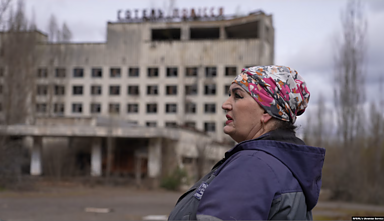
After the release of the HBO TV series Chernobyl, much of which was filmed at the Ignalina nuclear power plant, the Visaginas has gained new fame among tourists. While researching online, one is bound to come across videos by vloggers who go to Visaginas to experience something unique, something “Soviet”.
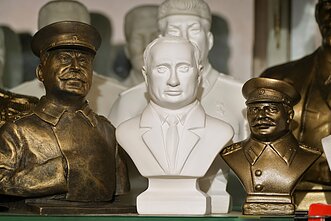
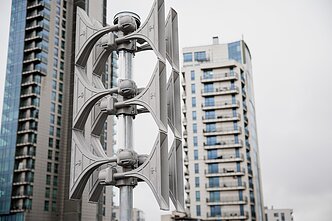
Some may be disappointed not to see a Lenin monument or Russian flags on the main square. There are no Russian chansons playing from the loudspeakers of the public alert system, which was left after the shutdown of the power plant. The town lives a life entirely of its own, speaking both Russian and Lithuanian, even if with a slight accent and a few mistakes.
This story originally appeared at Novaya Gazeta Baltya, partners of LRT English.

Newsletter
Every Friday morning.