









The LRT Investigation Team has uncovered a Russian network facilitating aircraft purchases from the EU and circumventing sanctions. The scheme involves companies in Turkey, Kyrgyzstan, Italy, and Russia. A private Russia-bound plane has been stranded in Lithuania’s Palanga for several weeks, with the pilot missing.
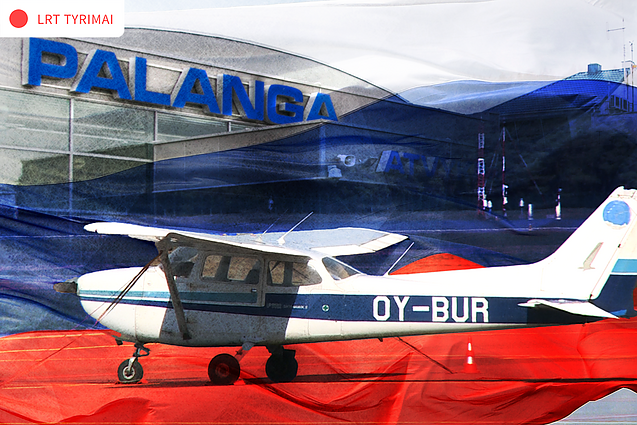
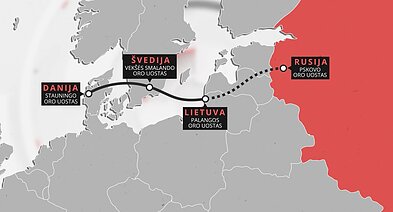
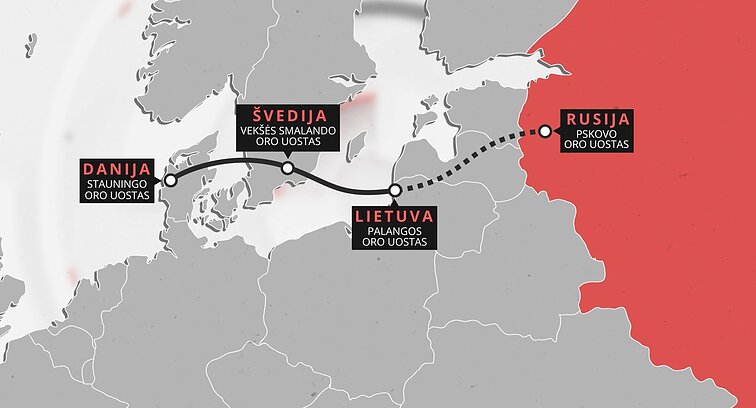
On March 16, a private plane flying from Sweden landed at Palanga Airport in western Lithuania. The pilot wanted to refuel and continue to Pskov Airport in Russia. However, when it became clear that Russia was the final destination, the aircraft was not allowed to take off.
The pilot’s nationality also raised suspicions. The trip was brokered by an Italian company whose real owners are in Russia. And the plane itself, although officially registered in Denmark, was recently sold to a Turkish company owned by a Russian citizen.
The investigation shows that Lithuania is caught in a cleverly constructed network, with Russian businesses at its core, offering to help acquire or recover aircraft or aircraft parts otherwise out of reach due to sanctions.
INVESTIGATION IN BRIEF
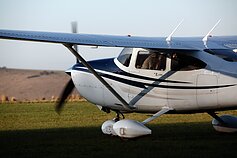
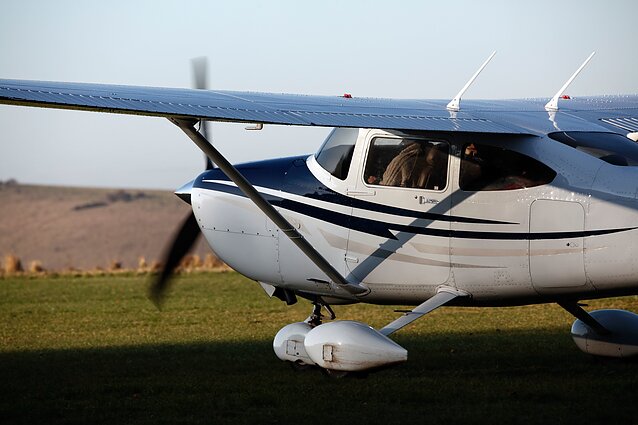
- On March 16, a private Cessna 172 plane from Sweden landed at Palanga Airport to refuel. It has been grounded for several weeks. An investigation is underway to see if it has violated sanctions.
- The LRT Investigation Team has found that, on the same day, a plane piloted by a Russian citizen flew from Denmark to Sweden and then to Lithuania in an attempt to reach Russia.
- The plane was purchased from the Danish Aero Club by a Turkish company owned by Russian businessman Evgeny Kabanov. Kabanov owns MAK Aviation Services S.r.l. in Italy, which arranged the flight to Pskov airport. In Russia, a company of the same name specialises in circumventing sanctions, offering to assist in purchasing or returning aircraft from any country in the world.
- The Danes who reportedly sold the plane to the Turks claim they were told the aircraft was bound for Antalya.
- The situation is under investigation by Lithuanian and Danish authorities for a possible breach of sanctions.
- The pilot of the Cessna 172 plane is a Russian citizen with a residence permit in Lithuania.
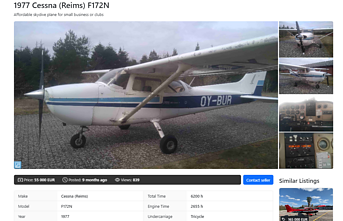
Last summer, an ad appeared on several websites: a private Cessna 172 was for sale. It is a small, four-seater private plane, previously used by a Danish aeroclub. The price tag was 55,000 euros.
In spring this year, a buyer from Turkey came forward, saying he needed the plane for parachute drops in Antalya. However, the aircraft did not head to Turkey, but to Pskov Airport in Russia.
The flight that ended up in Palanga exposed loopholes in the sanctions regime and caused confusion for both Lithuanian and Danish authorities. An investigation is underway to determine whether sanctions against Russia have been violated.
Under EU regulation, aircraft owned, chartered or otherwise controlled by Russians cannot land in or depart from EU territory.
Turkish businessman Evgeny
The plane is currently still registered in Denmark. LRT has contacted the Denmark-based aeroclub, the seller of the aircraft. The Danish man who negotiated the sale with the Turkish company wished to remain unnamed.
He said that the buyer, named Evgeny, introduced himself as a Turkish businessman. The transaction was carried out with Edermont Ltd, a company registered in Istanbul. The company, which is listed on its official website as operating since 2016, claims to be involved in the import and export of a wide range of goods worldwide. “To any place,” the company’s website states.
“We were told that the buyer, the company, was in Turkey and that the plane was going to Turkey!” the Danish seller said.
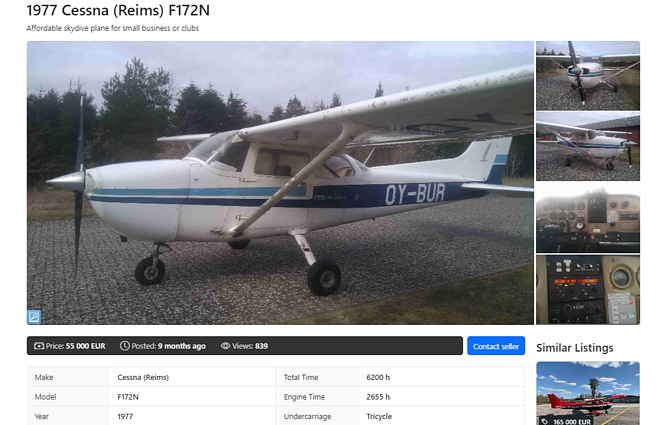
The buyer promised that the private jet would be used for parachuting and that the final destination would be Antalya Airport.
The seller met the pilot who would fly the plane to Antalya on March 15 and took him to Stauning Airport. The pilot reportedly spent the night in a hotel and took off from the airport the following morning, March 16.
The plane flew from Stauning Airport in Denmark to Växjö-Smaland Airport in Sweden and from there to Palanga Airport. Lithuanian authorities were not aware that the aircraft had stopped at two other airports on the same day before landing in Palanga.
“I don’t know where it was before that. According to the flight plan [...] that we were given, it had departed from a Swedish airport,” said Virginija Žegunytė, head of the Civil Aviation Division at the Lithuanian Transport Safety Administration (LTSA).
The flight took place within EU airspace and the plane was registered in the EU, which is why no one was suspicious. Apparently, when the pilot took off from Denmark, he did not say the final destination was Russia.
“After the aircraft landed and the pilot presented a new flight plan with a final destination in Russia and it became clear that the pilot was a Russian citizen, we immediately informed all responsible authorities and they launched an additional screening procedure. [...] Once the checks were done, the aircraft was prevented from departing from Palanga Airport until we received clarification from authorities,” commented Vidas Kšanas, director of the Safety and Security Department at Lithuanian Airports.
The Danish seller told LRT that he was still in touch with the businessman Evgeny after the plane was detained in Palanga. On March 27, the buyer asked him to change the pilot’s details in insurance documents so that the aircraft could take off.
Pilot missing
According to LTSA representatives, if the investigation finds that the flight violated sanctions, the pilot would also be held responsible. His identity is known to the LRT Investigation Team. He is a Russian citizen who has had a residence permit in Lithuania since 2018 and is employed by BAA Training, a pilot training company. It is owned by Avia Solutions Group, the Lithuanian conglomerate owned by the businessman Gediminas Žiemelis.
The pilot’s Linkedin account indicates that he lives in Spain.
“The pilot in question was working part-time for our Spanish branch. What he does in his spare time we have no way of knowing, we are not interested in it. If you provide us with information that there was indeed any unethical or inappropriate activity, we would certainly take measures to prevent it and to clarify the specific situation,” commented Kšyštof Gulbinovič, head of Marketing and Communications at BAA Training.
He has also noted that another company linked to Avia Solutions Group helped prevent the plane from reaching Russia: Baltic Ground Services, which provides ground handling services at Palanga Airport. “Our other company was approached to refuel the plane and refused because the plane could have been linked to sanctioned individuals,” Gulbinovič has said.
Neither the LTSA, which is investigating the situation, nor BAA Training have been able to contact the pilot. According to Gulbinovič, the pilot is employed for only 10 hours per month. “We have not been able to contact him,” Gulbinovic said.
Following the publication of this story in Lithuanian, BAA Training announced that it was firing the pilot of the Cessna 172 plane.
“In response to information in the media regarding the activities of a BAA Training employee, of which we were previously unaware, we have taken the decision to terminate the employment relationship with the pilot, as this is not in line with the company’s values,” it said in a statement.
Network of companies
While the authorities are trying to figure out what happened, the LRT Investigation Team has found out that the plane, which has been grounded for two weeks, and the missing pilot are just the tip of the iceberg. The aircraft became part of a clever scheme to circumvent sanctions.
The scheme involved not only the Turkish company Edermont Ltd, which bought the plane from the Danes but also agents in Italy. MAK Aviation Services, a company registered in Milan, acted as an intermediary for the plane in its attempt to fly to Russia.
According to the Italian commercial register, the company has been operating since 2013. Its only shareholder is a Russian citizen named E. Kabanov.
In Russia, he owns Sovremennye Tekhnologii (Modern Technologies), which operates an aviation service provider under the same name as the Italian company, MAK Aviation Services. It claims to assist aircraft operators and pilots in obtaining permits, developing routes, arranging fuel supplies and coordinating with airports.
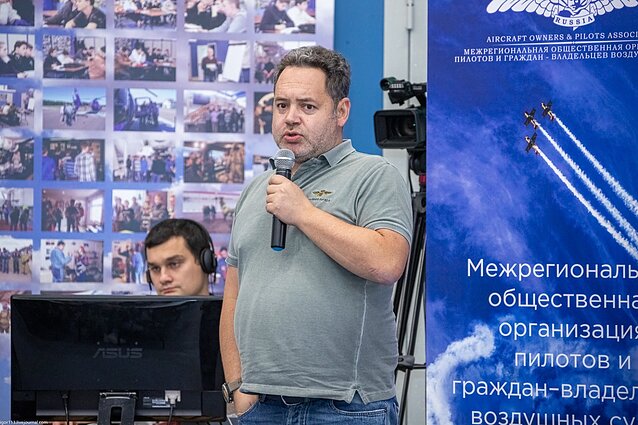
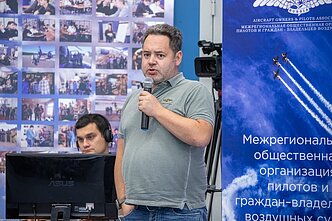
Kabanov, a 51-year-old businessman, is a well-known pilot in Russia who has also been involved in the trade since 1992. He is a former chairman of the Board of Directors of the Baltic Development Bank in Moscow. He now sits on the board of the Russian Pilots and Aircraft Owners Association (AOPA). Kabanov comes from a military family. His grandfather Yevgeny is a Soviet aviation general. His father Alexander has several military aviation inventions under his name and is also a businessman and a former member of the Duma’s Expert Council on Economic and Investment Policy.
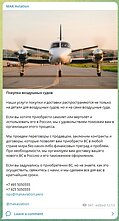
MAK Aviation Services makes no secret of helping to circumvent sanctions. It advertises these services on its Telegram channel:
“When almost all borders are closed, sanctions prevent the sale of airplanes, and you need to buy an airplane or a helicopter, we have a solution. We can help you with any international transaction. If necessary, we will contact the seller and agree on the price and terms to reduce your stress. We’ll provide solutions for fast and efficient aircraft delivery – obtaining the necessary permits, finding a crew for the flight, and offering the best route.”
The aviation service provider offers to bring entire planes to Russia, as well as aircraft parts from the US or EU, by land or by air.
Under EU sanctions, transporting goods and technology adapted for use in the aviation industry to Russia is prohibited.
Another service offered by MAK Aviation Services is returning Russian-owned aircraft stranded abroad.
“Due to the events of last year and the sanctions imposed by European countries, aircraft registered in Russia are blocked in EU countries without the possibility to fly back to Russia or other countries. If you are facing a similar problem and don’t know how to get your plane back, we are ready to help,” the company’s Telegram channel reads.

Curiously, a man named Kabanov is also the president and board member of the Turkish company that bought the plane, Edermont Ltd. The company was only set up last November and its website was launched last summer, although it claims to have been operating since 2016. Last December, Kabanov also set up a company in Kyrgyzstan, Edermont Pamir. This means that the network of companies was already in place when the invasion of Ukraine started and Russia was slammed with sanctions.
The LRT Investigation Team has sent questions to companies in Russia and Turkey, but no replies have been received as of the publication date.
Investigations by Lithuania and Denmark
The whole scheme is not yet officially known to the authorities investigating the plane. Lithuania is awaiting evidence from the Danes, who are also still investigating.
According to the LTSA’s Žegunytė, if there’s enough evidence that the customer of the flight or the company that purchased the aircraft are linked to Russia, this could be considered a violation of sanctions. The aircraft will not leave Palanga until the investigation is completed.
“It will remain grounded until we find out if there was a violation. We need to establish who owns it, who ordered the flight,” she says.
The pilot, who is considered the operator of the flight, could face liability under the Code of Administrative Offences. Violation of international sanctions carries a fine of between 200 and 6,000 euros.
The Cessna 172 is subject to an airport parking fee, but the authorities have not yet found anyone to invoice.
“The recipient of the invoice will be clarified after the competent authorities have provided clarifications on the further procedures to be followed,” said Vidas Kšanas, a spokesman for Lithuanian Airports.
Meanwhile, Naviair, the Danish air traffic regulator under the Ministry of Transport, has sent a reply stating that it is not in a position to provide data on the March 16 flight because the aircraft is private.
Turkey in sanction circumventing schemes
It is not uncommon for Russians to use third countries to circumvent EU sanctions.
“We see that one of the countries used by the Russians to circumvent sanctions is Turkey. We have documented products going through Turkey to Russia. Hong Kong, China, Azerbaijan and other countries are also involved. This is how sanctions circumvention works,” James Byrne, head of Open Source Intelligence and Analysis at the British Royal United Services Institute (RUSI), told LRT.
Last December, an investigation carried out by the Institute together with Reuters journalists revealed a global supply chain that continues to provide Russia with Western computer components and other electronics. Shipments of semiconductors and other technologies continue to arrive in Russia from Hong Kong, Turkey, and other trading centres.
One of the firms identified in the investigation was Azu International, founded by the Turkish businessman Gokturk Agvaz. According to Russian customs records, at least 20 million dollars worth of components were exported to Russia over a seven-month period, including chips made by US manufacturers.
According to Byrne, there are cases where companies are set up for a single transaction.
“The Russians have a long history of circumventing sanctions and one of their priorities is to hide the real owner of the company, to hide the fact that Russians, in particular, are running the companies, and in order to do that you need to set up companies in countries that do not impose sanctions on Russia, or where there are loopholes. And then use those companies to do business in the EU,” the analyst notes.
According to estimates by The New York Times, Russia’s trade with non-EU countries – such as Brazil, Japan, China, India and Turkey – has increased significantly since the EU imposed sanctions. Average monthly trade volumes grew by 310 percent with India, while trade with Turkey increased by 198 percent, compared to the average monthly volume between 2017 and 2021.
Mads Isaksen, a freelance journalist from Denmark, and Sara Manisera, a freelance journalist from Italy, contributed to this report.

Newsletter
Every Friday morning.