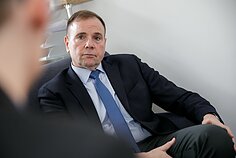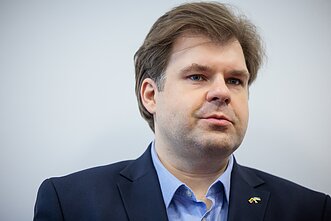















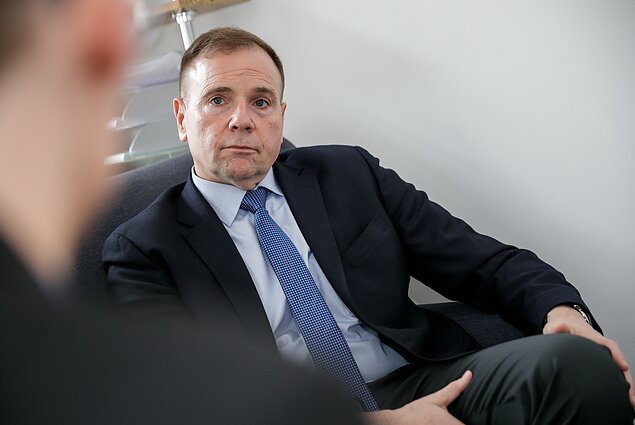
Lithuania prides itself on spending 2 percent GPD on defence, one of the few in NATO, but it still has a lot to do to defend itself, says retired General Ben Hodges, former commander of the US Land Forces in Europe.
In an interview with LRT.lt, he argues that the Lithuanian society is not ready to defend itself and that politicians, despite their hawkishness, have done precious little to, for example, integrate Lithuania’s defence plans with those of its neighbours or finish the crucial Rail Baltica project.
The retired general insists that until Lithuania gets its own act together, a German brigade or US boots on its ground are not number-one priority.
On the war in Ukraine, he says that the most important issue for Ukraine now is to take Crimea.
We keep hearing about Ukraine planning a massive counter-attack against Russian forces. What do you think it will be like?
We’re all talking that this big counter-offensive is coming, but the Ukrainian general staff is not going to advertise when or where or how. So we don’t know and, frankly, we should not know.
Anything that I say about that offensive is just my own speculation because I can read a map and as I think about what I would hope to see.

Clearly the decisive terrain for this war is Crimea. Crimea is what has to be liberated. You could kill every Russian soldier within 200 kilometres of Bakhmut, that would not change the strategic outcome. The liberation of Crimea is what’s going to change the strategic situation and that’s how Ukraine is going to win.
So I imagine that when all the conditions are set, they [Ukrainians] will launch a counter offensive that would allow them to break the land bridge that connects Crimea to Russia and that they will use other weapons to wreck the Kerch Bridge again and they will use long-range weapons to make Crimea untenable.
Sevastopol, Saky – you hit these places on Crimean Peninsula and the Russians cannot stay there. I think that the Ukrainians are right now building up a very strong armoured force, they’re keeping it out of Bakhmut, so that means other units are having to pay the price in Bakhmut to stop Russians there.
Well, the armoured forces over here are preparing for an attack in a probably a different direction.
You think Ukrainians should first take Crimea and only then go to Donbas?
I think Crimea is most important and after they have liberated Crimea, things will change so much in Russia that I don’t think there will be much enthusiasm for Russians continuing to support separatists [in Donbas].
Why is Crimea so important?
When you look at the map, you see that as long as Russia occupies Crimea, Ukrainians will never be able to have access in or out the Azov Sea. So that means even if Mariupol or Berdiansk are liberated, Russia still blocks the Azov Sea.

And of course, as long as the Russian Black Sea fleet sits in Sevastopol, they’re able to stop, disrupt, interdict anything coming in and out of Odesa.
Crimea gives Russians the ability to prevent Ukraine from ever rebuilding its economy. It also provides a platform for the next attack – air, sea, logistics, all this sits right there. So they have to get Russia out of Crimea.
Opinions differ on the strategic importance of Bakhmut – some say it wouldn’t give Russians much of an advantage, while others think it’s important for Ukraine to keep it in its hands. What’s your take?
I think – of course, I don’t know this – they [Ukrainians] benefit from staying there, even though they suffer a lot of casualties. Because the Russians and Prigozhin have focused on it so much, they keep going there and the Russians are suffering so many casualties, using so much ammunition and so. In military doctrine, what Ukrainians are doing is what we would call economy of force mission: to use what you have to prevent the enemy from being able to do something else, while you prepare for the main effort, which is not gonna be over here.
So it’s valuable to Ukrainian general staff stop the Russians there and they’ve been stopping over there for seven months.
You can’t be looking every day at what village, what stream, what happened, you’ll go crazy. What really matters is to step back and look at it from a higher level. What’s happening around Bakhmut and all of this area is that the Russians are losing 700, 800, 900, over a thousand soldiers every day and for no benefit for themselves.

Would you say that when it comes to military expediency, Russians have their own logic that is quite different from Western calculations?
Sure, they clearly don’t care how many lives are lost, including their own soldiers. They’re just going to keep pushing these poorly trained, unlucky conscripts into this meat grander, which is kind of what they have done for centuries, and hope to overwhelm, overrun Ukrainian defenders.
But I think that this is not an endless reservoir. Even Russia will find the limit in terms of ammunition, people and, more importantly, will power. I think that Ukraine, as long as we give them what we said we would and if my president would say “We want Ukraine to win”, then all sorts of things will start to arrive much more quickly.
And yet we start hearing talks from some quarters in the US that perhaps Washington should scale down its support. Is there a Ukraine fatigue in the US?
No, Americans aren’t tired, but the president does have the responsibility to explain why this is important. This is not something that’s happening over in Europe. This is something that affects us, it affects our strategic interests. The president has to explain why it’s important that we’re doing this.
And I think when he does that, most people will say, OK, that makes sense. And actually, I was at the Munich security conference back in February, and I saw many senior Republican members of Congress and the Senate say that Ukraine’s gotta win, this is important.
So yes, of course, there’re some voices on the extreme right and the extreme left that don’t support this but my sense right now is bipartisan support in Congress remain strong. But the president has got to provide clarity what our objective is.
Poland and Slovakia said they were giving MiG fighters to Ukraine, although NATO had long been talking about handing over modern F-16 fighters. Should they do it?
First thing is to decide that we want Ukraine to win. That’s the most important thing, and when we say we want them to win, all the excuses go away.
That will be the end of this incremental sayings, that, you know, the Russians won’t be happy if we give this. I mean, that kind of nonsense? Rather than argue about F-16, we should be talking about why doesn’t the administration say we want Ukraine to win? Then all of this stuff – tanks, Atacams, F-16 – will happen. […]
We never had a clear political objective for 20 years in Afghanistan, see how that ended. The burden is on our elected leaders to tell us what the objective is and why this matters.
When it comes to NATO, only seven members are spending 2 percent of their GDP on defence. Do you think that’s a problem?
For sure it’s a problem that not every nation is doing everything that they should for their own defence. I mean, everybody knows about Article 5, not everybody remembers that Article 3 says that each nation must do all that it can to defend itself and be prepared to help others. […]

But it’s not just 2 percent. I think I would ask my Lithuanian friends: yes, Lithuania is spending 2 percent [on defence], no doubt. But Russia will not be deterred if you just put a big sign on the border of Lithuania that said “Hey, we’re 2 percent”. That will not stop anybody.
But if Russia looks a Lithuania and says: “We’ll suffer and we will fail, we will suffer too many casualties”, that’s what you want.
So I would ask, has Lithuania done everything it can to defend itself? Do you have the same sort of societal resilience like Finland, for example? I mean, you have a worse problem than Finland: you are smaller, wedged between Belarus and Kaliningrad, you have more difficulty. But honestly, I don’t get the same sense of urgency to make sure that the society inside Lithuania is ready.
Number two, your reserves. I know you have thousands of soldiers who are in reserve. I don’t think that they have been integrated, that they have been called to practise, I think there are many who don’t have a unit to which they would report, it is just a manpower pole.
But what I’m hearing here is we want a German brigade, we want more Americans. Wait a minute, you got probably 100,000 reservists that are not trained, not assigned to go anywhere.
Has Lithuania cooperated with Poland to the maximum? I’m pretty sure not. I heard that Poland is now beginning to build up its defences along the border of Kaliningrad, is Lithuania cooperating with that? I’m not saying that Lithuania should also do that. But neighbours have to be cooperating with each other.
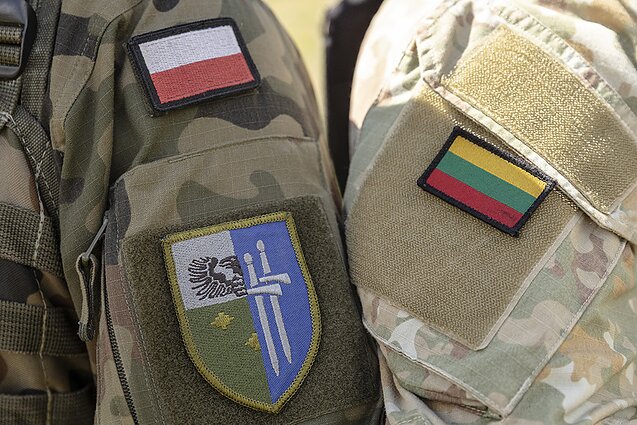
I would ask, is Lithuania being smart about its procurement? Can Lithuania and Estonia and Latvia use the same equipment, use the same ammunition? I know the answer is no. Each nation makes its own decisions, but can you really afford to have something completely different from two other neighbours that are also relatively small in terms of GDP and population?
Transportation – I’ve been hearing about Rail Baltica for 20 or more years, but it’s still not done? That’s an essential element to move before the conflict starts, and it’s still not done.
I hear all the time, we want a German brigade here. To do what? I mean, if you don’t have the training area, if you just have a brigade of soldiers sitting in their barracks, that is worse than having no soldiers. I’m not sure that Lithuania has done everything it can, that should have been done to be ready to defend itself.
And everything I just mentioned that’s not the army. Those are political decisions.
You have very good soldiers – General Valdemaras Rupšys [Liethuania’s chief of defence] is an excellent officer. I’ve been with Lithuanians now for more than 20 years and very good quality women and men in the armed forces, there’s no doubt about it. All these challenges that I just raised, those are all political decisions. That’s who needs to be answering those questions.

Newsletter
Every Friday morning.